• HOME
  • NEWS
  • EXPLORE
    • CAREER
      • Companies
      • Jobs
    • EVENTS
    • iGEM
      • News
      • Team
    • PHOTOS
    • VIDEO
    • WIKI
  • BLOG
  • COMMUNITY
    • FACEBOOK
    • INSTAGRAM
    • TWITTER
Tuesday, June 30, 2026
BIOENGINEER.ORG
No Result
View All Result
  • Login
  • HOME
  • NEWS
  • EXPLORE
    • CAREER
      • Companies
      • Jobs
        • Lecturer
        • PhD Studentship
        • Postdoc
        • Research Assistant
    • EVENTS
    • iGEM
      • News
      • Team
    • PHOTOS
    • VIDEO
    • WIKI
  • BLOG
  • COMMUNITY
    • FACEBOOK
    • INSTAGRAM
    • TWITTER
  • HOME
  • NEWS
  • EXPLORE
    • CAREER
      • Companies
      • Jobs
        • Lecturer
        • PhD Studentship
        • Postdoc
        • Research Assistant
    • EVENTS
    • iGEM
      • News
      • Team
    • PHOTOS
    • VIDEO
    • WIKI
  • BLOG
  • COMMUNITY
    • FACEBOOK
    • INSTAGRAM
    • TWITTER
No Result
View All Result
Bioengineer.org
No Result
View All Result
Home NEWS Science News Chemistry

Molecular additives enhance mechanical properties of organic solar cell material

Bioengineer by Bioengineer
August 12, 2020
in Chemistry
Reading Time: 2 mins read
0
IMAGE
Share on FacebookShare on TwitterShare on LinkedinShare on RedditShare on Telegram

Computational experiments on semiconducting polymers show under harsh loading conditions — stretching and compression – the addition of small molecules enhances performance and stability; points to promising new direction for solar cell research
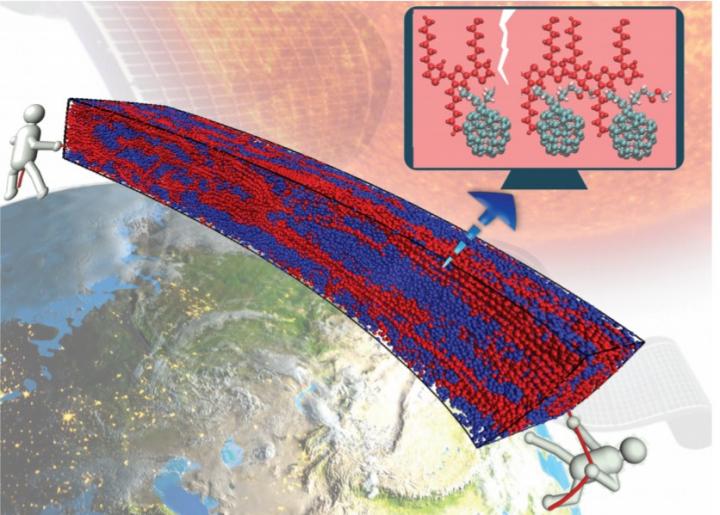
IMAGE

Credit: Professor Ganesh Balasubramanian’s laboratory (Group for Interfacial and Nanoengineering), Department of Mechanical Engineering and Mechanics, Lehigh University, Bethlehem, USA.

Organic solar cells are ideal for use in flexible electronics because of the inherently malleable nature of semiconducting polymers. Recent research on the interplay between processing, thermodynamics and mechanical stability of typical photoactive layers in organic cells is providing a deeper understanding of these high-potential materials.

Ganesh Balasubramanian, P.C. Rossin assistant professor of Mechanical Engineering & Mechanics at Lehigh University, and his graduate student Joydeep Munshi recently set out to understand how stable these materials are when deformed, and whether the promising properties can be realized under harsh loading conditions when the solar cells may be subject to stretching and compression. Through computational experiments using the leadership class computing resources in Frontera, the team demonstrated that adding small molecules to the semiconducting polymer blend enhances the performance and stability of material used in organic solar cells. They predict this is also true for organic solar cell material more generally.

The study is described in an article, “Elasto-morphology of P3HT:PCBM bulk heterojunction organic solar cells” featured on the back cover of Soft Matter. Additional authors include: professors TeYu Chien at the University of Wyoming and Wei Chen, at Northwestern University.

“Based on previous literature, we anticipated that variations in the materials processing parameters would influence the structure as well as the thermal and mechanical properties of these solar cells,” says Balasubramanian. “However, the finding that presence of small molecular additives can augment the mechanical properties is new knowledge gained from this work.”

The team demonstrated that, in addition to the solar-to-electrical power conversion efficiency, the mechanical stability and flexibility of typical organic solar cells is significantly impacted by the presence of molecular additives.

“This could prove crucial towards the commercialization of organic solar cells,” says Balasubramanian.

The results were achieved by performing large scale molecular simulations in the supercomputer Frontera, located at the Texas Advanced Computing Center (TACC) at the University of Texas at Austin), which is the world’s fastest academic supercomputer. The predictions consisted of the deformation mechanisms of the polymer blend under straining conditions as well as examining the structure/morphology of the material upon loading. Balasubramanian’s team has been among the first to utilize Frontera.

While similar approaches have been considered for interrogating the properties of organic photovoltaic materials, the correlation between the material structure and elastic properties had not been done before, according to Balasubramanian. By adding molecular additives to the polymeric blends, advanced solar power materials and devices can be fabricated that sustain extreme operational stress-strain conditions while delivering superior performance.

He adds: “The research has the potential to provide new directions for scientific practices in this field of materials and energy research.”

###

Media Contact
Lori Friedman
[email protected]

Related Journal Article

http://dx.doi.org/10.1039/D0SM00849D

Tags: Chemistry/Physics/Materials SciencesComputer ScienceElectrical Engineering/ElectronicsMaterialsMechanical EngineeringSuperconductors/SemiconductorsTechnology/Engineering/Computer Science
Share12Tweet8Share2ShareShareShare2

Related Posts

Biochar-Based Materials Offer Promising Solution for Sustainable Uranium Recovery in Nuclear Energy — Chemistry

Biochar-Based Materials Offer Promising Solution for Sustainable Uranium Recovery in Nuclear Energy

June 30, 2026
From Cells to Boundaries: Unveiling the Origins of Biological Order — Chemistry

From Cells to Boundaries: Unveiling the Origins of Biological Order

June 30, 2026

AI and Physics Collaborate to Design Advanced Hydrogen Storage Materials

June 25, 2026

International Team Including Dresden Scientists Develops Novel Designer Proteins for Advanced Study of Living Tissue

June 25, 2026
Please login to join discussion

POPULAR NEWS

  • Saying Goodbye to PGY-6: Pediatric Fellowship Realities

    103 shares
    Share 41 Tweet 26
  • Detection of EDCs in Breast Milk and Infant Urine Up to Six Months Highlights Early Exposure Risks

    77 shares
    Share 31 Tweet 19
  • New Drug Candidate Developed at McMaster Shows Potential for Treating Brain Cancer

    58 shares
    Share 23 Tweet 15
  • KTU Researchers Explore Ultrasound’s Role in Enhancing Blood Flow Beyond Diagnostics

    53 shares
    Share 21 Tweet 13

About

We bring you the latest biotechnology news from best research centers and universities around the world. Check our website.

Follow us

Recent News

Biochar-Based Materials Offer Promising Solution for Sustainable Uranium Recovery in Nuclear Energy

Experimental Treatment Shows Promise in Improving Outcomes for ARDS Patients

Early Asian Mammals Prioritized Strength Over Bite Power, Tooth Fossil Analysis Reveals

Subscribe to Blog via Email

Enter your email address to subscribe to this blog and receive notifications of new posts by email.

Join 82 other subscribers
  • Contact Us

Bioengineer.org © Copyright 2023 All Rights Reserved.

Welcome Back!

Login to your account below

Forgotten Password?

Retrieve your password

Please enter your username or email address to reset your password.

Log In
No Result
View All Result
  • Homepages
    • Home Page 1
    • Home Page 2
  • News
  • National
  • Business
  • Health
  • Lifestyle
  • Science

Bioengineer.org © Copyright 2023 All Rights Reserved.