


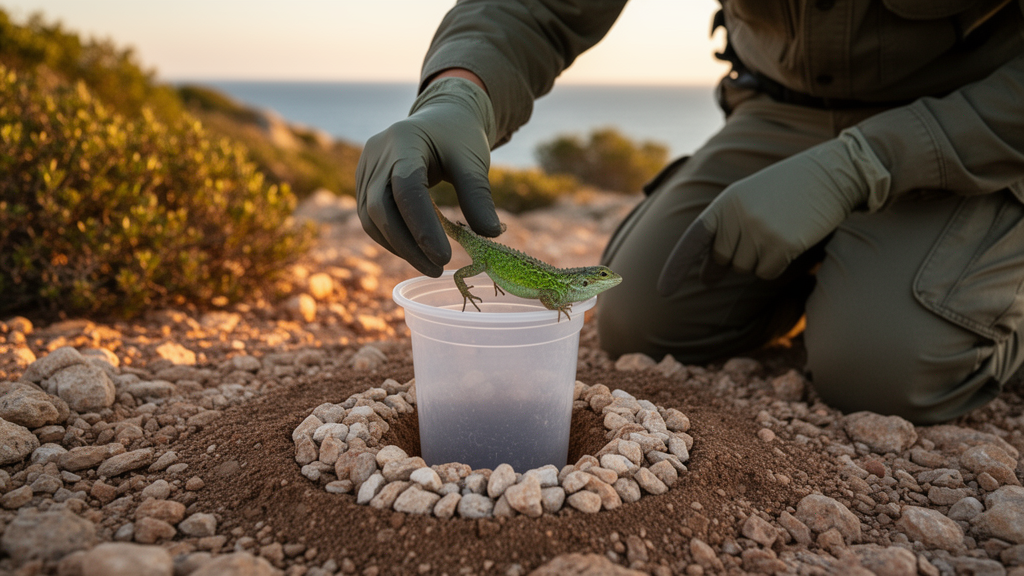
Engineers of a lizard removal campaign in the Aeolian Archipelago have described a redesigned pitfall trap that allowed them to capture 4,965 invasive Italian wall lizards (Podarcis siculus) on two small volcanic islets over a cumulative 88 days of trapping, while keeping trap mortality below 1.5 percent despite daily maximum temperatures that stayed above 30 °C for nearly the entire summer. The design, reported in the journal Herpetozoa, was developed during an intensive removal operation on the islets of Lisca Bianca and Bottaro, near Panarea, where the invasive lizards threaten the critically endangered endemic Aeolian wall lizard (Podarcis raffonei).
The campaign formed part of the EOLIZARD conservation programme, which aims to create sanctuaries free of P. siculus so that native endemic lizards can be re-introduced. In the Aeolian Archipelago, the Italian wall lizard is considered a threat to P. raffonei not only through competition but also through hybridisation, a risk documented in earlier genetic and ecological studies. Previous genetic work showed that the P. siculus populations on Lisca Bianca and Bottaro are not distinct from those on nearby Panarea, the island chosen as the recipient site for translocated individuals, which made translocation to Panarea an authorised and necessary management measure.
Standard pitfall traps, in which ground-level containers are buried flush with the soil, are widely used for sampling small, surface-active lizards and represent the most practical option for large-scale removal of surface-active lacertids. But the authors of the new study argue that conventional designs carry operational and welfare drawbacks that become acute in intensive removal programmes. Retrieving animals manually from ground-level containers is time-consuming and complicates bait management and trap maintenance. Open, unshaded chambers can expose captured animals to potentially lethal temperatures under extreme summer conditions, and the absence of a protective cover may facilitate predation on trapped individuals. Conventional designs are also typically non-selective, resulting in incidental captures of non-target arthropods.
The modified trap addresses these problems with a layered structure built from inexpensive components costing about six euros in total. A removable plant pot, 20 centimetres high with a 12-centimetre upper diameter, sits inside a permanently buried PVC tube of matching height whose rim is flush with the soil surface. At the bottom of the tube, an aluminium dish holds fruit juice used as bait. The base of the pot dips only a few millimetres into the liquid, and drainage holes of roughly 5 by 10 millimetres allow scent to diffuse and give captured lizards access to hydration, while the raised bottom keeps the capture chamber almost completely dry.
Above ground, a white polypropylene roof measuring 20 by 20 centimetres, elevated 5 to 10 centimetres on three metal stakes, reduces direct solar exposure and shields captured lizards from avian predators. Each trap can be closed with a plastic cap matching the pot’s diameter, allowing traps to be deactivated and reactivated as needed without removing them from the ground. Traps were individually numbered and installed roughly 8 metres apart across the accessible plateau areas of the two islets: 304 traps on Lisca Bianca, which covers about 20,000 square metres, and 42 on Bottaro, which covers about 3,000 square metres. Both sites are characterised by low Mediterranean scrub, exposed rock and bare volcanic soil, with no freshwater apart from rainfall; only 11.5 millimetres fell during the period from 6 June to 23 September, when meteorological measurements showed daily maxima constantly above 30 °C except for a single day.
Over the study period, the 346 traps remained active for a cumulative total of 88 days between 6 June and 6 November 2025, equivalent to 30,448 trap-days. Inspections were conducted 43 times as weather conditions permitted, generally every second day, with a mean interval of 2.2 days between visits, a minimum of one day and a maximum of ten. During each check, the roof was lifted, the pot removed and the captured lizards transferred into breathable bags by gently inverting the pot. The bait dish was inspected and replenished as needed, and arthropods were released. Captured lizards were kept in ventilated, dark containers, transported to Panarea, counted and released at multiple sites across the inhabited areas of the island within a few hours of capture.
The results show a capture pattern typical of depletion trapping. Of the 4,965 lizards captured, 4,371 came from Lisca Bianca and 594 from Bottaro, giving a mean of 14.4 lizards per trap over the study period, with daily captures per trap ranging from zero to 13 individuals and an overall rate of 0.16 lizards per trap per day. Most captures occurred during the first days after trap activation, and capture frequency, especially of adult lizards, declined progressively as removal reduced the local population size. The number of small juveniles captured rose slightly in the first weeks, in response to new births and the reduced presence of adults in the traps, before decreasing in turn.
Operational efficiency was a central outcome of the design. Mean inspection time was 38 seconds per trap, a figure that includes lizard collection, bait replacement, occasional bycatch removal and movement to the next trap. That speed allowed a team of two operators to complete daily management of the entire 346-trap network in one hour and fifty minutes on average. Across the 43 inspection events, total field effort for trap inspection, lizard handling and bait maintenance amounted to 157 hours and 36 minutes of person-hours. Arthropod bycatch was sporadic and limited to a few hundred individuals across the 30,448 trap-days, with fewer than 10 percent of traps containing arthropods during inspections; the captured arthropods, mainly ants and beetles, were always found alive and released.
Animal welfare outcomes were equally favourable under conditions that would normally stress trapped reptiles. A total of 74 lizards, 1.5 percent of all captures, were found dead in traps. No obvious signs of dehydration were observed in captured lizards, and no mortality peaks were associated with the longest intervals between inspections or with the hottest events recorded during the study, when maximum temperatures exceeded 35 °C. All traps remained structurally intact throughout the deployment: no soil collapse, flooding or trap damage occurred, and the traps were operational for 100 percent of the active period. The authors suggest that the combination of shading and the trap’s configuration may have helped limit thermal stress under the study conditions, while the raised rim and structural layout appear to have been associated with the low non-target captures, though they note that more insects might be caught at sites with higher insect diversity and abundance.
The study’s authors are careful to frame the scope of their conclusions. No direct quantitative comparison with traditional pitfall traps was performed, so the apparent advantages over flush-mounted systems in handling speed and trap servicing remain observational rather than measured. The overall effectiveness of the removal campaign in terms of population reduction also remains to be assessed. They add that the low mortality may partly reflect the relatively high resistance of P. siculus to dehydration compared with other Podarcis species, and that higher mortality could occur in less tolerant taxa; the design’s performance in wetter environments, compact soils or with other species has yet to be tested. To their knowledge, the only previously published active removal campaigns targeting P. siculus were conducted in Athens, Greece, and in Buckinghamshire, Britain, using different approaches and at much smaller scales. Nevertheless, the combination of nearly 5,000 captures, very low mortality, minimal maintenance and a six-euro per-trap cost suggests that the modified configuration performs well under demanding field conditions, and the authors argue that further applications in different ecological contexts would help clarify how broadly the design can be applied to invasive lizard management on remote islands.
Subject of Research: A modified pitfall trap design for large-scale removal of invasive Italian wall lizards on small Mediterranean islands
Article Title: An improved pitfall trap design for large-scale removal of invasive Podarcis siculus on Mediterranean islets
Article References: Muzzini, V. G., Bertolotto, P., Gambioli, B., Borgatti, D., Calò, F., Leanza, A. A., Salvi, D., Vignoli, L., & Bombi, P. (2026). An improved pitfall trap design for large-scale removal of invasive Podarcis siculus on Mediterranean islets. Herpetozoa, 39, 441-445. https://doi.org/10.3897/herpetozoa.39.e195638
Image Credits: AI Generated
DOI: 10.3897/herpetozoa.39.e195638
Keywords: pitfall traps, invasive species, Podarcis siculus, Italian wall lizard, Aeolian Islands, Lisca Bianca, Bottaro, lizard removal, island conservation, Podarcis raffonei, trap mortality, herpetology
News Source: Margaret Porter. (October 29, 2026). Modified pitfall traps remove thousands of invasive lizards on Mediterranean islets with low mortality. Scienmag.



