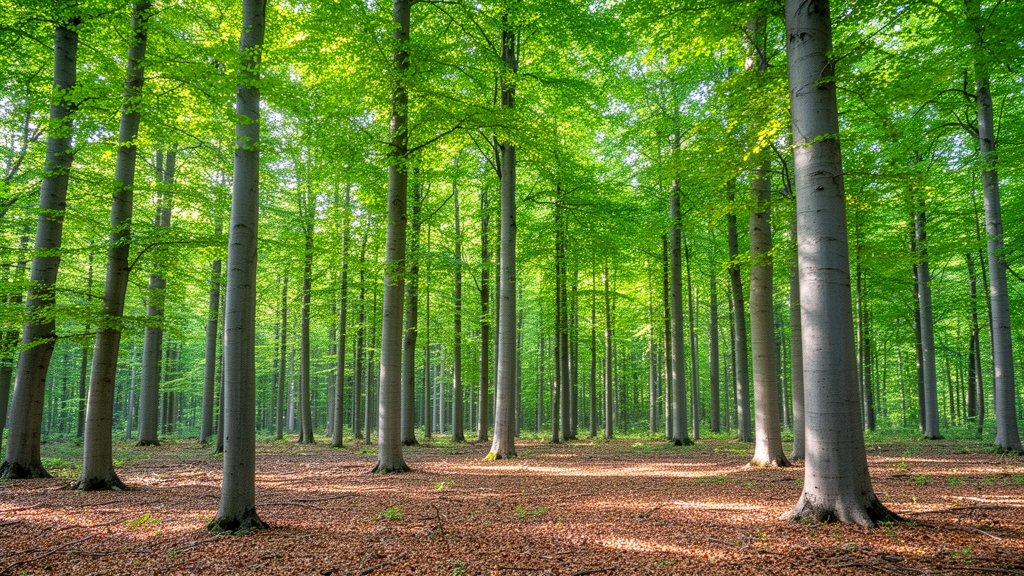
Forestry researchers investigating temperate European beech stands have uncovered a delicate physiological trade-off governing how canopy management influences timber growth and climate vulnerability. In a comprehensive long-term evaluation of pure beech stands in Germany, scientists determined that while removing competing trees dramatically accelerates trunk diameter expansion, aggressive opening of the forest canopy introduces acute ecological liabilities. The research reveals that moderate thinning interventions provide the optimum balance for tree vitality by securing the substantial growth advantages and drought resilience typically seen under heavy thinning regimes, while effectively shielding mature trees from heightened growth fluctuations, excessive crown ramification, and severe vulnerability to late-spring frost damage.
The investigation focused on European beech, scientifically classified as Fagus sylvatica L., which represents the most ecologically widespread and economically significant deciduous forest species across Central Europe. Despite its broad ecological amplitude, European beech has experienced widespread vitality loss and pronounced reductions in stem radial increment over recent decades due to rising summer temperatures, prolonged moisture deficits, and repeated heatwaves. Forest managers historically deploy silvicultural thinning to relieve competition for light, soil moisture, and subterranean nutrients, thereby accelerating tree development toward target harvest dimensions. However, silviculturists have long debated whether intensely reducing stand density genuinely fortifies trees against mounting weather extremes or inadvertently exposes them to physiological shock, destabilizing their canopy architecture and reproductive balance.
To rigorously test these dynamics, the research team examined three monodominant beech forest sites situated in the Rhineland-Palatinate region of southwestern Germany: Donnersberg, Vierbrüder, and Lahnstein. These experimental stands are maintained as part of the specialized growth monitoring network directed by the Research Centre for Forest Ecology and Forestry in Trippstadt. The selected study locations share characteristic brown earth soils and temperate climate profiles, exhibiting mean annual temperatures of approximately 9.9 degrees Celsius and mean annual precipitation totals ranging between 653 and 791 millimeters. Across these sites, the scientists assessed trees across three distinct maturity cohorts, specifically evaluating stands aged 50, 70, and 90 years to isolate the interacting influences of biological tree age and competitive canopy density.
The experimental framework compared three clearly defined management regimes across twelve discrete forest plots. The control treatment received zero silvicultural interventions, maintaining unthinned, fully stocked stand conditions as a baseline reference. The moderate thinning regime, executed through established selection thinning protocols, focused on retaining 80 vigorous future crop trees per hectare by releasing target crowns once or twice per decade to support harvest rotations of 100 to 120 years. Conversely, the heavy thinning treatment followed the qualification-dimensioning system, aggressively opening the upper canopy every five to ten years to maintain just 40 dominant future crop trees per hectare. This heavy treatment aims to permanently liberate living crowns, suppress natural lower branch mortality, and shorten harvest production rotations to between 80 and 100 years.
Field measurements incorporated detailed radial stem sampling across 125 carefully chosen future crop trees displaying zero external crown or trunk defects. In the spring of 2024, researchers extracted increment cores at standard breast height of 1.30 meters using five-millimeter Haglöf increment borers. High-resolution digital imaging under fifty-times optical magnification, coupled with specialized dendrochronological software platforms including CooRecorder, CDendro, and PAST4, enabled the complete detection of microscopic annual rings and missing growth layers. Researchers subsequently transformed these annual radial measurements into basal area increment series to track absolute wood production and determine exact biological cambial age from pith to bark.
Simultaneously, the researchers deployed high-resolution terrestrial laser scanning to capture the full three-dimensional spatial architecture of all twelve experimental parcels prior to spring foliar emergence. From these detailed geometric reconstructions, researchers calculated comprehensive architectural metrics for each study tree, including total crown volume, living crown base height, average internodal branch lengths, and the cumulative branching nodes encountered along water-conducting hydraulic pathways from the trunk base to outer branch tips.
To evaluate environmental pressures, the authors synthesized comprehensive meteorological and ecological datasets spanning from 1950 through 2023. Daily weather observations from the European E-OBS gridded ensemble permitted calculation of the Standardised Precipitation Evapotranspiration Index across May, June, and July, identifying extreme summer drought events when the index dipped below negative 1.5. Thermal degree-day accumulation above five degrees Celsius from early January until the final freezing episode below negative two degrees Celsius established annual late-spring frost risk indices, which peaked notably during 2017. Regional masting patterns were quantified using long-term annual canopy surveys from the state forest condition monitoring network, tracking localized beech fruit production scores across a 25-kilometer buffer surrounding the study stands.
Statistical modeling through generalized linear and mixed-effects models demonstrated that thinning intensity exerted a transformative effect on absolute wood growth and temporal stability. While both moderate and heavy thinning significantly enhanced basal area increment over control levels, heavily thinned trees exhibited significantly elevated interannual growth variation across both absolute and relative scales. In contrast, unthinned control trees exhibited stagnant radial growth with minimal year-to-year variation, reflecting chronic resource constraints that prevented them from seizing favorable growing conditions. Crucially, the mixed-effects evaluations confirmed that while heavy thinning maximized individual basal area increment in benign seasons, it disproportionately magnified growth drops during years plagued by late-spring frost, whereas moderately thinned stands with partially closed canopies provided optimal microclimatic buffering.
Drought recovery dynamics further highlighted the functional equivalence between thinning intensities during severe climatic shocks. Assessing four-year post-disturbance periods following severe historical droughts in 2003, 2015, and 2018 demonstrated that unthinned control stands suffered acute, multi-year legacy depressions, remaining significantly suppressed for up to two years before slowly surpassing baseline growth rates in year three. Conversely, trees in both moderately and heavily thinned stands maintained stable growth anomalies during acute drought years and recovered rapidly, achieving resilience index values well above 1.0. Heavy thinning conferred no statistical advantage over moderate thinning in post-drought recovery, indicating that retaining 80 crop trees per hectare provides adequate root and water access without incurring the elevated frost risks of open canopies.
Detailed structural analyses revealed an unexpected physiological feedback within tree crowns that fundamentally governs stem productivity. While heavier thinning significantly expanded crown volume, lowered crown base height, and multiplied branching bifurcations, dense branching proved advantageous only in smaller tree crowns. In expansive, voluminous crowns, excessive ramification and shortened internodal distances imposed structural constraints that actually suppressed stem basal area increment. The researchers concluded that replacing generic, categorical thinning classifications with direct structural modeling based on laser-scanned crown volume and hydraulic branching topology offers a far superior framework for predicting tree growth. These architectural insights prove that moderate thinning provides forest managers with the most balanced silvicultural strategy for sustaining European beech health amid escalating climate volatility.
Beyond immediate climate shocks, the authors identified intricate interactions linking reproductive masting events with tree growth and water availability. In unthinned control stands, heavy fructification significantly magnified the growth reductions caused by summer drought, reflecting a strict resource trade-off where trees diverted limited carbon from radial wood formation toward flower and seed production. Conversely, thinned stands displayed a more buffered response, where reproductive investment did not trigger an equivalent growth collapse, likely because superior access to light and soil moisture afforded greater physiological flexibility. Tree age also exerted a pronounced non-monotonic effect on stem development across all treatments, mapped through a fourth-degree polynomial function. Radial growth expanded during earlier decades, peaked at intermediate stand ages between 70 and 90 years, and subsequently declined in older individuals.
The branching evaluations explained the anatomical mechanisms linking crown architecture to hydrological transport efficiency. Quantitative structure modeling showed that the average number of branching nodes along water-conducting paths rose from 3.3 ramifications in dense canopies to nearly 4 under heavy thinning. As ramification frequency increased, internodal segment lengths decreased correspondingly. Shorter conduction segments facilitate safer conductance by minimizing hydraulic resistance, helping safeguard water transport toward foliage during moisture shortages. However, this architectural transformation reaches a physiological threshold in exceptionally large crowns. While branch ramification stimulated radial growth in modest crowns by increasing leaf area density, excessive branching in voluminous crowns imposed internal structural constraints that restricted stem basal area increment.
These structural findings carry direct implications for operational forest management under changing climatic conditions. Although heavy thinning maximizes stem dimensions for individual trees, it reduces overall timber volume production at the stand level due to lower target stocking densities. Local site factors also modulate these responses, as observed at the middle-aged Vierbrüder site where moderate and heavy treatments produced equivalent radial growth rates. Because high-resolution laser scanning can now capture branch topologies and crown volumes, researchers suggest replacing broad thinning categories with tree-centered structural metrics. This physiological framework enables more accurate predictions of growth and climate vulnerability, supporting adaptive silviculture across European beech and other temperate broadleaf forests.
Subject of Research: Silvicultural thinning intensity and crown architectural trade-offs in European beech resilience
Article Title: Crown–branching trade-offs mediate growth and resilience to drought, frost, and masting under moderate thinning in European Beech (Fagus sylvatica L.)
Article References: Larysch, E., Schindler, Z., Hirsch, M., Kröner, K., Braun-Wimmer, J., Frey, J., Reiter, P., Bücking, M., & Seifert, T. (2026). Crown–branching trade-offs mediate growth and resilience to drought, frost, and masting under moderate thinning in European Beech (Fagus sylvatica L.). Annals of Forest Science, 83(1), Article 3. https://doi.org/10.1186/s13595-025-01319-1
Image Credits: AI Generated
DOI: 10.1186/s13595-025-01319-1
Keywords: European beech, Fagus sylvatica, silviculture, moderate thinning, heavy thinning, basal area increment, crown architecture, quantitative structure models, terrestrial laser scanning, drought resilience, late frost risk, masting, SPEI, tree rings, forest management, hydraulic path, ramification
News Source: Alan Morgan. (November 13, 2026). Moderate Thinning Optimizes European Beech Growth While Limiting Climate Stress. Scienmag.