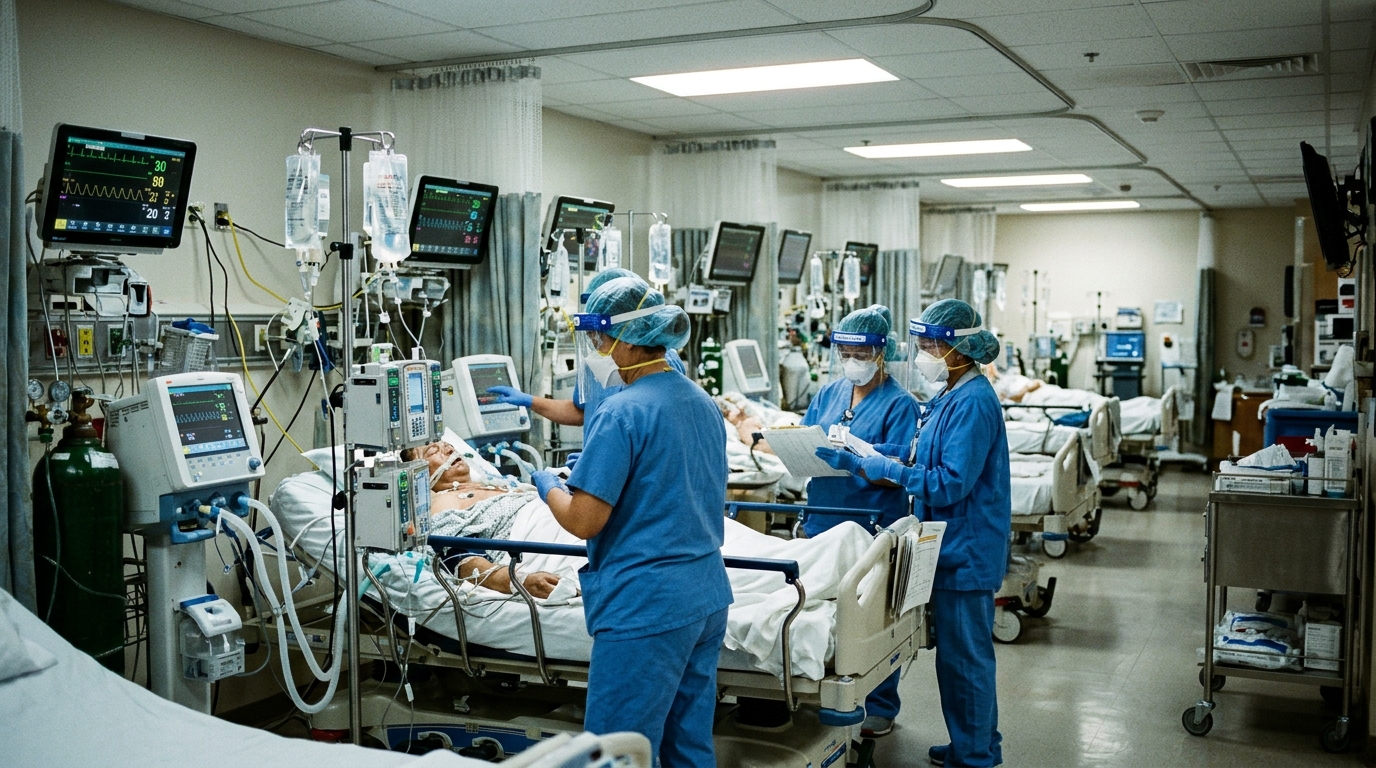
Large national stockpiles of pandemic influenza antivirals may be structurally incapable of preventing hospitals from being overwhelmed in a severe pandemic, according to a modeling study published in PLOS Medicine. Nir Gavish and Amit Huppert projected daily hospital bed demand for the United Kingdom, Japan, and the United States and found that in high-severity scenarios, the daily surge of patients could exceed available hospital capacity by a factor of five to nine. This inundation occurred even under the assumption that every symptomatic patient received antiviral treatment, meaning the drugs would be incapable of preventing a transition to crisis standards of care.
Pandemic preparedness in high-resource nations has traditionally relied on large antiviral stockpiles, typically targeting coverage for 25 percent of the population. The researchers note that this inventory-based benchmark focuses on cumulative disease burden but often overlooks the inelastic capacity of healthcare systems to manage acute surges. As multi-billion-dollar inventories reach expiration, the team evaluated whether static stockpiles remain a viable strategy for preventing healthcare system collapse during future pandemics.
To project demand, the study used three complementary frameworks: a static lower-bound estimation, a dynamic deterministic Susceptible-Infectious-Hospitalized-Recovered transmission model, and historical reconstructions of the 1918, 1957, and 1968 pandemics using mortality data. The authors evaluated official planning scenarios for the three countries and compared projected demand against national surge capacities, defined as staffed beds. To test the theoretical limits of the stockpile strategy, they applied best-case assumptions, including perfect distribution of antivirals to 100 percent of symptomatic cases and high clinical effectiveness, modeled as a 30 to 60 percent reduction in hospitalization.
The results revealed a critical feasibility gap. While stockpiles successfully suppressed demand to manageable levels in moderate scenarios analogous to the 1957 and 1968 pandemics, they were structurally insufficient for severe events. In high-severity scenarios, analogous to the 1918 pandemic or to the parameters the US Centers for Disease Control and Prevention classifies as Very Severe, the daily surge of patients exceeded available hospital capacity by a factor of five to nine. Because this inundation persisted even at full treatment coverage, the failure is structural rather than a matter of distribution logistics.
The authors emphasize that the analysis is subject to the inherent uncertainties of future pandemics, but that their use of optimistic best-case assumptions suggests the identified structural failures are a lower-bound estimate. Realistic operational hurdles would only widen the disparity between stockpile targets and system capacity. In other words, the modeled gap represents the most favorable outcome the stockpile strategy could plausibly deliver, and real-world conditions are expected to perform worse.
The study’s methodology carries several limitations that the authors state explicitly. The analysis used a conservative four-day hospital length of stay, which underestimates prolonged intensive care needs. It relied on general hospital beds as a proxy, a choice that abstracts away from critical sub-system bottlenecks such as specialized staffing or equipment. It also assumed guaranteed antiviral efficacy against novel strains, an assumption that cannot be verified in advance for a virus that has not yet emerged. Each of these choices biases the analysis toward finding that stockpiles are sufficient, yet the strategy still failed in severe scenarios.
On the basis of these findings, the authors conclude that large reserves cannot overcome the rigid physical constraints of healthcare systems, even under the optimistic assumption of perfect distribution. They argue that the conventional 25 percent coverage target for antiviral stockpiles, a hallmark of legacy planning, presents a critical opportunity for re-evaluation. Because global stocks are nearing expiration, the researchers suggest policymakers are uniquely positioned to use this inflection point to explore a different framework.
The proposed alternative is a capacity-based approach, described in the study as an adaptive paradigm. Rather than anchoring policy to a fixed fraction of the population, this framework would incorporate a synergistic mix of targeted reserves, temporary non-pharmaceutical interventions, and flexible delivery options such as decentralized home-first care. The authors present these integrated measures as a potential temporal bridge, preserving system integrity until vaccine deployment. The study is a modeling exercise based on historical data and official planning scenarios; it does not report clinical trial results, and the effectiveness of any specific policy combination in a future pandemic remains subject to the uncertainties the authors acknowledge.
Subject of Research: Modeling of pandemic influenza antiviral stockpiles and hospital surge capacity in severe pandemic scenarios
Article Title: Transforming pandemic influenza antiviral stockpiling using a capacity-based approach: A modeling study
Article References: Gavish, N., & Huppert, A. (2026). Transforming pandemic influenza antiviral stockpiling using a capacity-based approach: A modeling study. PLOS Medicine, 23(11), e1004992. https://doi.org/10.1371/journal.pmed.1004992
Image Credits: AI Generated
DOI: 10.1371/journal.pmed.1004992
Keywords: pandemic influenza, antiviral stockpiles, hospital surge capacity, modeling study, crisis standards of care, non-pharmaceutical interventions, healthcare system capacity, PLOS Medicine, pandemic preparedness, transmission model, Transforming, pandemic
News Source: Ophelia Keating. (November 6, 2026). Modeling study finds antiviral stockpiles cannot prevent hospital overload in severe flu pandemics. Scienmag.