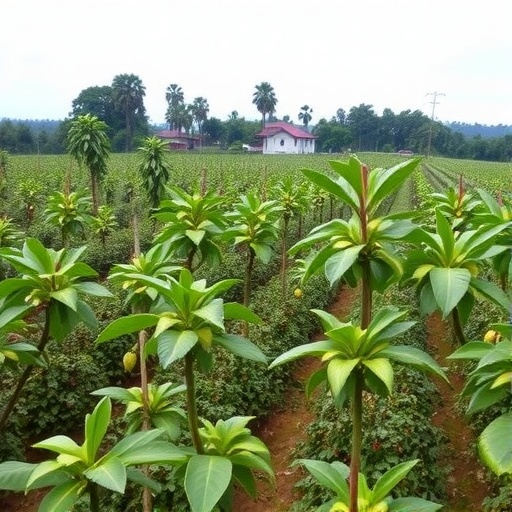
Ghana’s cocoa farmers, the backbone of an industry that anchors the West African nation’s economy, are far less ready for climate change than they believe themselves to be, according to a new study that applied a sophisticated econometric technique known as the Cragg double hurdle model to one of the most detailed datasets yet assembled on hazard preparedness among smallholder cocoa producers. The research, conducted in the Wassa Amenfi East Municipality of Ghana’s Western Region and published in the journal Discover Agriculture, reveals a striking paradox: although nearly two-thirds of surveyed farmers consider themselves prepared for climate-related disasters, the measured intensity of that preparedness is strikingly low.
The study, led by Richard Obed Dankyi of Kwame Nkrumah University of Science and Technology with colleagues from several Ghanaian institutions and the University of Pretoria, surveyed 200 cocoa farmers drawn from a registered population of 13,670 in the municipality. Using Yamane’s formula with a 7 percent margin of error, the team sampled farmers from ten communities through a multi-stage procedure combining purposive selection of the study area, simple random balloting of communities, and systematic random sampling of individuals within each community. Face-to-face structured interviews were administered by five trained enumerators over three weeks, with questions translated into local dialects where necessary, and the instrument’s reliability was verified using Cronbach’s alpha alongside expert content validation.
The hazards confronting these farmers are neither hypothetical nor distant. Every one of the 200 respondents reported experiencing extreme rainfall, drought or water scarcity, and extreme sunlight; 185 had endured heatwaves, 93 had faced flooding, and 15 had weathered thunderstorms. Cocoa, a crop exquisitely sensitive to consistent moisture levels, suffers under prolonged dry spells, while erratic rainfall disrupts the flowering and fruiting cycles that determine annual yields. The municipality’s vulnerability is compounded by deforestation and illegal small-scale mining, which the authors note have intensified local exposure to drought, heatwaves, and extreme precipitation events.
The central analytical innovation of the study lies in its treatment of preparedness as two distinct decisions rather than a single behavior. First proposed by econometrician John Cragg in 1971, the double hurdle model posits that a farmer first decides whether to prepare at all—a binary choice estimated through probit regression—and then determines how intensively to prepare, a continuous outcome estimated through truncated regression. This approach offers a crucial advantage over alternatives: the Tobit model assumes that the same underlying rationality governs both decisions, potentially yielding inconsistent parameter estimates, while the Heckman two-stage model suffers from correlated errors between its equations because unmeasured variables influence both the discrete and continuous components. By employing separate probit and truncated regressions, the double hurdle framework produces consistent and asymptotically efficient estimates. The researchers also ran Tobit and Heckman models as robustness checks, with the likelihood ratio test statistic of 232.998 guiding model selection.
Preparedness intensity itself was quantified through a five-point Likert scale covering five dimensions: awareness and information, training and knowledge, adaptive measures, resource availability, and community engagement. The results expose a widening gulf between perception and reality. While 64 percent of farmers claimed to be prepared, the overall preparedness index stood at just 2.14 on the five-point scale. Resource availability scored lowest of all at 1.13, indicating farmers feel severely constrained in accessing the inputs, financing, and irrigation infrastructure needed for adaptation. Awareness and information registered 2.09, suggesting a significant breakdown in knowledge dissemination channels. Training and knowledge reached only 2.29, and community engagement a mere 1.84, pointing to a lack of collective action in which farmers may feel isolated in their efforts. Only adaptive measures, at 3.34, approached a neutral midpoint, reflecting moderate recognition of the importance of coping strategies.
The socioeconomic determinants of preparedness emerged with considerable clarity across the competing models. Gender exerted a significant influence, with a positive coefficient of 0.719 in the Tobit model indicating that male farmers tend to be both more prepared and more intensively prepared than their female counterparts—a finding that contradicts several earlier studies reporting that women more frequently select climate-resistant varieties. Education carried a positive coefficient of 0.065, equipping farmers with the capacity to assess risks and deploy adaptive strategies proactively. Household headship showed the largest positive effect at 1.658, presumably reflecting the responsibility of securing family livelihoods, while engagement in secondary occupations added 0.759, as diversified income streams provide both the resources and the risk-buffering capacity to invest in preparedness activities.
Not all findings followed intuitive expectations. Access to climate information, with a coefficient of 0.705, reliably enhanced both preparedness and its intensity, confirming the pivotal role of information and communication technologies in building adaptive capacity. But credit access registered a significant negative effect of 1.304, a result the authors describe as counterintuitive. Rather than enabling adaptation investments, borrowed funds may impose debt burdens or be diverted to immediate household needs, leaving less capacity for long-term preparedness. Farm size, too, showed a negative coefficient of 0.066 in the Heckman model, suggesting that farmers managing larger operations prioritize production over adaptation, or simply lack the surplus resources to prepare adequately across greater acreage.
On the ground, farmers are not passive in the face of these threats. Planting shade trees emerged as the most favored adaptive practice, earning a mean score of 4.66 out of 5, with 68.5 percent of respondents strongly agreeing with its value. Shade trees regulate soil temperature, reduce evaporation, and provide habitat for beneficial organisms, collectively buffering cocoa trees against heat stress. Mulching and manure application followed at 4.04, reflecting widespread understanding of practices that improve soil structure, water retention, and nutrient availability. Fertilizer application scored 3.92, with notable hesitation among a substantial neutral segment, suggesting a need for targeted education on optimal application rates and the risks of over-reliance on chemical inputs.
The demographic profile of the surveyed farmers underscores the structural challenges facing Ghana’s cocoa sector. The average respondent was 49 years old with nearly 20 years of farming experience and 9.81 acres of land. Men constituted 77 percent of respondents, 85.5 percent were married, and 80 percent were household heads. Only 8 percent belonged to cooperative societies, a strikingly low figure that the authors highlight as evidence of the need to promote collective action, and 93 percent reported having no access to credit whatsoever. Radio dominated as the preferred source of climate information, a detail with practical implications for how forecasts and warnings should be delivered.
The study’s policy recommendations flow directly from its econometric findings. The authors call for the establishment of weather monitoring systems and mobile-based weather forecasting tools to close the information gap reflected in the low awareness index, alongside targeted training programs in climate data interpretation to build the practical skills farmers currently lack. Comprehensive education programs addressing climate impacts and sustainable resource management should be tailored to local contexts, they argue, while partnerships with agricultural extension services could rebuild the community engagement that scored so poorly. Crucially, the authors emphasize gender inclusivity, insisting that women and marginalized groups gain equal access to training and resources—particularly given the finding that female farmers currently lag in preparedness. Enhanced collaboration between governmental and non-governmental organizations is proposed as the mechanism for overcoming existing barriers.
The broader significance of the work extends beyond one municipality. Ghana is the world’s second-largest cocoa producer, and the crop’s sensitivity to shifting rainfall patterns has been documented across the cocoa belt of West Africa. By disaggregating the decision to prepare from the depth of that preparation, the study demonstrates that policies treating preparedness as a single outcome may misdiagnose the problem: the issue is not that farmers refuse to act, but that the resources, knowledge, and institutional scaffolding needed for meaningful action remain absent. In an era when climate projections anticipate increasingly frequent and intense droughts, heatwaves, and extreme rainfall across Ghana’s forest and savannah zones, the 2.14 preparedness index stands as a quantified warning—and a baseline against which future interventions can be measured.
Subject of Research: Preparedness of Ghanaian cocoa farmers for multiple climate change-related hazards, examined using the Cragg double hurdle model in the Wassa Amenfi East Municipality.
Subject of Research: Agriculture
Article Title: Modelling preparedness for multiple climate hazards among Ghanaian cocoa farmers using the Cragg double hurdle approach
Article References: Dankyi, R. O., Tham-Agyekum, E. K., Awalime, D. E., Jones, E. O., Wongnaa, C. A., & Ankuyi, F. (2026). Modelling preparedness for multiple climate hazards among Ghanaian cocoa farmers using the Cragg double hurdle approach. Discover Agriculture, 4(1), Article 227. https://doi.org/10.1007/s44279-026-00664-7
Image Credits: AI Generated
DOI: 10.1007/s44279-026-00664-7
Keywords: Climate change adaptation, Cocoa farmers, Hazard preparedness, Adaptive practices, Resilience strategies, Cragg double hurdle model, Ghana, Smallholder farmers, Climate information, Preparedness intensity
Cite Scienmag News
APA MLA Chicago
Alan Morgan. (September 6, 2026). Modeling Ghanaian cocoa farmers’ preparedness for multiple climate hazards. Scienmag. https://scienmag.com/modeling-ghanaian-cocoa-farmers-preparedness-for-multiple-climate-hazards/
Alan Morgan. “Modeling Ghanaian cocoa farmers’ preparedness for multiple climate hazards.” Scienmag, 6 September 2026, https://scienmag.com/modeling-ghanaian-cocoa-farmers-preparedness-for-multiple-climate-hazards/. Accessed 6 September 2026.
Alan Morgan. “Modeling Ghanaian cocoa farmers’ preparedness for multiple climate hazards.” Scienmag. September 6, 2026. https://scienmag.com/modeling-ghanaian-cocoa-farmers-preparedness-for-multiple-climate-hazards/
Copy citation Download RIS
Tags: agricultural hazard preparednessassessment of farmers’ climate disaster readinessClimate change adaptationclimate change impact on smallholder cocoa farmersclimate disaster awareness among farmersclimate hazard risk assessmentclimate hazard vulnerability among Ghanaian cocoa producersclimate vulnerability in West Africacocoa farming socio-economic factorsCragg double hurdle model application in agriculturedetailed datasets on climate resilience in West African agricultureeconometric analysis of climate resilience in Ghanaeconometric modeling in agriculturefarmer perception versus actual preparednessfarmers’ perception versus actual climate preparednessGhana Western Region cocoa farming community studyGhanaian cocoa farmersGhanaian cocoa farmers climate hazard preparednessimplications of climate change on Ghana’smulti-stage sampling in agricultural studiessmallholder agriculture climate adaptation strategiessmallholder farmer resiliencesurvey methodology for climate risk assessmentsurvey methodology in agricultural research