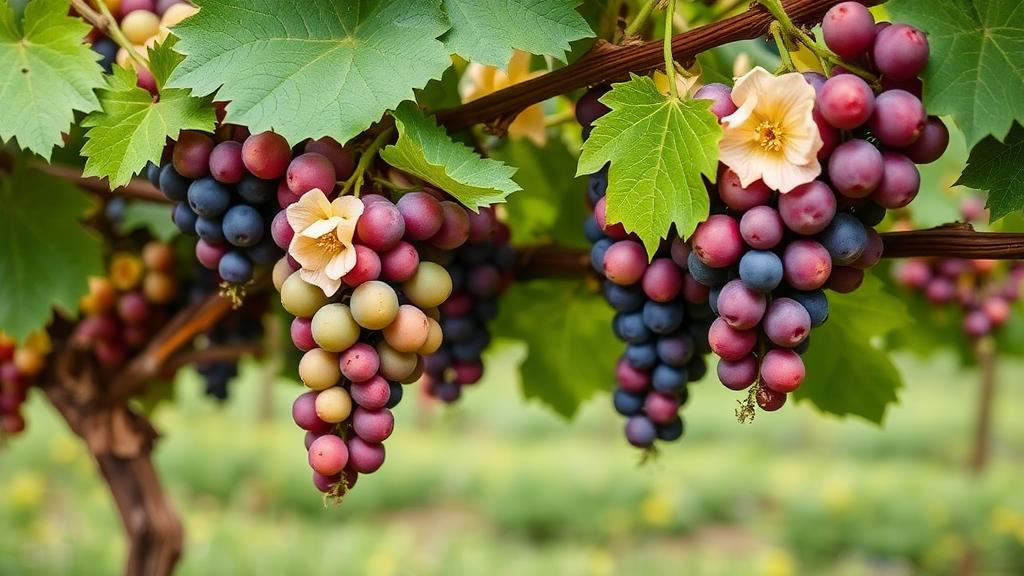
Every summer, vineyard workers around the world perform the same tedious chore: stripping curling tendrils off grapevines so they do not weave themselves through wires, canopies, and neighboring vines. Those tendrils are more than a nuisance. They are a sign of a deep developmental puzzle that has intrigued botanists for more than a century, because a grapevine tendril and a grape cluster begin life as the very same organ. Now, a study published in Plant Cell Reports by researchers at Yangzhou University has dissected the molecular decision that sends one lateral shoot organ down the flowering path and another down the climbing path, and in doing so has opened a route to vines that simply make fewer tendrils.
The research team, led by Yuanqian Ni and supervised by Zhaosen Xie and Youmei Li, took advantage of a natural contrast between two grapevine cultivars. ‘Einset Seedless’, abbreviated ENT in the study, tends to produce inflorescences at the lower tendril nodes of its lateral shoots, while ‘Pinot Noir’, or PN, overwhelmingly produces true tendrils at the equivalent positions. By comparing these two varieties node by node, the researchers could ask a precise question: when the same meristem faces the same choice, what is different inside the cells of a plant that flowers versus a plant that climbs?
The homology of tendrils and inflorescences in grapevine is well established. Classical anatomical work showed that both organs arise from the same uncommitted primordia on lateral shoots, and earlier molecular studies found that floral meristem identity genes are expressed even in developing tendrils, as if the tendril were an inflorescence that never quite committed to flowering. Decades ago, pioneering experiments by Srinivasan and Mullins demonstrated that isolated tendrils could even be coaxed into forming inflorescences in vitro, hinting that the switch between the two fates is chemically malleable. What the new study adds is a genome-wide, node-resolved map of the transcriptional landscape in which that switch is thrown.
The team first quantified the anatomical difference, confirming that ENT achieved a markedly higher flowering rate at tendril nodes one through four than PN did. They then harvested tissue from specific tendril nodes in both cultivars and performed RNA sequencing, using an intersection and exclusion strategy to isolate 549 differentially expressed genes that distinguish inflorescence-prone from tendril-prone tissue. When those genes were subjected to Kyoto Encyclopedia of Genes and Genomes pathway enrichment analysis, two signaling systems rose to the top: plant hormone signal transduction and mitogen-activated protein kinase cascades. In other words, the decision between flower and tendril appears to be broadcast through the cell by hormonal and phosphorylation-based communication channels rather than by a single master switch.
To move beyond a static snapshot, the researchers applied Mfuzz clustering, a computational method that groups genes according to the shape of their expression trajectories across a developmental series. This revealed that multiple expression programs rise and fall in patterns that track the flowering gradient running along the shoot, from the most inflorescence-prone basal nodes to the tendril-dominated upper nodes. Across every dynamic cluster, plant hormone signal transduction emerged as the predominantly enriched pathway, underscoring that phytohormones are not merely participants in this process but sit at its very center.
Guided by that transcriptional evidence, the team measured the endogenous levels of two key hormones directly in the nodal tissues: zeatin, the classic cytokinin that generally promotes reproductive meristem activity and flowering, and gibberellin GA3, which is more often associated with stem elongation and vegetative growth. The striking result was that the ratio between the two, rather than the absolute level of either hormone alone, paralleled the flowering gradient across nodes and correlated with the gene expression trajectories identified by clustering. A high zeatin-to-GA3 ratio accompanied the inflorescence-prone state, while a lower ratio accompanied tendril formation. This provides concrete physiological support for a cytokinin-gibberellin interaction model in which the balance between these two antagonistic hormones helps determine whether a lateral meristem matures into a flower-bearing branch or an elongating, climbing tendril.
The hormone story dovetails with a long history of viticultural observation. Growth retardants that suppress gibberellin synthesis have been known since the 1960s to influence fruitfulness in grapes, and cytokinin treatments have been shown to convert tendril primordia into inflorescences, with the success of that conversion depending on the genotype. The famous ‘green revolution’ dwarfing mutation in grapevine, which links reduced gibberellin response with enhanced floral induction, fits the same pattern. What the new transcriptomic work contributes is the mechanistic scaffolding: it shows that the endogenous hormone ratio in the organ itself, not just externally applied chemicals, tracks the developmental outcome, and that the downstream transcriptional response is organized into coherent, flowering-correlated trajectories.
Within the pool of differentially expressed transcription factors, one gene stood out. A MADS-box gene named FRUITFULL-LIKE, or VvFUL-L, was markedly upregulated in PN tendrils compared with inflorescence-prone ENT tissue. MADS-box transcription factors are the celebrated architects of floral development, and the FRUITFULL lineage in particular is known from arabidopsis and tomato to regulate meristem identity, flowering time, and inflorescence architecture. To probe what VvFUL-L might be doing, the team overexpressed it heterologously in arabidopsis. The transgenic plants flowered earlier than normal and produced inflorescences with reduced branching, phenotypes consistent with a role in steering lateral meristem development. The authors suggest that VvFUL-L may help tip the uncommitted grapevine lateral meristem toward the tendril program, although confirming that function in grapevine itself will require further work in the crop.
The agronomic implications are immediate and tangible. Excessive tendril growth increases vineyard management costs because tendrils must be removed or redirected by hand or machine, and they can girdle shoots and interfere with canopy machinery. If the cytokinin-to-gibberellin ratio and regulators like VvFUL-L can be manipulated, whether through breeding, targeted gene editing, or growth regulator programs, growers could eventually favor inflorescence formation at the basal nodes where fruit is wanted and suppress the runaway tendril production that wastes the vine’s resources. The study’s authors frame their findings as a foundation for future molecular and breeding studies aimed at managing tendril growth, and the identification of a small set of hormone-responsive genes and a candidate transcriptional regulator is exactly the kind of entry point such efforts require.
There is also a broader evolutionary resonance in the result. Across the grape family, the Vitaceae, tendrils and inflorescences are thought to be variations on a single ancestral organ, and expression studies of APETALA1, FRUITFULL, FLOWERING LOCUS T, and LEAFY orthologs throughout the family support that homology. The Yangzhou study now supplies a quantitative, node-by-node account of how that shared developmental potential is partitioned within a single plant, showing that the fate of each primordium is written in the language of hormone ratios and read out by MADS-box transcription factors. A curling tendril on a Pinot Noir vine, in this light, is not a failed flower but an alternative interpretation of the same instructions, and researchers are learning to read, and perhaps one day to rewrite, the grammar behind that choice.
Subject of Research: Molecular regulation of tendril versus inflorescence development in grapevine lateral shoots
Article Title: Comparative transcriptomics reveals hormone signaling and MADS-box genes in divergent development of inflorescences and tendrils in grapevine lateral shoots
Article References: Ni, Y., Bian, Y., Xie, Z., & Li, Y. (2026). Comparative transcriptomics reveals hormone signaling and MADS-box genes in divergent development of inflorescences and tendrils in grapevine lateral shoots. Plant Cell Reports, 45(9), Article 270. https://doi.org/10.1007/s00299-026-03957-9
Image Credits: AI Generated
DOI: 10.1007/s00299-026-03957-9
Keywords: grapevine, Vitis vinifera, tendrils, inflorescences, cytokinin, gibberellin, MADS-box, VvFUL-L, transcriptomics, hormone signaling, flowering, viticulture
News Source: Juliet Wilcox. (October 4, 2026). Hormone Balance and a Flowering Gene Decide Whether Grapevines Grow Tendrils or Clusters. Scienmag.