• HOME
  • NEWS
  • EXPLORE
    • CAREER
      • Companies
      • Jobs
    • EVENTS
    • iGEM
      • News
      • Team
    • PHOTOS
    • VIDEO
    • WIKI
  • BLOG
  • COMMUNITY
    • FACEBOOK
    • INSTAGRAM
    • TWITTER
Wednesday, October 21, 2026
BIOENGINEER.ORG
No Result
View All Result
  • Login
  • HOME
  • NEWS
  • EXPLORE
    • CAREER
      • Companies
      • Jobs
        • Lecturer
        • PhD Studentship
        • Postdoc
        • Research Assistant
    • EVENTS
    • iGEM
      • News
      • Team
    • PHOTOS
    • VIDEO
    • WIKI
  • BLOG
  • COMMUNITY
    • FACEBOOK
    • INSTAGRAM
    • TWITTER
No Result
View All Result
Bioengineer.org
No Result
View All Result
Home NEWS Science News Technology

Model predicts cyclic uplift failure in soft-clay helix anchors

by
October 21, 2026
in Technology
Reading Time: 2 mins read
0
Model predicts cyclic uplift failure in soft-clay helix anchors

Model predicts cyclic uplift failure in soft-clay helix anchors

Share on FacebookShare on TwitterShare on LinkedinShare on RedditShare on Telegram

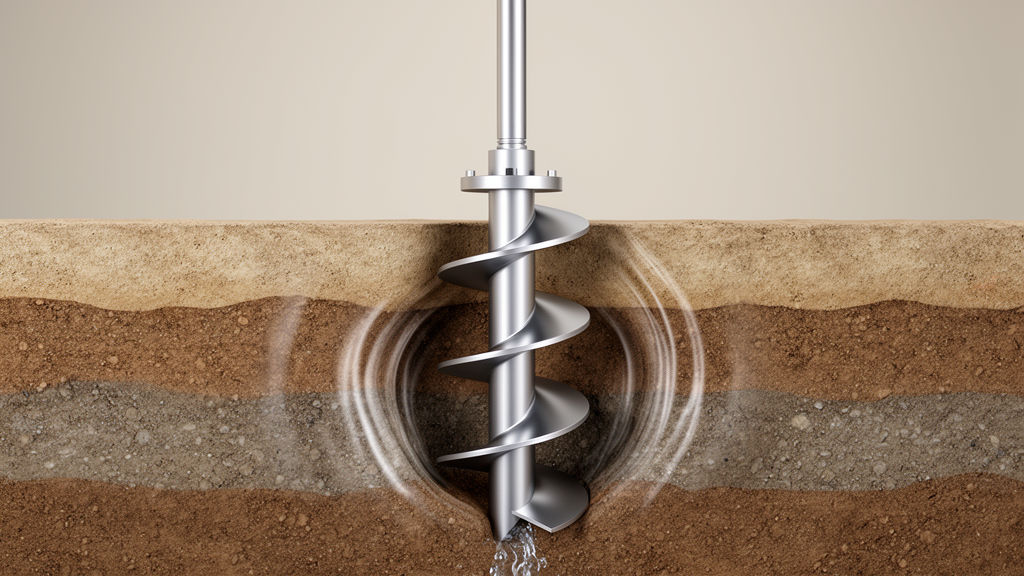
Vertical cyclic loading can reduce the stiffness of a single-helix anchor in soft clay, build excess pore pressure and leave a permanently displaced anchor head, according to a numerical and theoretical study that combined benchmark testing with finite element simulation. The research examined how an installed helical anchor behaves when repeatedly pulled upward, a loading pattern that can shift the soil around the shaft from shallow failure toward deeper local flow around the helix.

The investigators built a two-dimensional axisymmetric finite element model of the anchor–soil system using data from a benchmark cyclic uplift test involving a 26 mm diameter shaft. Its clay formulation included small-strain stiffness, cyclic hardening, plastic displacement accumulation and pore-pressure generation. Against the benchmark test, the model reproduced the observed displacement trend and captured the transition from a shallow wedge of soil moving upward to deeper local flow around the helix. The simulations also showed how excess pore pressure developed in the soil surrounding the helix during repeated uplift.

The researchers also developed a cyclic Q–z model to represent the relationship between load and displacement at the anchor head. This model combined a hyperbolic monotonic backbone with an analytical ultimate-capacity bound, mapping between monotonic and cyclic behavior, a moving projection center and parameters describing cyclic degradation. Together, these components allowed the model to account for path-dependent response, declining stiffness and the accumulation of residual displacement rather than treating each loading cycle as independent.

Calculations with the model examined embedment depth, shaft diameter, mean load and cyclic amplitude. The resulting cyclic interaction diagrams indicated that rapid ratcheting occurred when the maximum cyclic load approached approximately 0.4–0.5 times the ultimate capacity, Qu. This is a modeled threshold, not a universal field limit: the study presents an experimental–finite element–theoretical framework for preliminary assessment of single-helix anchors in soft clay, and the reported behavior depends on the modeled anchor geometry, loading history and soil response.

Subject of Research: Finite element and theoretical modeling of cyclic uplift in single-helix anchors embedded in soft clay

Article Title: Numerical and theoretical analysis of vertical cyclic uplift of single-helix anchors in soft clay

Article References: Shiwei, W., Sihua, L., & Hang, C. (2026). Numerical and theoretical analysis of vertical cyclic uplift of single-helix anchors in soft clay. Scientific Reports. https://doi.org/10.1038/s41598-026-75211-x

Image Credits: AI Generated

DOI: 10.1038/s41598-026-75211-x

Keywords: single-helix anchors, soft clay, cyclic uplift, finite element modeling, pore pressure, residual displacement, stiffness degradation, soil mechanics, anchor ratcheting, Numerical, theoretical, analysis

News Source: Denise Maddox. (October 21, 2026). Model predicts cyclic uplift failure in soft-clay helix anchors. Scienmag.


Tags: analysisanchor ratchetingcyclic upliftFinite Element ModelingNumericalpore pressureresidual displacementsingle-helix anchorssoft claysoil mechanicsstiffness degradationTheoretical
Share12Tweet7Share2ShareShareShare1

Related Posts

Silicon photonic circuit maps exceptional topology on a Klein bottle

Silicon photonic circuit maps exceptional topology on a Klein bottle

October 21, 2026
Perspective Reviews Spatial Strategies for Bacterial–Mammalian Cell Co-Culture

Perspective Reviews Spatial Strategies for Bacterial–Mammalian Cell Co-Culture

October 21, 2026

Prompting boosts multimodal models modestly in tongue-diagnosis benchmark

October 21, 2026

Alkali-Treated Fly Ash Aggregate Lightens and Strengthens Concrete

October 21, 2026

POPULAR NEWS

  • Inulin-linked postoperative nutrition accompanies improved colonic healing in mice

    Inulin-linked postoperative nutrition accompanies improved colonic healing in mice

    29 shares
    Share 12 Tweet 7
  • Synthetic organelle records transient gene activity in human cells

    29 shares
    Share 12 Tweet 7
  • AI tools emerge for Gamma Knife planning and outcome prediction

    29 shares
    Share 12 Tweet 7
  • Research report: Prevalence of iron deficiency anaemia and associated factors among preterm infants aged 3–6 months attending clinics in Dodoma, Tanzania: a facility-based cross-sectional study

    29 shares
    Share 12 Tweet 7

About

We bring you the latest biotechnology news from best research centers and universities around the world. Check our website.

Follow us

Recent News

Inulin-linked postoperative nutrition accompanies improved colonic healing in mice

Synthetic organelle records transient gene activity in human cells

AI tools emerge for Gamma Knife planning and outcome prediction

Subscribe to Blog via Email

Enter your email address to subscribe to this blog and receive notifications of new posts by email.

Join 85 other subscribers
  • Contact Us

Bioengineer.org © Copyright 2023 All Rights Reserved.

Welcome Back!

Login to your account below

Forgotten Password?

Retrieve your password

Please enter your username or email address to reset your password.

Log In
No Result
View All Result
  • Homepages
    • Home Page 1
    • Home Page 2
  • News
  • National
  • Business
  • Health
  • Lifestyle
  • Science

Bioengineer.org © Copyright 2023 All Rights Reserved.