A paper appeared in Chemical Physics
The contemporary materials industry raises the problem of creating a microscopic theory that allows to describe the observed physicochemical properties of a wide class of substances which are in demand in modern industry, medicine, and agriculture. A general and consistent theory will help to obtain reliable information from experimental data on the structure of matter, existing interactions and dynamic processes occurring in it, which can help in the synthesis and quality control of prospective materials.
The study of the molecular structure of a substance and its intermolecular interactions is one of the most important and interesting tasks facing modern science. Of particular interest is the study of molecular interactions in media with a disordered structure. Molecular interactions in disordered materials are studied by a variety of methods, but the most universal is the method of dielectric spectroscopy, which makes it possible to study processes occurring in perioids to 10^(-9) sec.
In disordered media, the main peak of the dielectric loss spectrum, as a rule, has a non-Debye shape: at low and high frequencies, it is determined by fractional power-law frequency dependences. Power exponents characterize the shape of the peak and are associated with the parameters of microscopic structural and dynamic processes in the studied environment. The non-Debye dielectric loss spectra can be divided into two groups according to the shape of the main peak: typical and atypical. Typical spectra, for which the high-frequency power-law exponent is higher than the low-frequency one, are well described by the so-called Havriliak-Negami function, account for 70% of the total number of non-Debye spectra and are well studied theoretically. Atypical spectra, for which, on the contrary, the low-frequency power exponent is higher than the high-frequency one, cannot be described by this function and have been studied much less. An atypical dielectric response is usually observed in disordered media with limited geometry.
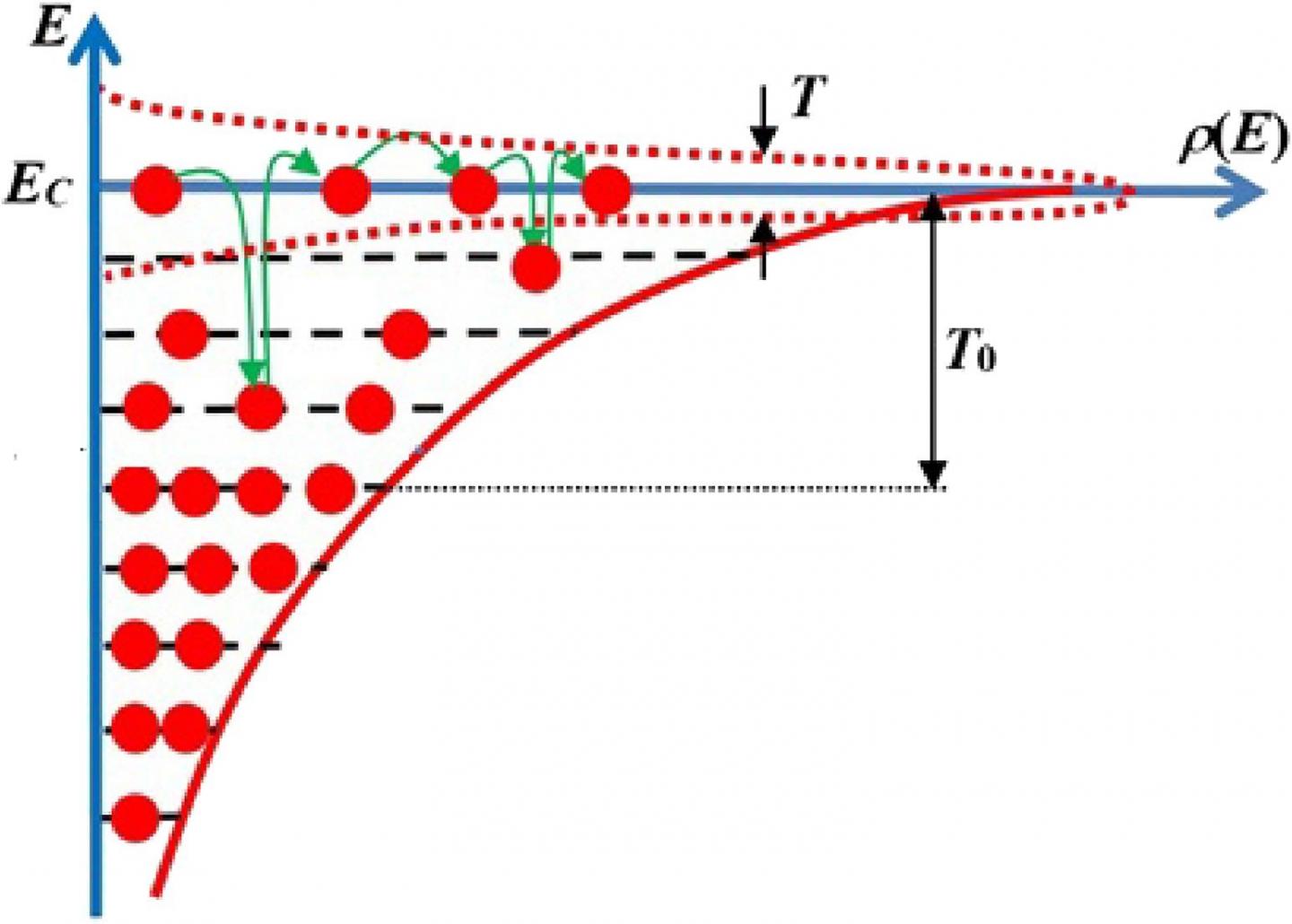
This article, co-authored by Airat Khamzin (Kazan Federal University) and Alexander Nikitin (Kazan State Power Engineering Unviersity), proposes a new dielectric relaxation model that takes into account the spatial and energy disorder in the system. Spatial disorder is modeled using a space-dependent diffusion coefficient for charge carriers. Energy disorder is determined by widely distributed energy traps (localized states). The model leads to a new expression for the frequency dependence of the complex dielectric constant. The advantage of the new model is the possibility of obtaining relationships between the parameters of the dielectric function and the parameters of the microscopic structure of the medium under study.
The developed model is of great practical importance, since the application of the dielectric function obtained within the framework of the model to describe atypical peaks of dielectric losses will allow experimenters to extract the maximum of useful information about the structural and dynamic processes in the medium under study. In particular, the article shows that one of the indicators of the peak shape is directly related to the porosity of the medium. For porous glass, the porosity was estimated, which coincided with the value found in it by direct measurement.
The theoretical approach proposed in this article for describing dielectric behavior in media with a disordered structure is planned to be further developed to describe complex spectra, which, depending on temperature, exhibit features of atypical or typical relaxation behavior.
This study was made available online in March 2021 ahead of final publication in issue on July 1, 2021
###
Media Contact
Yury Nurmeev
[email protected]
Original Source
https:/
Related Journal Article
http://dx.