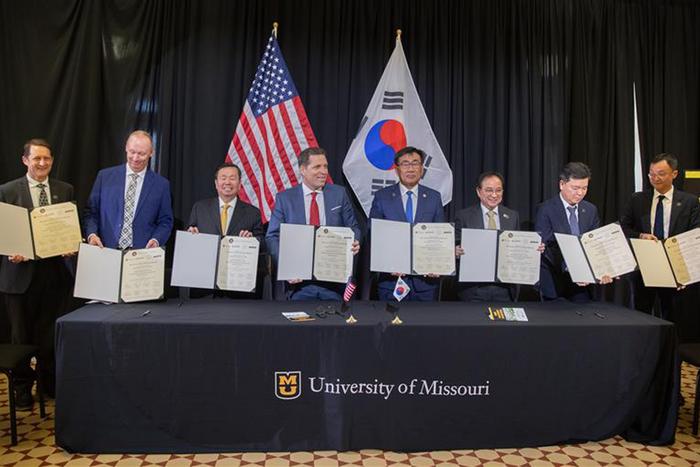

The University of Missouri has embarked on an ambitious and transformative venture to establish NextGen MURR, a cutting-edge research reactor aimed at advancing nuclear science and medical applications. This highly anticipated project officially began with the signing of a foundational agreement that sets into motion the design and licensing of the new reactor. Marking a pivotal milestone in the university’s history, NextGen MURR promises to redefine the landscape of nuclear research and isotope production in the United States, with far-reaching implications for health care, medical technology, and scientific innovation.
In an unprecedented move, the University of Missouri has formed a strategic consortium to spearhead the development of NextGen MURR. This coalition includes Hyundai Engineering America, the Korea Atomic Energy Research Institute (KAERI), Hyundai Engineering Company, and MPR Associates. Each member brings specialized expertise to the table: KAERI contributes deep experience in research reactor development, Hyundai Engineering offers world-class engineering and construction capabilities, and MPR Associates provides essential nuclear regulatory and licensing knowledge. Together, this international partnership exemplifies the collaborative spirit necessary to build a reactor poised to become a national strategic asset.
University of Missouri President Mun Choi heralded the project as an epochal advancement not only for the region but also for the nation’s future in nuclear science and medicine. He emphasized that NextGen MURR is not just infrastructure; it represents a commitment to life-enhancing research and a platform for producing critical medical isotopes. These isotopes are indispensable in modern precision diagnostics and targeted therapies, particularly for cancer patients. The reactor’s capabilities will elevate Missouri’s standing as a hub for scientific discovery, engineering innovation, and patient-centered healthcare advancements.
The increasing global demand for radioisotopes underscores the critical need for reliable, domestic production facilities. Current supply chains face vulnerabilities, and the establishment of NextGen MURR addresses this strategic requirement by securing a steady and scalable source of these vital materials. Radioisotopes produced by the reactor will support an array of applications, including diagnostic imaging, radiotherapy, and emerging nuclear medicine technologies, all of which have seen rapid growth due to advancements in personalized medicine.
Economic impact is a key driver behind the initiative, as the new reactor represents the largest capital investment in the university’s history. This infusion of resources supports local and national economic development by creating high-tech jobs, attracting research funding, and fostering partnerships between academia, industry, and government agencies. Todd Graves, chair of the University of Missouri Board of Curators, noted that NextGen MURR is designed to be an engine of progress, strengthening Missouri’s role in nuclear science research and medical innovation for decades to come.
Technically, the design phase—initiated by the recent $10 million agreement—will involve exhaustive programming studies and precise site evaluations. These are critical to developing a comprehensive “roadmap” that defines project scope, cost, timeline, and technical specifications. During this phase, consortium engineers and scientists will leverage advanced modeling techniques and materials science innovations to optimize reactor performance and safety. This early work will inform the preliminary design and licensing phases, ensuring the reactor adheres to stringent nuclear regulatory standards while fulfilling research and isotope production needs.
Michael Hoehn II, the program director for NextGen MURR, described the reactor as a future-facing facility engineered to integrate multiple functions: isotope production, materials testing, and workforce development. This multifunctional approach will position NextGen MURR as a versatile platform to explore advanced fuel cycles, validate materials under high neutron flux, and train the next generation of nuclear scientists and healthcare professionals. The reactor thus embodies a convergence of scientific inquiry, technical advancement, and educational mission.
Collaboration between the United States and South Korea underpins this project, highlighting international partnership in cutting-edge science. KAERI’s president, Han Gyu Joo, affirmed that this cooperation goes beyond technology transfer; it represents shared dedication to enhancing human health and advancing nuclear science globally. The exchange of knowledge and expertise across borders will facilitate not only the construction and operation of the reactor but also sustained innovation in nuclear medicine technologies.
Unlike typical power reactors, research reactors like NextGen MURR operate under specific parameters tailored for specialized applications. They produce a high neutron flux environment necessary for the creation of medical isotopes such as molybdenum-99 and others vital to diagnostic imaging. NextGen MURR will incorporate advanced cooling and shielding systems to maximize operational efficiency and safety while minimizing environmental impact. Its design is informed by lessons learned from previous reactors, including the original University of Missouri Research Reactor, which has been a reliable source of isotopes for decades.
The scale and complexity of NextGen MURR project require meticulous planning, addressing challenges such as nuclear licensing, project financing, material procurement, and community engagement. The consortium’s phased approach ensures iterative assessment and alignment with emerging regulatory frameworks. Public safety and environmental stewardship are paramount, with continuous monitoring and transparent stakeholder communication woven into the project’s governance structure.
NextGen MURR is poised to revolutionize how the United States approaches isotope production and nuclear research. Beyond medical applications, the reactor will facilitate advanced materials science, improving reactor fuels’ durability and safety, and supporting innovative research in nuclear physics. It will serve as a linchpin for collaborations across disciplines—including pharmacology, cancer research, and clinical medicine—creating a synergistic ecosystem to accelerate discovery and practical applications.
The realization of NextGen MURR represents a visionary investment in the future of nuclear technology—one that strengthens national security by reducing dependency on foreign isotope suppliers, enhances public health through novel therapies, and fuels economic vitality through research and innovation. As this large-scale initiative unfolds over the coming decade, it stands as a testament to the transformative power of science, engineering, and international cooperation forged in pursuit of common goals.
Subject of Research: Development and design of a state-of-the-art research reactor for advanced medical isotope production and nuclear science applications.
Article Title: University of Missouri Launches NextGen MURR: Pioneering America’s Future in Nuclear Medicine and Research
News Publication Date: Not specified
Web References:
https://earimediaprodweb.azurewebsites.net/Api/v1/Multimedia/304756fd-70b5-4c4f-a135-61cbb878bca6/Rendition/low-res/Content/Public
Image Credits: Nic Benner/University of Missouri
Keywords:
Discovery research, Educational institutions, Cancer treatments, Engineering, Nuclear engineering, Nuclear physics, Drug research, Clinical research, Health and medicine, Human health, Drug development, Drug design, Drug discovery, Pharmacology, Cancer medication, Medical treatments, Scientific facilities, Laboratories, Medical research facilities, Health care, Personalized medicine
Tags: cutting-edge reactor designHyundai Engineering collaborationinternational consortium for research reactorKorea Atomic Energy Research Institute involvementmedical isotope productionMizzou NextGen MURR projectnuclear regulatory and licensing expertisenuclear research reactor developmentscientific innovation in health carestrategic partnership in nuclear sciencetransformative nuclear technologyUniversity of Missouri advancements