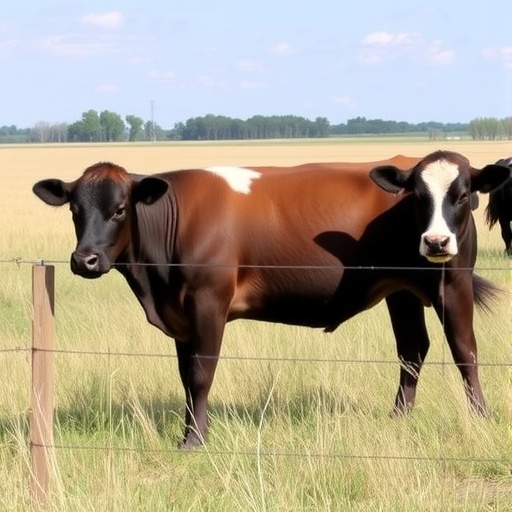
The University of Missouri is spearheading a transformative advancement in livestock management by expanding the deployment of virtual fencing technology, a state-of-the-art solution rapidly gaining traction among cattle producers and agricultural policymakers in the Midwest. This innovative technology leverages GPS-enabled collars to revolutionize traditional grazing practices, offering profound enhancements in labor efficiency, land stewardship, and sustainable agricultural production.
With a substantial $3.7 million grant awarded by the National Fish and Wildlife Foundation (NFWF), Mizzou’s Center for Regenerative Agriculture is set to extend its virtual fencing initiative to hundreds of livestock operators across Missouri and Nebraska. This funding propels a scalable approach to heritage cattle grazing, enabling producers to remotely delineate boundaries and direct herds to optimally managed pastures without the physical confines of wire or wood fencing.
Virtual fencing collars utilize sophisticated GPS technology integrated with behavior-modulation cues to guide cattle movements. Producers define dynamic virtual perimeters via intuitive mobile or desktop applications and activate these electronically enforced boundaries with a single command. This technology eradicates the laborious, physically demanding practice of erecting, dismantling, and relocating traditional fencing, thus conferring significant time and cost savings alongside improved operational flexibility.
Rob Myers, director of the Center for Regenerative Agriculture, highlights the dual advantages of virtual fencing: “By automating interior fence management, we’re returning valuable time to producers and simultaneously advancing sustainable land management. The technology allows cattle to fully utilize cover crop fields sequentially, maximizing forage efficiency and land productivity.” This efficiency gain illustrates how digital innovations are reshaping agricultural best practices by harmonizing environmental stewardship with economic viability.
The initial pilot phase, conducted in collaboration with five Missouri producers, demonstrated promising outcomes. Buoyed by these successes, the program will broaden its impact, deploying collars for 200 producers who collectively oversee approximately 150,000 acres of grazing land. The initiative is a component of the expansive $32.8 million Grassland Resilience and Conservation Initiative championed by NFWF, which is underpinned by investments from McDonald’s USA, the USDA Natural Resources Conservation Service, and key beef and beverage industry stakeholders.
This grant program not only subsidizes adoption of the virtual fencing system but also incentivizes producers to protect ecologically sensitive landscapes such as streams and riparian buffers. Moreover, the Center’s efforts extend beyond fencing technology to encompass improvements in watering infrastructure and the cultivation of native forage species, thus enhancing holistic pasture management and soil health.
Native plant integration is critical to extending grazing seasons and bolstering ecosystem services. Myers explains, “Most Missouri pastures rely heavily on tall fescue, a non-native grass. By incorporating native plants into grazing regimens, we promote biodiversity, improve soil structure, and provide wildlife habitat, all while delivering year-round forage options for livestock.”
The broader mission of the Center for Regenerative Agriculture encompasses crafting integrative farming models that foster resilience and sustainability throughout food systems. Myers draws on his personal farming heritage in Illinois, where witnessing the dramatic benefits of cover crops on soil erosion cemented his commitment to regenerative agriculture — a philosophy that prioritizes soil vitality and ecosystem balance for future generations.
The virtual fencing project embodies the extension of university research into applied societal benefits, reflecting the hallmark role of a flagship institution like the University of Missouri. Myers emphasizes outreach and education as crucial components, stating, “Our work transcends laboratory insights; it’s about transforming agricultural communities by delivering practical, scalable solutions. We envision virtual fencing playing a vital part in maintaining soil productivity and creating resilient farming landscapes in the Midwest and beyond.”
Technically, virtual fencing systems employ collars equipped with GPS modules, auditory signals, and mild electrical stimuli to train and control cattle movement. When livestock approach a defined virtual boundary, they receive a conditioned response cue, which, after initial training, encourages voluntary compliance, thereby reinforcing fence integrity without physical barriers. This technology leverages advancements in location accuracy, behavioral science, and wireless communication to facilitate seamless grazing management.
In addition to labor and environmental benefits, virtual fencing opens new frontiers for data collection and precision agriculture. Real-time tracking of herd distribution, movement patterns, and grazing intensity can inform adaptive management strategies optimizing pasture health and resource allocation. This data-centric approach enriches producers’ decision-making and fosters more sustainable, profitable ranching enterprises.
The widespread adoption of virtual fencing aligns with emerging agricultural paradigms that blend conservation priorities with technological innovation, addressing pressing challenges such as soil degradation, water quality impairment, and biodiversity loss. By providing producers with advanced tools to harmonize livestock production and ecosystem resilience, Missouri’s initiative exemplifies how cutting-edge research can drive transformative change in food and environmental systems.
As the program scales, ongoing research at the University of Missouri will evaluate the long-term ecological and economic impacts of virtual fencing adoption. Metrics such as soil organic matter enrichment, nutrient cycling, forage utilization efficiency, and cattle health will be scrutinized to refine methodologies and validate regenerative outcomes. These empirical insights will help frame policies and incentive structures to broaden access and impact.
Ultimately, the University of Missouri’s leadership in virtual fencing heralds a paradigm shift in livestock management — where digital innovation catalyzes a new era of sustainable agriculture, supports rural livelihoods, and reinforces the ecological integrity of grazing landscapes. This intersection of technology, ecology, and economics underscores the vital role of interdisciplinary approaches in solving complex agricultural challenges of the 21st century.
Subject of Research: Virtual fencing and regenerative agriculture technology for sustainable livestock management
Article Title: University of Missouri Advances Virtual Fencing to Revolutionize Livestock Grazing and Land Stewardship
News Publication Date: Not explicitly stated
Web References:
https://showme.missouri.edu/2026/no-fences-needed-gps-collars-show-virtual-fencing-is-next-frontier-of-livestock-grazing/
Image Credits: University of Missouri
Keywords: virtual fencing, regenerative agriculture, livestock grazing, GPS collars, sustainable farming, pasture management, soil health, conservation technology, precision agriculture, Missouri agriculture, herd management, environmental stewardship
Tags: agricultural technology adoptioncattle grazing innovationGPS-enabled livestock managementlivestock boundary managementMissouri cattle farming technologyNational Fish and Wildlife Foundation grantsNebraska livestock technologyregenerative agriculture in Midwestremote cattle herding systemsscalable virtual fencing solutionssustainable grazing practicesvirtual fencing technology for cattle