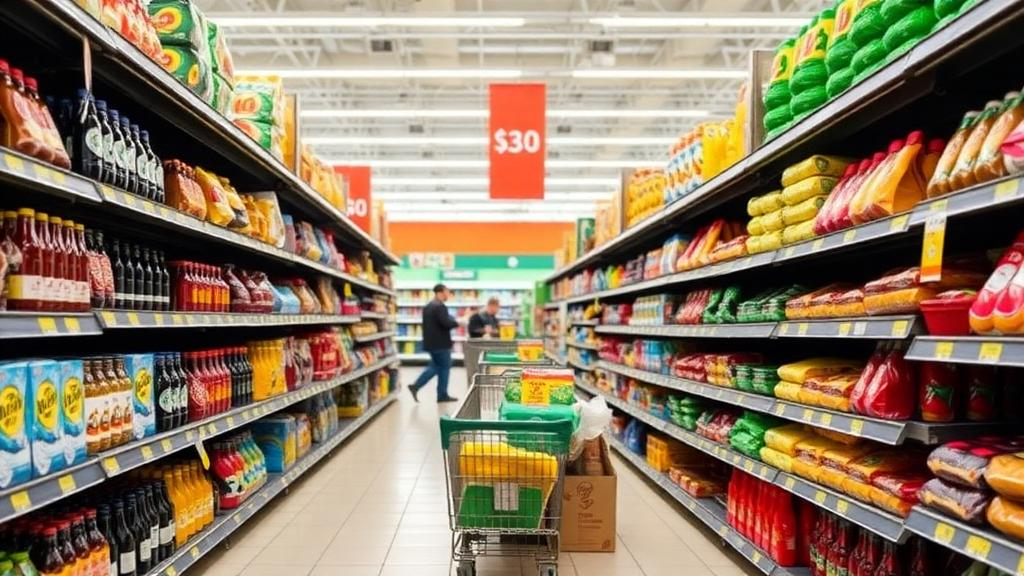
As grocery prices climb and traditional supermarkets retreat from many rural and low-income neighborhoods, dollar stores have quietly become one of the most consequential forces in the American food system. What began as a retail format focused on discount household goods now supplies a substantial share of the food that millions of families put on their tables each week. That transformation has prompted a new three-year, interdisciplinary research effort led by Wenhui Feng, an assistant professor of public health at the University of Rhode Island College of Health Sciences, to examine exactly how these stores shape household food purchases and what that means for public health.
The study is funded by a $1 million grant from the U.S. Department of Agriculture’s National Institute of Food and Agriculture, and it brings together collaborators with expertise spanning nutrition, agricultural economics, and community health. Feng’s team includes Sean Cash, an associate professor at Tufts University; Abby Gold, a health and nutrition specialist at the University of Minnesota; Denise Holston, an associate professor and nutrition specialist at Louisiana State University; and Qingxiao Li, an assistant professor of agricultural economics and agribusiness at LSU. The geographic focus on Minnesota and Louisiana is deliberate, pairing a largely rural Upper Midwest context with a Southern state where food access challenges and diet-related disease burdens are well documented.
The scale of dollar store expansion is striking. According to the data service company Statista, there were more than 39,000 dollar stores in the United States in 2025, an increase of 4,700 stores since 2021. Dollar General alone accounted for the highest number of locations in 2025, with 20,959 stores, more than Dollar Tree and Family Dollar combined. Perhaps most telling for food researchers: groceries made up more than 80 percent of Dollar General’s sales in 2025. While many retail sectors contracted or stagnated during the economic disruptions of 2020 and 2021, dollar stores grew aggressively, often opening in communities that larger grocery chains had abandoned.
That growth has made dollar stores the fastest-growing food-retail channel in rural America. A 2023 study led by Feng and published in the American Journal of Public Health examined dollar stores and food access for rural households across the United States. It found that from 2008 to 2020, dollar stores increased their share of rural household food purchases by 102.9 percent. In communities where the nearest supermarket may be a long drive away, the local dollar store can function as a de facto grocery store, and in some places it may be the only storefront selling food at all. That dual identity, as both a lifeline and a potential nutritional liability, sits at the center of the new research.
The public health concern is straightforward. Dollar stores tend to stock shelf-stable, heavily processed items: sugar-sweetened beverages, salty snacks, canned goods, and breakfast cereals, alongside limited protein options and little or no fresh produce. When such stores become a household’s primary food source, the resulting diet can skew toward calories dense in added sugars and sodium but low in nutrients. Feng’s earlier work, published this past fall in the Journal of the Academy of Nutrition and Dietetics, analyzed the healthfulness of foods purchased at dollar stores and documented these patterns in detail. The new study builds on that foundation by shifting from description to intervention, exploring concrete opportunities for nutritional improvement.
Feng frames the issue with nuance rather than alarm. Some shoppers, she notes, find dollar stores a convenient and affordable place to get food, especially those living far from traditional grocery stores. Others worry the stores may cause harm because they do not offer the healthiest options. The research team wants to understand how consumers actually incorporate this emerging retail format into their household food purchasing strategies, rather than assuming a single story of either benefit or harm. That consumer-centered perspective shapes the study’s methodology, which combines qualitative and computational approaches.
Technically, the project proceeds in three integrated phases. First, researchers will conduct interviews and focus groups with dollar store shoppers and community stakeholders in Minnesota and Louisiana, probing their perceptions and motivations as they work to fulfill their households’ dietary requirements. Second, the team will apply machine learning cluster analysis to food purchase data, a technique that groups households with statistically similar buying patterns and allows researchers to characterize distinct types of food purchase behavior. Each cluster can then be evaluated for healthfulness, and the strategies that consumers within healthier clusters use to maintain a nutritious diet with dollar store food can be identified and studied. Third, the team will translate those findings into educational resources designed to help low-income Americans achieve food and nutrition security and sustain better health over time.
The intervention phase will put those tools to the test. The researchers plan a pilot initiative using the educational resource toolkit with shoppers and other stakeholders in two communities in Minnesota and two in Louisiana. The toolkit is intended to improve understanding of nutrition, food affordability, and healthy shopping strategies, and the pilot may include workshops, community outreach programs, and cooking demonstrations, all carried out in collaboration with local organizations. This community-driven design reflects a deliberate choice: rather than prescribing solutions from outside, the team aims to build approaches that fit the real constraints and habits of dollar store shoppers, including tight budgets, limited transportation, and the practical realities of what is on the shelves.
The communities most affected by dollar store proliferation are also those with the least food retail choice. Feng notes that dollar store shopper demographics skew toward rural households, People of Color, and lower-income households, and that the data collected should help provide a well-rounded understanding of the dollar store phenomenon. Dollar stores have added a new dimension to food systems in all communities, but rural areas and lower-income communities with racial and ethnic minority households are especially impacted, both as customers and as sites of rapid store expansion. Understanding how these households navigate the trade-off between convenience, cost, and nutritional quality is essential for any policy or program that hopes to reduce diet-related health disparities.
The stakes extend beyond individual shopping carts. If dollar stores are now a structural pillar of food access for vulnerable populations, then improving what those stores sell, and how shoppers use them, could move the needle on nutrition insecurity at population scale. Feng’s goal, as she describes it, is to create a holistic and community-driven approach that helps dollar store shoppers fulfill their households’ need for healthy foods, make healthier choices, and ultimately contribute to reducing or eliminating nutrition insecurity. With insights gained through data collection and direct conversations with consumers, the team will develop tools to help shoppers stretch their food budget while using dollar stores as food retailers. If there is knowledge to be gained that promotes healthy eating with limited resources, Feng says, the team wants to share it. The three-year study promises to turn one of American retail’s most rapid expansions into one of its most closely examined public health experiments.
Subject of Research: The impact of dollar store food retail on household food purchases and nutrition security in rural and low-income American communities
Article Title: Assessing the fastest-growing food retailers—dollar stores
Article References: Assessing the fastest-growing food retailers—dollar stores. (n.d.). Original publication
Image Credits: AI Generated
DOI: Not provided
Keywords: dollar stores, food retail, nutrition security, food access, rural communities, public health, USDA, Dollar General, diet quality, low-income households, machine learning, grocery shopping
News Source: Daisy Hatcher. (October 7, 2026). Dollar Stores Become America’s Fastest-Growing Food Retailers, Prompting Major Study. Scienmag.