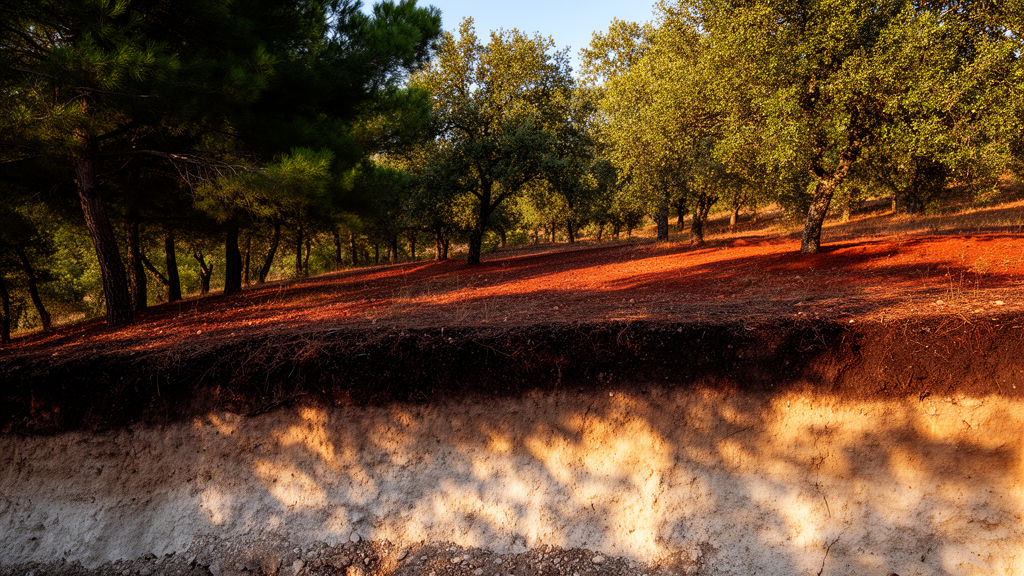
Soil holds more carbon than all the world’s vegetation and the atmosphere combined, yet scientists still struggle to predict how much of that carbon different forests can actually lock away. A new study of mature Mediterranean forests in Israel adds a striking twist to this puzzle: mixing tree species boosts soil carbon storage, but the extra carbon ends up mostly in forms that cycle quickly, while the long-lasting fraction is capped by something far less negotiable, the soil’s own texture. The findings, published in the journal Biogeosciences by a team from the Weizmann Institute of Science and collaborating institutions, carry direct implications for how forests are planted and managed in a warming, drying climate.
The research focused on Yishi Forest in the Judean foothills, a hot Mediterranean site receiving about 510 millimeters of rain per year, where a thin soil layer of just 5 to 20 centimeters sits atop limestone bedrock. The team, led by Stav Livne-Luzon and Assaf Yaakobi under the supervision of Tamir Klein, compared plots dominated by three functionally distinct native species: the canopy conifer Pinus halepensis, the sub-canopy broadleaf Quercus calliprinos, and the understory woody shrub Pistacia lentiscus. Some plots contained only one dominant species, while others were mixed stands containing all three. Beneath every selected tree, and in the open gaps between canopies, the researchers collected soil from the top 10 centimeters, gathering 104 samples in total across the forest.
The central analytical move was to split soil organic carbon into two fractions with very different personalities. Mineral-associated organic carbon, or MAOC, consists of small organic molecules such as microbial necromass and root exudates that bind to clay and silt particles, shielding them from decomposition for periods that can stretch to millennia. Particulate organic carbon, or POC, is made of larger, tougher plant compounds like lignin and cellulose that resist chemical binding but remain exposed to microbial attack, turning over within decades. Globally, MAOC makes up roughly 65 percent of soil organic carbon, so understanding what controls each fraction is essential for any serious carbon accounting.
The results were unambiguous at the microsite scale. Soils under tree canopies held up to twice as much organic carbon as soils in nearby forest gaps, and Quercus plots stored 10 to 30 percent more carbon than either Pinus or Pistacia plots. Across the site, carbon concentrations ranged from 18.3 to 187.1 grams of carbon per kilogram of soil, with the highest values under oaks and the lowest in a gap within a mixed plot. When the researchers converted concentrations into stocks, accounting for the site’s shallow soils and abundant stones, mixed Quercus plots approached nearly 3 kilograms of carbon per square meter, compared with about 1 kilogram in monospecific gaps and Pistacia plots.
But the real story emerged when the fractions were separated. Trends in total soil carbon tracked the labile POC fraction almost entirely, and POC tended to be higher in mixed stands than in single-species ones. MAOC, by contrast, showed no significant differences among forest types or microsites, because it had effectively run out of room. The mineral-associated fraction displayed a classic saturation pattern, plateauing at around 45 grams of carbon per kilogram of soil, a figure closely matching saturation values of roughly 40 grams reported for European soils. At low-carbon sites, MAOC comprised nearly 80 percent of the soil carbon pool, but at the richest sites its share collapsed as POC came to account for more than 90 percent of the total.
What sets that ceiling? The answer, in this system, is mineralogy. MAOC increased linearly with clay and silt content across the plots, and a 95th-percentile regression yielded a site-specific carbon capacity of 50.3 grams of carbon per kilogram of clay plus silt. That value sits close to the 48 grams estimated for low-activity mineral soils globally, which fits the site’s carbonate-rich geology, since carbonate minerals are generally less reactive than the iron and aluminum oxides found in more volcanic soils. Notably, when the team applied the same calculation to a large dataset of dryland forests worldwide, the capacity came out substantially higher at 70.2 grams, suggesting that at Yishi Forest it is the minerals themselves, not the arid climate, that limit long-term carbon storage.
The microbial dimension of the study produced equally thought-provoking results. Using a high-resolution sequencing approach that targeted six variable regions of the 16S rRNA gene and enriched the reference database with full-length sequences from PacBio long-read sequencing, the team profiled bacterial communities across seasons and microsites. The sequencing revealed 1,531 amplicon sequence variants spanning 20 phyla, along with 413 novel full-length sequences representing bacteria absent from existing databases. Bacterial communities beneath tree canopies turned out to be subsets of the richer communities found in open gaps, implying that the altered soil conditions under trees act as an environmental filter, winnowing the microbial pool down to favored specialists.
Each tree species appeared to recruit its own microbial entourage. Soils under pines hosted proportionally more Proteobacteria, while oak soils were enriched in Firmicutes. Under pine canopies, genera such as Pseudolabrys, Bradyrhizobium, and Tardiphaga increased in abundance, while oak canopies favored Bradyrhizobium, Nocardioides, and a nitrosomonad genus, taxa associated with nitrogen fixation, nitrification, and the degradation of aromatic compounds. Intriguingly, however, neither bacterial richness nor diversity correlated consistently with any carbon pool, and microbial richness dropped out of the final structural equation model entirely. In this ecosystem, at least, the sheer number of microbial species matters less for carbon storage than the physical and chemical stage on which they perform.
That structural equation model, which explained 43 percent of the variation in MAOC and 66 percent in POC, painted a coherent picture of competing controls. Clay and silt content exerted the strongest direct effect on MAOC, while soil properties and microsite dominated POC, with a direct microsite effect hinting that belowground inputs such as root exudation and root turnover differ among species in ways aboveground litter alone cannot explain. Litter density showed a negative direct path to POC that was offset by a positive indirect route through soil properties, leaving no net effect. Taken together, the model confirms that labile and mineral-associated carbon pools answer to different masters.
The practical bottom line is quantified and sobering in equal measure. Mixed forests in this system were estimated to store approximately 6.1 megagrams of carbon per hectare more than monospecific pine stands, with the difference residing almost entirely in the fast-cycling POC pool, particularly where MAOC was already near saturation. As afforestation and forest management are promoted as leading natural climate solutions, the study suggests that planting diverse stands can meaningfully raise soil carbon stocks in dry regions, but that the durable, century-to-millennium fraction of that carbon is ultimately bounded by soil texture. In shallow, carbonate-rich Mediterranean soils approaching their mineralogical limits, the most reliable carbon gains from forest diversity may be real but transient, a finding that planners banking on soils as permanent carbon vaults would do well to heed.
Subject of Research: Tree species composition, microbial communities, and soil texture controls on particulate and mineral-associated soil organic carbon in Mediterranean forest soils
Article Title: Tree-microbe-soil interactions affecting soil organic carbon fractions in Mediterranean forest soils
Article References: Livne-Luzon, S., Yaakobi, A., Yalin, D., Sade, D., Dener, E., Oppenheimer-Shaanan, Y., & Klein, T. (2026). Tree-microbe-soil interactions affecting soil organic carbon fractions in Mediterranean forest soils. Biogeosciences, 23(18), 6763-6779. https://doi.org/10.5194/bg-23-6763-2026
Image Credits: AI Generated
Keywords: soil organic carbon, Mediterranean forests, mineral-associated organic carbon, particulate organic carbon, tree diversity, mixed forests, soil microbiome, carbon sequestration, soil texture, carbon saturation, Pinus halepensis, Quercus calliprinos
News Source: Drew Townsend. (October 9, 2026). Mixed Mediterranean Forests Store More Soil Carbon, But Only in the Fast Lane. Scienmag.