


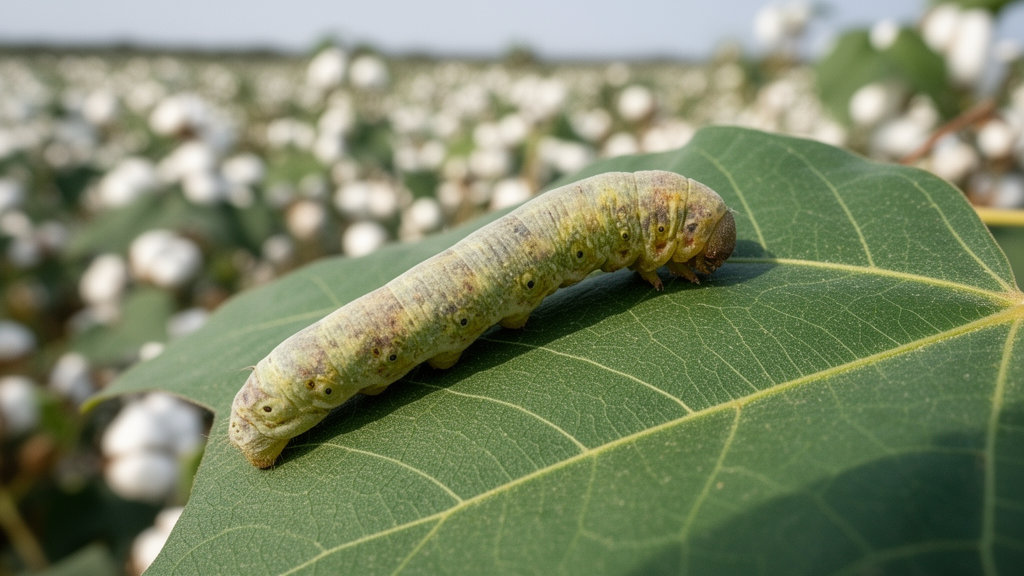
A laboratory study from Egypt has tested whether two insect-specific viruses work better together than alone against one of the world’s most destructive crop pests, and the answer is a qualified yes. Combining a nucleopolyhedrovirus isolate with a granulovirus isolate raised mortality of first-instar cotton leafworm larvae above the levels seen with either virus on its own. Yet careful statistical comparison showed that the combined effect simply matched the sum of the two individual effects. The interaction was additive rather than synergistic, a distinction the authors argue matters for anyone hoping to squeeze extra killing power out of mixed viral formulations.
The target organism, Spodoptera littoralis, the Egyptian cotton leafworm, is a highly polyphagous moth whose larvae feed on plants across more than 40 families, including cotton, maize, vegetables and legumes. It is a major economic pest across Africa, the Middle East and Southern Europe, causing substantial crop losses and driving up control costs. Chemical insecticides, chiefly synthetic pyrethroids, organophosphates and carbamates, remain the dominant management tool, but heavy use has produced resistance across generations of the pest and raises environmental concerns, including toxicity to non-target species and contamination of soil and water. Baculoviruses, by contrast, are highly host-specific insect viruses regarded as promising biological control agents because of their safety profile and compatibility with integrated pest management.
The two isolates under study were SpliNPV-AN1956, a nucleopolyhedrovirus originally isolated by Abul Nasr in 1956, and SpliGV-EG24, a field-collected granulovirus of type I previously characterized by the same research group. Both were originally obtained from S. littoralis cadavers. The two viruses differ structurally: the alphabaculovirus SpliNPV produces large polyhedral occlusion bodies that can contain multiple virions, while the betabaculovirus SpliGV forms smaller granular occlusion bodies that each typically enclose a single virion. Before any bioassays, the team propagated both viruses in fourth-instar larvae, purified the occlusion bodies through sucrose gradients, and confirmed their identity and purity by transmission electron microscopy, finding no signs of cross-contamination.
The virulence comparison rested on dose-response bioassays with first-instar larvae, the stage most susceptible to viral infection because of its thinner peritrophic membrane and less developed immune defenses. Virus suspensions ranging from 10³ to 5 × 10⁵ occlusion bodies per milliliter were mixed into semi-synthetic diet, with fifty neonate larvae per concentration and each experiment run in triplicate. Mortality was recorded over seven days, corrected for background deaths using Abbott’s formula, and analyzed by probit regression to estimate median lethal concentrations with 95 percent confidence intervals. Untreated control mortality stayed low, at 10.5 percent in the granulovirus experiment and 6.8 percent in the nucleopolyhedrovirus experiment, supporting the reliability of the readings.
The results showed a clear concentration-dependent rise in mortality for both viruses. SpliNPV proved the more potent of the two, with an LC50 of 7.47 × 10⁴ occlusion bodies per milliliter against 2.03 × 10⁵ for SpliGV, making the nucleopolyhedrovirus approximately 2.7-fold more virulent under these conditions. The probit slopes were 0.82 ± 0.09 for SpliGV and 0.95 ± 0.11 for SpliNPV, a steeper response curve for the nucleopolyhedrovirus that the authors interpret as greater homogeneity in larval susceptibility. Both probit models fit the data well, with non-significant chi-square values indicating acceptable goodness of fit.
For the mixed-infection phase, the granulovirus was applied at a single concentration equal to its LC50, while the nucleopolyhedrovirus was used at two doses: a low concentration representing its LC10 and a high concentration representing its LC50. The combination of granulovirus with the high nucleopolyhedrovirus dose produced the highest mean larval mortality of any treatment, 84.0 percent ± 2.31, significantly exceeding every individual-virus treatment in a one-way analysis of variance followed by Tukey’s post hoc test. It was followed by the high nucleopolyhedrovirus dose alone at 70.1 percent, the granulovirus plus low-dose combination at 51.4 percent, granulovirus alone at 46.6 percent, and finally the low-dose nucleopolyhedrovirus alone at 20.8 percent.
To determine whether this improvement reflected true synergy, the researchers compared observed mortality in each combined treatment with the mortality expected under an independent-action model of pure additivity. For the granulovirus plus high-dose combination, observed corrected mortality of 84.0 percent sat close to the expected additive value of 80.7 percent, a non-significant difference (χ² = 0.297, P = 0.586). The granulovirus plus low-dose combination showed 51.37 percent observed against 49.1 percent expected (χ² = 0.385, P = 0.535). Since neither combination significantly exceeded its expected value, both were classified as additive interactions rather than synergistic ones.
The authors place these findings in a wider context of baculovirus co-infection research stretching back to Tanada’s mid-twentieth-century experiments, in which granuloviruses have sometimes dramatically enhanced nucleopolyhedrovirus infectivity. One known mechanism involves enhancin proteins, metalloproteases carried on some granulovirus occlusion bodies that degrade the mucins of the insect’s peritrophic membrane and ease the passage of virions into the midgut. Whether SpliGV-EG24 carries such enhancin-like genes remains unknown, because the isolate’s complete genome sequence has not yet been published. The authors also caution that direct equivalence between nucleopolyhedrovirus and granulovirus occlusion body counts cannot be assumed, given the structural difference in virions per occlusion body, so their cross-virus comparison rested on occlusion body numbers rather than standardized infective units.
Several limitations frame the conclusions. All experiments were conducted under controlled laboratory conditions with a long-established laboratory colony of S. littoralis maintained for more than 20 generations without insecticide exposure, which may not reflect the ecological complexity, UV exposure, temperature fluctuations and plant chemistry that field populations encounter. Viral replication dynamics and occlusion body production in co-infected larvae were not quantified, and the speed of kill, measured as time to death, was not assessed; the authors flag both as priorities for future work, since a granulovirus-driven slower but sustained mortality pattern could complement the faster action of the nucleopolyhedrovirus.
From a pest management standpoint, the study suggests that mixed baculovirus formulations could raise mortality against S. littoralis without requiring synergistic chemistry, potentially reducing the viral dosage needed and helping to postpone resistance emergence, while the simultaneous release of both polyhedral and granular occlusion bodies from co-infected cadavers might aid environmental persistence. The authors stop short of field recommendations, noting that the additive outcome may differ under field conditions and that interaction outcomes among baculoviruses are highly context-dependent, varying with viral genotype, host species, inoculum ratio, larval physiology and environment. Even so, they argue the findings support the strategic inclusion of mixed SpliNPV and SpliGV formulations in integrated pest management programs targeting the cotton leafworm, as a safe and sustainable complement to chemical insecticides.
Subject of Research: Laboratory testing of combined nucleopolyhedrovirus and granulovirus isolates against the Egyptian cotton leafworm
Article Title: Assessing the efficacy of combined nucleopolyhedrovirus and granulovirus isolates against Spodoptera littoralis (Boisd.) (lepidoptera: Noctuidae): a laboratory-based investigation
Article References: Elmenofy, W., & Raslan, M. (2026). Assessing the efficacy of combined nucleopolyhedrovirus and granulovirus isolates against Spodoptera littoralis (Boisd.) (lepidoptera: Noctuidae): a laboratory-based investigation. Egyptian Journal of Biological Pest Control, 36(1), Article 24. https://doi.org/10.1186/s41938-026-00904-4
Image Credits: AI Generated
DOI: 10.1186/s41938-026-00904-4
Keywords: Spodoptera littoralis, baculovirus, nucleopolyhedrovirus, granulovirus, biological control, LC50, synergy, additive interaction, integrated pest management, cotton leafworm, biopesticide, larval bioassay
News Source: Alan Morgan. (October 29, 2026). Mixed Baculovirus Infections Boost Cotton Leafworm Mortality, but Only Additively. Scienmag.



