• HOME
  • NEWS
  • EXPLORE
    • CAREER
      • Companies
      • Jobs
    • EVENTS
    • iGEM
      • News
      • Team
    • PHOTOS
    • VIDEO
    • WIKI
  • BLOG
  • COMMUNITY
    • FACEBOOK
    • INSTAGRAM
    • TWITTER
Monday, May 18, 2026
BIOENGINEER.ORG
No Result
View All Result
  • Login
  • HOME
  • NEWS
  • EXPLORE
    • CAREER
      • Companies
      • Jobs
        • Lecturer
        • PhD Studentship
        • Postdoc
        • Research Assistant
    • EVENTS
    • iGEM
      • News
      • Team
    • PHOTOS
    • VIDEO
    • WIKI
  • BLOG
  • COMMUNITY
    • FACEBOOK
    • INSTAGRAM
    • TWITTER
  • HOME
  • NEWS
  • EXPLORE
    • CAREER
      • Companies
      • Jobs
        • Lecturer
        • PhD Studentship
        • Postdoc
        • Research Assistant
    • EVENTS
    • iGEM
      • News
      • Team
    • PHOTOS
    • VIDEO
    • WIKI
  • BLOG
  • COMMUNITY
    • FACEBOOK
    • INSTAGRAM
    • TWITTER
No Result
View All Result
Bioengineer.org
No Result
View All Result
Home NEWS Science News Biology

Mitigation of greenhouse gases in dairy cattle through genetic selection

Bioengineer by Bioengineer
July 22, 2020
in Biology
Reading Time: 2 mins read
0
IMAGE
Share on FacebookShare on TwitterShare on LinkedinShare on RedditShare on Telegram

Study targets reducing methane production by 20 percent in 10 years according to research in the Journal of Dairy Science®
IMAGE

Credit: Journal of Dairy Science

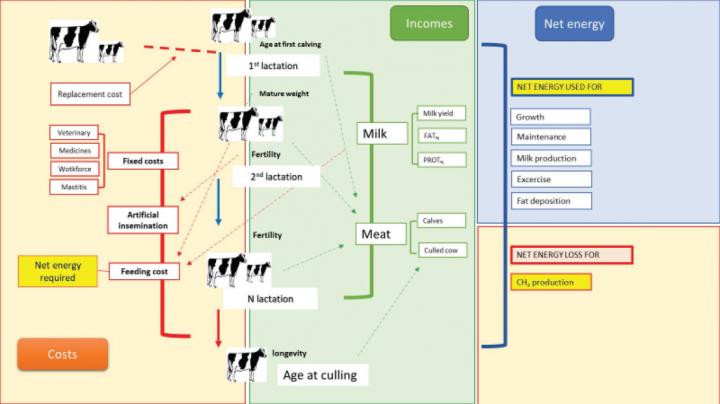
Philadelphia, July 22, 2020 – Researchers in Spain propose mitigating methane production by dairy cattle through breeding. In an article appearing in the Journal of Dairy Science, scientists are targeting reduction of enteric methane in the breeding objectives for dairy cattle to select for animals that use feed more efficiently and thus produce less methane. Because livestock farming contributes 13 percent of global greenhouse gas (GHG) emissions, selective breeding can reduce those emissions while increasing milk output.

Methane from enteric fermentation is considered the main contributor to GHG coming from ruminants. These emissions contribute to global warming and represent a loss of dietary energy in ruminants. “Current selection pressure is increasing total methane production in the population of dairy cows but is reducing methane intensity (per kilogram of milk) due to higher productive levels of each cow. A reduction of methane in the breeding goals should also be included in the selection indices,” said lead author Oscar González-Recio, PhD, Department of Animal Breeding, Instituto Nacional de Investigación y Tecnología Agraria y Alimentaria (INIA), Madrid, Spain.

Evaluation of the genetic traits and economic response of the traits in the selection index were considered in this study that used genetic parameters estimated with 4,540 records from 1,501 cows. The project was funded by the Spanish National Plan of Research, Development, and Innovation 2013-2020. While methane production is necessary to maintain rumen homeostasis, total methane emissions are expected to decrease four to six percent in 10 years due to increased milk production per cow. If annual methane production per cow is included in breeding goals and ad hoc weights are placed on methane production, GHG emission from cattle could be reduced by 20 percent in 10 years.

Dr. González-Recio added that “increasing per-cow productivity may reduce the number of cows needed per billion kilograms of milk produced, contributing to mitigation of GHG emissions, but this is not enough. If no action is taken, the genetic potential for methane production is expected to increase.”

While the biological limit of methane production remains unknown, this study shows the potential for including environmental traits in selection indices while retaining populations of cows that are profitable for producers.

###

Media Contact
Eileen Leahy
[email protected]

Related Journal Article

http://dx.doi.org/10.3168/jds.2019-17598

Tags: Agricultural Production/EconomicsAgricultureClimate ChangeClimate ScienceEcology/EnvironmentGenetics
Share13Tweet8Share2ShareShareShare2

Related Posts

Butyrate Alleviates Temporomandibular Joint Pain via Epigenetic Mechanisms — Biology

Butyrate Alleviates Temporomandibular Joint Pain via Epigenetic Mechanisms

May 18, 2026
How Hibernation Impacts Visual Processing in Squirrels’ Brains — Biology

How Hibernation Impacts Visual Processing in Squirrels’ Brains

May 18, 2026

PKU Researchers Pioneer First-in-Class Drug Candidate Targeting Cholestatic Itch

May 18, 2026

Economic Impact Report Highlights the Value of Open Biodata Infrastructure

May 18, 2026
Please login to join discussion

POPULAR NEWS

  • Research Indicates Potential Connection Between Prenatal Medication Exposure and Elevated Autism Risk

    845 shares
    Share 338 Tweet 211
  • New Study Reveals Plants Can Detect the Sound of Rain

    731 shares
    Share 292 Tweet 182
  • Salmonella Haem Blocks Macrophages, Boosts Infection

    62 shares
    Share 25 Tweet 16
  • Breastmilk Balances E. coli and Beneficial Bacteria in Infant Gut Microbiomes

    58 shares
    Share 23 Tweet 15

About

We bring you the latest biotechnology news from best research centers and universities around the world. Check our website.

Follow us

Recent News

Butyrate Alleviates Temporomandibular Joint Pain via Epigenetic Mechanisms

Cellulose Aerogel Inspired by White Beetles Enables Passive Daytime Cooling

How Hibernation Impacts Visual Processing in Squirrels’ Brains

Subscribe to Blog via Email

Enter your email address to subscribe to this blog and receive notifications of new posts by email.

Join 82 other subscribers
  • Contact Us

Bioengineer.org © Copyright 2023 All Rights Reserved.

Welcome Back!

Login to your account below

Forgotten Password?

Retrieve your password

Please enter your username or email address to reset your password.

Log In
No Result
View All Result
  • Homepages
    • Home Page 1
    • Home Page 2
  • News
  • National
  • Business
  • Health
  • Lifestyle
  • Science

Bioengineer.org © Copyright 2023 All Rights Reserved.