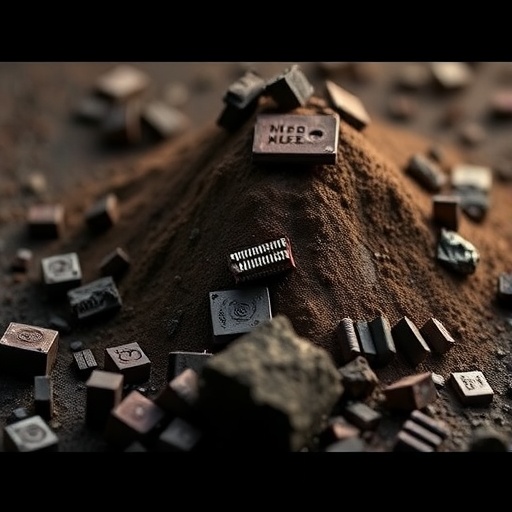
MINNEAPOLIS / ST. PAUL — A low-purity iron ore mined from Minnesota’s Iron Range could become an unexpected source of advanced electronic materials, according to researchers at the University of Minnesota Twin Cities. In a study published in Physical Review Applied, the team demonstrated for the first time that iron ore commonly regarded as unsuitable for high-performance semiconductor production can be converted into semiconductor-quality iron sulfide, or pyrite. Better known as “fool’s gold,” pyrite is attracting growing interest because it combines strong light absorption with low cost, abundant constituent elements and comparatively low toxicity. The finding suggests that a material historically valued primarily as an industrial feedstock could eventually contribute to new generations of solar technologies, batteries, electronic components and water-purification systems.
The result is particularly striking because semiconductor manufacturing generally depends on extremely pure starting materials. Even small concentrations of unwanted elements, structural defects or irregularities in crystal growth can alter how a semiconductor transports electrical charge or responds to light. These concerns have traditionally made low-grade mineral resources appear incompatible with sophisticated electronic applications. Minnesota, however, possesses one of the largest iron resources in the United States, producing approximately 75 percent of the nation’s iron ore and generating more than $4 billion in annual revenue. The state’s Mesabi Iron Range has supported iron production for decades, while processing innovations such as taconite beneficiation transformed previously uneconomical rock into a major industrial resource.
The University of Minnesota researchers began with a question that challenged a common assumption in pyrite research: whether the material used in electronic experiments truly needed to be highly purified before it could exhibit useful semiconductor behavior. “We realized that pyrite’s really not like a typical semiconductor—it is surprisingly immune to impurities,” said Chris Leighton, a Distinguished McKnight University Professor in the Department of Chemical Engineering and Materials Science and senior author of the study. That unusual tolerance encouraged the team to test whether iron ore taken directly from Minnesota’s Iron Range could be converted into pyrite without the extensive purification steps normally associated with semiconductor materials. The experiments produced a result that initially surprised the researchers: the impurities present in the ore did not prevent the formation of high-quality semiconducting iron sulfide.
The team tested three different grades of iron ore and found that Direct Reduced Grade Taconite produced the most promising results. This grade is among the commonly available iron-ore materials in Minnesota and is typically processed for iron production rather than for electronic applications. In the researchers’ approach, the ore was converted into pyrite through relatively simple processing. The work showed that the low-purity starting material could yield crystals with semiconductor-relevant properties without an additional purification stage. While the study does not claim that the ore can immediately be used to manufacture commercial devices, it demonstrates that the mineral resource itself does not impose the fundamental barrier that scientists had expected.
Pyrite is chemically composed of iron and sulfur, written as FeS₂, two elements that are widely available compared with many materials used in advanced electronics. Its ability to absorb light intensely is one of its most attractive features. A thin layer of a strongly absorbing semiconductor can, in principle, interact with incoming sunlight or other forms of electromagnetic radiation without requiring a large quantity of material. Pyrite also has an electronic band structure that allows it to participate in charge-generation and charge-transport processes, although controlling defects, interfaces and electrical contacts remains essential for practical devices. The material’s abundance and low production cost could make it appealing for applications where expensive or scarce semiconductor compounds limit large-scale deployment.
The researchers’ discovery also offers a new perspective on the role of impurities in functional materials. In many semiconductors, impurities introduce energy states inside the electronic band gap, acting as traps that capture charge carriers or encourage unwanted recombination. These effects can reduce conductivity, shorten carrier lifetimes and lower the efficiency of devices such as solar cells. Pyrite appears to behave differently under the conditions examined by the Minnesota team. The researchers found that the chemical and structural characteristics of pyrite allow it to remain semiconducting even when it is produced from an ore containing components that would normally be regarded as problematic. Understanding why this occurs could help scientists deliberately control pyrite’s composition rather than treating every impurity as an obstacle.
The implications extend beyond the laboratory because the starting material is linked to an established regional mining and processing industry. If future studies confirm that additional grades of Iron Range ore can be converted into useful pyrite, the approach could create new value from resources already extracted at large scale. It could also reduce the energy, chemicals and cost associated with purifying iron before using it in an electronic material. Such an outcome would not automatically make pyrite-based technologies sustainable; mining, sulfur processing, waste management and device manufacturing would still require careful environmental assessment. Nevertheless, using abundant local feedstocks and avoiding extra purification could improve the economic and environmental profile of future material-production pathways.
Potential uses remain at an early research stage, but the researchers identify several areas where semiconductor-quality pyrite could be investigated. In solar panels, its strong optical absorption could be useful in thin-film architectures, provided scientists can improve charge collection and long-term performance. In batteries, iron sulfide chemistry may offer pathways to electrodes based on widely available elements. Pyrite could also be examined in electronic components, sensors and systems designed to remove contaminants from water, where its surface and electronic properties may support chemical or photo-assisted reactions. The next step is to move beyond bulk pyrite crystals and fabricate thin films, which are more directly relevant to real devices. Thin films will allow the team to study interfaces, thickness effects, defects and electrical contacts under conditions closer to those found in working technologies.
The study was conducted by Leighton, graduate student Yeon Lee and Caitlyn Komar of the University of Minnesota’s Department of Chemical Engineering and Materials Science, together with Jennifer T. Mitchell of the University Characterization Facility and Department of Earth and Environmental Sciences, and Matt Mlinar, Jestos Taguta and George Hudak of the University of Minnesota Natural Resources Research Institute. The work was funded by Minnesota’s Environment and Natural Resources Trust Fund, following recommendations from the Legislative Citizen Commission on Minnesota Resources. It was completed in collaboration with the University of Minnesota Characterization Facility and the Minnesota Nano Center. The researchers plan to test more iron-ore grades and clarify how their mineral compositions influence pyrite formation. For now, the central message is both simple and provocative: a material once dismissed as too impure for advanced electronics may contain precisely the chemistry needed to make abundant, low-cost semiconductor research more practical.
Subject of Research: Converting low-purity Minnesota iron ore into semiconductor-quality pyrite (iron sulfide, FeS₂) for potential applications in electronics, solar panels, batteries and water purification.
Article Title: Semiconductor-quality pyrite FeS2 from iron ore
News Publication Date: 14-Aug-2026
Web References: Physical Review Applied article; DOI: 10.1103/6twd-lvvg
References: University of Minnesota Twin Cities; Physical Review Applied, “Semiconductor-quality pyrite FeS2 from iron ore,” published 13-Aug-2026.
Image Credits: Kalie Pluchel, University of Minnesota
Keywords
Pyrite, iron sulfide, FeS₂, iron ore, Minnesota Iron Range, taconite, semiconductors, electronics, thin-film materials, solar panels, batteries, sustainable materials, mineralogy, materials science, University of Minnesota
Tags: challengesconversion of industrial iron ore to high-quality semiconductorsenvironmentally friendly semiconductor materials derived from iron oreimpact of local mineral resources on advanced electronic manufacturinginnovative applications of fool’s gold in electronicslow-cost pyrite for electronic componentsMinnesota iron ore for semiconductor materialspotential of Minnesota iron sulfide in solar and battery technologysustainable semiconductor manufacturing from Iron Range mineralsuse of abundant and low-toxicity materials in electronicswater purification systems using iron sulfide semiconductors