• HOME
  • NEWS
  • EXPLORE
    • CAREER
      • Companies
      • Jobs
    • EVENTS
    • iGEM
      • News
      • Team
    • PHOTOS
    • VIDEO
    • WIKI
  • BLOG
  • COMMUNITY
    • FACEBOOK
    • INSTAGRAM
    • TWITTER
Friday, May 15, 2026
BIOENGINEER.ORG
No Result
View All Result
  • Login
  • HOME
  • NEWS
  • EXPLORE
    • CAREER
      • Companies
      • Jobs
        • Lecturer
        • PhD Studentship
        • Postdoc
        • Research Assistant
    • EVENTS
    • iGEM
      • News
      • Team
    • PHOTOS
    • VIDEO
    • WIKI
  • BLOG
  • COMMUNITY
    • FACEBOOK
    • INSTAGRAM
    • TWITTER
  • HOME
  • NEWS
  • EXPLORE
    • CAREER
      • Companies
      • Jobs
        • Lecturer
        • PhD Studentship
        • Postdoc
        • Research Assistant
    • EVENTS
    • iGEM
      • News
      • Team
    • PHOTOS
    • VIDEO
    • WIKI
  • BLOG
  • COMMUNITY
    • FACEBOOK
    • INSTAGRAM
    • TWITTER
No Result
View All Result
Bioengineer.org
No Result
View All Result
Home NEWS Science News Chemistry

Mind the nanogap: Fast and sensitive oxygen gas sensors

Bioengineer by Bioengineer
September 6, 2025
in Chemistry
Reading Time: 3 mins read
0
IMAGE
Share on FacebookShare on TwitterShare on LinkedinShare on RedditShare on Telegram

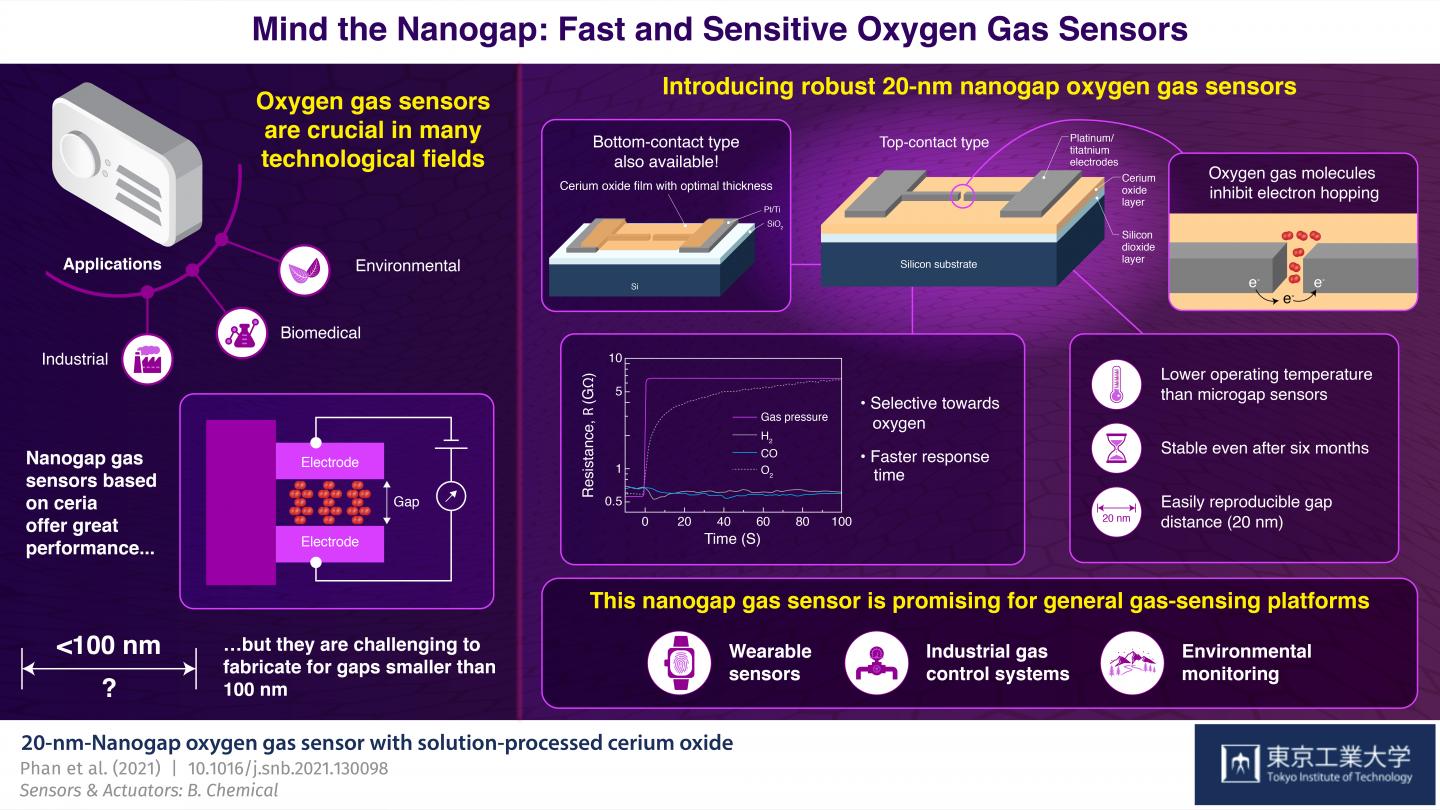
Oxygen (O2) is an essential gas not only for us and most other lifeforms, but also for many industrial processes, biomedicine, and environmental monitoring applications. Given the importance of O2 and other gases, many researchers have focused on developing and improving gas-sensing technologies. At the frontier of this evolving field lie modern nanogap gas sensors–devices usually comprised of a sensing material and two conducting electrodes that are separated by a minuscule gap in the order of nanometers (nm), or thousand millionths of a meter. When molecules of specific gases get inside this gap, they electronically interact with the sensing layer and the electrodes, altering measurable electric properties such as the resistance between the electrodes. In turn, this allows one to indirectly measure the concentration of a given gas.

Although nanogap gas sensors bear many more attractive properties than the closely related microgap gas sensors, they have proven much more difficult to mass produce reliably for gap distances in the order of tens of nanometers. At the Laboratory for Materials and Structures of Tokyo Tech, a team of scientists led by Dr. Yutaka Majima is seeking ways to fabricate better nanogap sensors. In their latest study, which was published in Sensors & Actuators: B. Chemical, the team presents a new strategy to produce nanogap oxygen gas sensors using platinum/titanium (Pt/Ti) electrodes and a cerium oxide (CeO2) sensing layer.

Two sensor designs were tested by Prof. Majima and his team. In the bottom-contact design, the CeO2 sensing layer is first deposited onto a silicon substrate and the two Pt/Ti electrodes are laid on top of the CeO2 through electron beam lithography (EBL). With EBL, one draws custom shapes on a resist film using a focused beam of electrons with extreme precision. This then allows for the selective etching or evaporation of Pt/Ti regions, thus giving shape to the nanogap electrodes. The other design (top-contact) was produced using EBL as well, but the CeO2 was applied on top of the Pt/Ti electrodes as a thin coating layer.

With this fabrication strategy, the team managed to reliably produce stable Pt nanogaps as small as 20 nm, which was unprecedented in the literature. Both sensor designs exhibited similar and highly promising performances, as Dr. Majima remarks: “For a gap separation of 35 nm, our nanogap O2 gas sensors exhibited a fast response time of 10 seconds at a relatively low operating temperature of 573 K (300 °C); this response time is approximately three orders of magnitude shorter than that of microgap sensors under the same measurement conditions.” Moreover, their procedure offers better scalability than those for previously developed nanogap gas sensors.

In addition to the sensor designs, this study provided important insights on the electron hopping mechanisms by which O2 molecules modulate the resistance between the Pt electrodes in the presence of CeO2 at the nanogap. Taken together, the results of this study are paving the way to better gas-sensing devices, as Dr. Majima concludes: “Our nanogap gas sensors could be promising candidates for the development of a general gas-sensing platform with a low operating temperature.” In due time, nanogap gas sensors shall surely find their way into more fields of application, including wearable biomedical devices, industrial condition monitoring, and environmental sensing.

###

Media Contact
Kazuhide Hasegawa
[email protected]

Related Journal Article

http://dx.doi.org/10.1016/j.snb.2021.130098

Tags: Industrial Engineering/ChemistryTechnology/Engineering/Computer Science
Share13Tweet8Share2ShareShareShare2

Related Posts

Smart Hydrogels Revolutionize Information Security with Photo-Patterning and Multi-Stimuli Responsive Structural Colors — Chemistry

Smart Hydrogels Revolutionize Information Security with Photo-Patterning and Multi-Stimuli Responsive Structural Colors

May 15, 2026
Scientists Overcome Longstanding Challenge in Measuring Semiconductor Defects — Chemistry

Scientists Overcome Longstanding Challenge in Measuring Semiconductor Defects

May 14, 2026

Wall Design Highlights Deaf and Hard-of-Hearing Experience at #ASA190

May 14, 2026

New Method Finds More Efficient Route Between Earth and Moon Than Ever Before

May 14, 2026
Please login to join discussion

POPULAR NEWS

  • Research Indicates Potential Connection Between Prenatal Medication Exposure and Elevated Autism Risk

    843 shares
    Share 337 Tweet 211
  • New Study Reveals Plants Can Detect the Sound of Rain

    729 shares
    Share 291 Tweet 182
  • Salmonella Haem Blocks Macrophages, Boosts Infection

    62 shares
    Share 25 Tweet 16
  • Breastmilk Balances E. coli and Beneficial Bacteria in Infant Gut Microbiomes

    58 shares
    Share 23 Tweet 15

About

We bring you the latest biotechnology news from best research centers and universities around the world. Check our website.

Follow us

Recent News

A*STAR Scientists Unveil Novel Technique to Decipher RNA Structure’s Impact on Health and Disease

Smart Hydrogels Revolutionize Information Security with Photo-Patterning and Multi-Stimuli Responsive Structural Colors

Unveiling the Unseen: POSTECH Team Creates AI Framework to Detect Hidden Defects in Metal 3D Printing

Subscribe to Blog via Email

Enter your email address to subscribe to this blog and receive notifications of new posts by email.

Join 82 other subscribers
  • Contact Us

Bioengineer.org © Copyright 2023 All Rights Reserved.

Welcome Back!

Login to your account below

Forgotten Password?

Retrieve your password

Please enter your username or email address to reset your password.

Log In
No Result
View All Result
  • Homepages
    • Home Page 1
    • Home Page 2
  • News
  • National
  • Business
  • Health
  • Lifestyle
  • Science

Bioengineer.org © Copyright 2023 All Rights Reserved.