The largest-ever fossil of a giant millipede – as big as a car – has been found on a beach in the north of England.
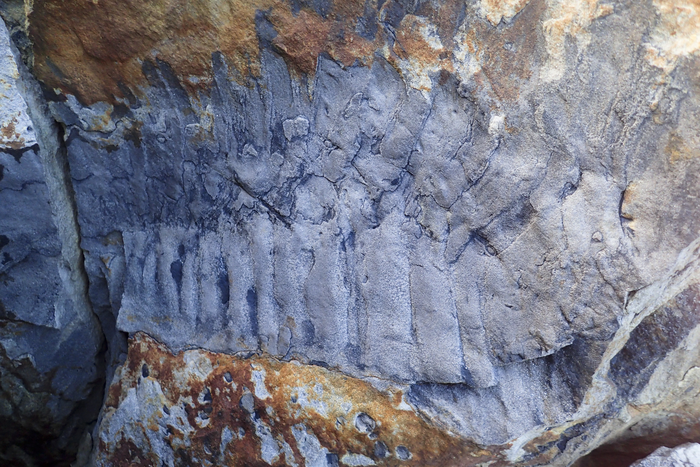
Credit: Neil Daves
The largest-ever fossil of a giant millipede – as big as a car – has been found on a beach in the north of England.
The fossil – the remains of a creature called Arthropleura – dates from the Carboniferous Period, about 326 million years ago, over 100 million years before the Age of Dinosaurs. The fossil reveals that Arthropleura was the largest-known invertebrate animal of all time, larger than the ancient sea scorpions that were the previous record holders.
The specimen, found on a Northumberland beach about 40 miles north of Newcastle, is made up of multiple articulated exoskeleton segments, broadly similar in form to modern millipedes. It is just the third such fossil ever found. It is also the oldest and largest: the segment is about 75 centimetres long, while the original creature is estimated to have measured around 2.7 metres long and weighed around 50 kilograms. The results are reported in the Journal of the Geological Society.
The fossil was discovered in January 2018 in a large block of sandstone that had fallen from a cliff to the beach at Howick Bay in Northumberland. “It was a complete fluke of a discovery,” said Dr Neil Davies from Cambridge’s Department of Earth Sciences, the paper’s lead author. “The way the boulder had fallen, it had cracked open and perfectly exposed the fossil, which one of our former PhD students happened to spot when walking by.”
Unlike the cool and wet weather associated with the region today, Northumberland had a more tropical climate in the Carboniferous Period, when Great Britain lay near the Equator. Invertebrates and early amphibians lived off the scattered vegetation around a series of creeks and rivers. The specimen identified by the researchers was found in a fossilised river channel: it was likely a moulted segment of the Arthropleura’s exoskeleton that filled with sand, preserving it for hundreds of millions of years.
The fossil was extracted in May 2018 with permission from Natural England and the landowners, the Howick Estate. “It was an incredibly exciting find, but the fossil is so large it took four of us to carry it up the cliff face,” said Davies.
The fossil was brought back to Cambridge so that it could be examined in detail. It was compared with all previous records and revealed new information about the animal’s habitat and evolution. The animal can be seen to have only existed in places that were once located at the Equator, such as Great Britain during the Carboniferous. Previous reconstructions have suggested that the animal lived in coal swamps, but this specimen showed Arthropleura preferred open woodland habitats near the coast.
There are only two other known Arthropleura fossils, both from Germany, and both much smaller than the new specimen. Although this is the largest Arthropleura fossil skeleton ever found, there is still much to learn about these creatures. “Finding these giant millipede fossils is rare, because once they died, their bodies tend to disarticulate, so it’s likely that the fossil is a moulted carapace that the animal shed as it grew,” said Davies. “We have not yet found a fossilised head, so it’s difficult to know everything about them.”
The great size of Arthropleura has previously been attributed to a peak in atmospheric oxygen during the late Carboniferous and Permian periods, but because the new fossil comes from rocks deposited before this peak, it shows that oxygen cannot be the only explanation.
The researchers believe that to get to such a large size, Arthropleura must have had a high-nutrient diet. “While we can’t know for sure what they ate, there were plenty of nutritious nuts and seeds available in the leaf litter at the time, and they may even have been predators that fed off other invertebrates and even small vertebrates such as amphibians,” said Davies.
Arthropleura animals crawled around Earth’s equatorial region for around 45 million years, before going extinct during the Permian period. The cause of their extinction is uncertain, but could be due to global warming that made the climate too dry for them to survive, or to the rise of reptiles, who out-competed them for food and soon dominated the same habitats.
The fossil will go on public display at Cambridge’s Sedgwick Museum in the New Year.
Neil Davies is a Fellow of Churchill College, Cambridge. The research was supported in part by the Natural Environment Research Council.
Journal
Journal of the Geological Society
DOI
10.1144/jgs2021-115
Method of Research
Observational study
Article Title
The largest arthropod in Earth history: insights from newly discovered Arthropleura remains (Serpukhovian Stainmore Formation, Northumberland, England)
Article Publication Date
21-Dec-2021