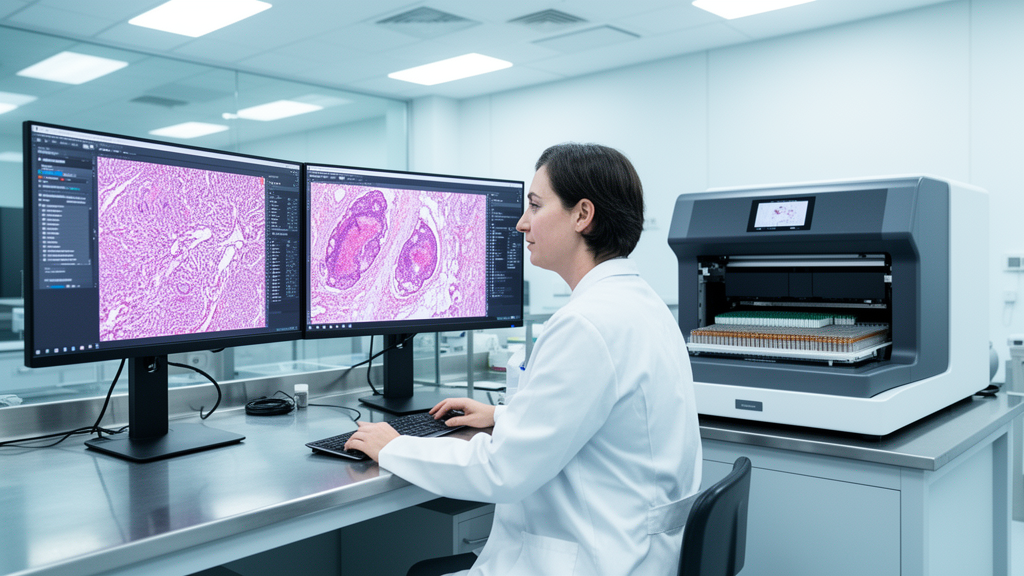
Mild JPEG2000 compression can reduce storage requirements by approximately 90 percent while preserving the diagnostic performance of deep learning models performing tumor segmentation on lung cancer whole-slide images, according to a recent computational pathology evaluation. In digital pathology, whole-slide images are generated at gigapixel resolution. This leads to substantial storage and data management demands. While lossy image compression techniques are commonly implemented to curb these escalating storage and data management demands, their precise impact on downstream artificial intelligence algorithms has remained uncertain.
Deep learning models applied to digital pathology, particularly those tasked with fine-grained tile-level tissue segmentation, can be remarkably sensitive to subtle visual distortions introduced during lossy compression. This unresolved tension between archival efficiency and analytical precision underscored the urgent necessity for a systematic, controlled evaluation of compression effects on automated pathology segmentation.
To establish a rigorous experimental benchmark, investigators evaluated tile-level tumor segmentation using a dataset of eighty-six whole-slide images of lung adenocarcinoma. To ensure high diagnostic fidelity and dependable ground-truth references, all eighty-six whole-slide images were meticulously annotated by four board-certified pathologists. The research team subdivided these extensive whole-slide preparations into standardized, nonoverlapping image tiles measuring 512 by 512 pixels at 20× optical magnification.
To assess architectural robustness against compression distortions, the researchers implemented and compared multiple deep learning paradigms, encompassing both convolutional neural networks and modern vision Transformer models. The convolutional cohort utilized the established U-Net framework configured with three distinct encoder backbones: MobileNetV3, ResNet-18, and ResNet-50. For the Transformer-based approach, the team selected the SegFormer architecture. Crucially, all models were trained exclusively on lossless PNG images.
The trained segmentation models were subsequently evaluated on test tiles subjected to JPEG2000 compression across an expansive range of compression rates, extending from a rate of 1, representing lossless preservation, up to an aggressive rate of 80. The investigators quantified segmentation performance by calculating the Dice coefficient against the pathologists’ manual annotations. Concurrently, objective image quality was monitored through Peak Signal-to-Noise Ratio and the Structural Similarity Index Measure, alongside the no-reference Perception-based Image Quality Evaluator. Practical storage efficiency was also systematically evaluated by comparing the compressed file volumes against baseline uncompressed TIFF images, directly linking computational performance to physical data savings across each experimental tier.
The experimental results revealed that segmentation performance remained remarkably stable at mild compression levels, demonstrating substantial data savings without compromising algorithmic accuracy. Specifically, the most robust architecture—the U-Net equipped with a MobileNetV3 encoder—experienced a marginal decrease of only approximately 1.7 percent in segmentation performance up to a JPEG2000 compression rate of 10 compared with the lossless baseline. Across this mild compression range, visual quality metrics remained exceptionally high, recording a Peak Signal-to-Noise Ratio of at least 33 decibels and a Structural Similarity Index Measure of at least 0.97. Concurrently, physical storage requirements were reduced by approximately 90 percent relative to uncompressed TIFF images.
At higher compression rates of 15 and beyond, however, segmentation performance began to decline progressively across all evaluated models, accompanied by marked image quality degradation and pronounced perceptual artifacts. Architectural comparisons demonstrated that convolutional neural network models exhibited greater overall robustness to compression artifacts than the Transformer-based alternative. The SegFormer model demonstrated an earlier and substantially steeper performance decline under escalating compression rates. Furthermore, an analysis of model confidence maps showed that predictive uncertainty along tumor boundaries increased as compression severity rose, manifesting as blurred boundary confidence even before substantial reductions in the overall Dice coefficient became numerically apparent.
The authors concluded that applying JPEG2000 compression at mild rates successfully preserves deep learning–based segmentation performance while substantially diminishing the heavy storage requirements of digital pathology workflows. These findings provide quantitative evidence on compression-performance trade-offs for tile-level image analysis under controlled experimental conditions and highlight architecture-dependent sensitivity to compression artifacts. These findings demonstrate that significant data savings can be achieved without undermining diagnostic machine learning models, provided that image compression remains within validated operational boundaries and accounts for the specific sensitivities of the underlying neural network architecture.
Subject of Research: Impact of JPEG2000 image compression on deep learning tumor segmentation accuracy and storage efficiency in digital pathology
Article Title: Evaluating JPEG2000 compression effects on prediction accuracy and storage efficiency in lung cancer whole-slide images: a deep learning–based analysis
Article References: Ji, H., Yook, M., Jung, C. K., & Choi, I. Y. (2026). Evaluating JPEG2000 compression effects on prediction accuracy and storage efficiency in lung cancer whole-slide images: a deep learning–based analysis. Diagnostic Pathology, 21(1), Article 90. https://doi.org/10.1186/s13000-026-01830-7
Image Credits: AI Generated
DOI: 10.1186/s13000-026-01830-7
Keywords: digital pathology, whole-slide images, JPEG2000 compression, lung adenocarcinoma, tumor segmentation, deep learning, convolutional neural networks, vision transformers, SegFormer, U-Net, MobileNetV3, ResNet-18, ResNet-50, Dice coefficient, Peak Signal-to-Noise Ratio, Structural Similarity Index Measure, Perception-based Image Quality Evaluator, storage efficiency
News Source: Ophelia Keating. (November 11, 2026). Mild JPEG2000 Compression Cuts Pathology Storage By Ninety Percent While Preserving Accuracy. Scienmag.