• HOME
  • NEWS
  • EXPLORE
    • CAREER
      • Companies
      • Jobs
    • EVENTS
    • iGEM
      • News
      • Team
    • PHOTOS
    • VIDEO
    • WIKI
  • BLOG
  • COMMUNITY
    • FACEBOOK
    • INSTAGRAM
    • TWITTER
Monday, August 24, 2026
BIOENGINEER.ORG
No Result
View All Result
  • Login
  • HOME
  • NEWS
  • EXPLORE
    • CAREER
      • Companies
      • Jobs
        • Lecturer
        • PhD Studentship
        • Postdoc
        • Research Assistant
    • EVENTS
    • iGEM
      • News
      • Team
    • PHOTOS
    • VIDEO
    • WIKI
  • BLOG
  • COMMUNITY
    • FACEBOOK
    • INSTAGRAM
    • TWITTER
  • HOME
  • NEWS
  • EXPLORE
    • CAREER
      • Companies
      • Jobs
        • Lecturer
        • PhD Studentship
        • Postdoc
        • Research Assistant
    • EVENTS
    • iGEM
      • News
      • Team
    • PHOTOS
    • VIDEO
    • WIKI
  • BLOG
  • COMMUNITY
    • FACEBOOK
    • INSTAGRAM
    • TWITTER
No Result
View All Result
Bioengineer.org
No Result
View All Result
Home NEWS Science News Biology

Microwave treatment is an inexpensive way to clean heavy metals from treated sewage

Bioengineer by Bioengineer
December 5, 2019
in Biology
Reading Time: 3 mins read
0
IMAGE
Share on FacebookShare on TwitterShare on LinkedinShare on RedditShare on Telegram

IMAGE

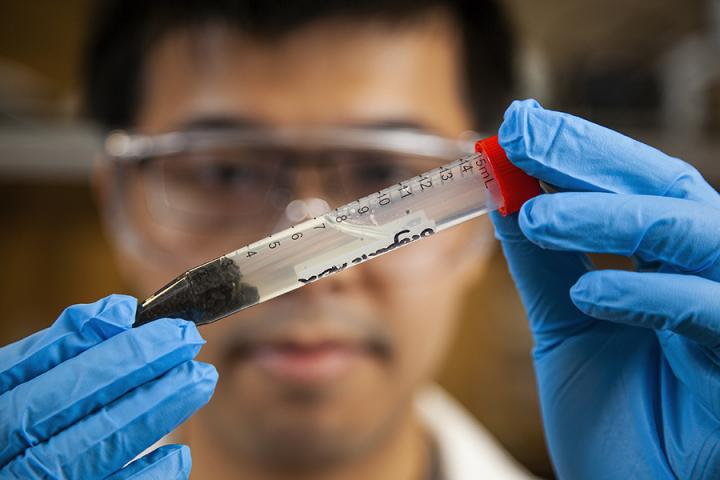
Credit: Mark Wallheiser / FAMU-FSU College of Engineering


TALLAHASSEE, Fla. — A team of Florida State University researchers studying new methods to remove toxic heavy metals from biosolids — the solid waste left over after sewage treatment — found the key is a brief spin through a microwave.

The method removed three times the amount of lead from biosolids compared to conventional means and could reduce the total cost of processing by more than 60 percent, making it a possible engineering solution to help produce fertilizer and allow more people to live with clean soil and water. The research is published in the Journal of Cleaner Production.

“Biosolids are a valuable resource, but heavy metals prevent their use,” said Gang Chen, a professor of Civil & Environmental Engineering at the FAMU-FSU College of Engineering.

As the human population of the planet grows and more people move to cities, sewage treatment plants around the world are producing more biosolids. Those byproducts are often disposed of in landfills or incinerators, but there are drawbacks to those solutions, such as high costs or secondary pollution from the treatment process itself.

Another option is to compost the biosolids, using them as an ingredient in fertilizer that finds a second life in agriculture. In the United States, about half of all biosolids are recycled.

Before disposal or recycling can happen, they need to be made safe to use. One obstacle is the presence of heavy metals, so named for their high atomic weight. Because these potential toxins can leach into the environment from biosolids, it’s important to extract them. However, that extraction can be expensive.

Chen and his team turned to their knowledge of energy to develop a more efficient process.

The investigation started from theory. They calculated the amount of energy that was needed to break the bonds that attached the heavy metals to the rest of the biosolid but would not destroy the biosolid itself. Somewhere on the electromagnetic spectrum, Chen’s group found the radiation with the right amount of energy.

Microwave radiation seemed to be just right. After treatment in a microwave, researchers were able to remove the heavy metals from biosolids with a lower dosage of treatment chemicals than traditional extraction requires.

It’s a technique that can be scaled up to facilities that service a city or a region to give them a less expensive way to make biosolids safe, Chen said.

It’s important work, because if heavy metals remain in biosolids that are applied to soil, those metals can be absorbed by plants, which become part of the food chain for animals or humans. As they accumulate in the body, they can cause intellectual disability in children, dementia in adults, central nervous system disorders and damage to organs.

“We want to break the loop,” Chen said.

Former doctoral student Simeng Li, a current assistant professor in the Department of Civil Engineering at California State Polytechnic University, Pomona, Runwei Li, a doctoral candidate in the FAMU-FSU College of Engineering, and Youneng Tang, an assistant professor of Civil & Environmental Engineering in the FAMU-FSU College of Engineering, contributed to this study. This research was supported by the Hinkley Center for Solid and Hazardous Waste Management.

###

Media Contact
Bill Wellock
[email protected]
850-645-1504

Original Source

https://news.fsu.edu/news/science-technology/2019/12/05/fsu-research-microwave-treatment-is-an-inexpensive-way-to-clean-heavy-metals-from-treated-sewage/

Related Journal Article

http://dx.doi.org/10.1016/j.jclepro.2019.118342

Tags: BiologyBiomedical/Environmental/Chemical EngineeringBiotechnologyCivil EngineeringEcology/EnvironmentFertilizers/Pest ManagementTechnology/Engineering/Computer Science
Share12Tweet8Share2ShareShareShare2

Related Posts

Delayed antiviral response in alveolar type 2 cells heightens influenza susceptibility

Delayed antiviral response in alveolar type 2 cells heightens influenza susceptibility

August 22, 2026
Genetic evidence links sleep disruption to hemorrhoidal disease, revealing a hidden connection

Genetic evidence links sleep disruption to hemorrhoidal disease, revealing a hidden connection

August 22, 2026

LASIK Versus Contact Lenses for Correcting Myopia

August 22, 2026

New Advances in Minimally Invasive Laryngeal Surgery

August 22, 2026
Please login to join discussion

POPULAR NEWS

  • Study reveals surge in type 2 diabetes among people under 20

    29 shares
    Share 12 Tweet 7
  • KAIST discovers pathway to faster-charging, longer-lasting electric vehicle batteries

    29 shares
    Share 12 Tweet 7
  • Blocking glucosylceramide production kills cancer cells via lysosomal dysfunction, not ceramide buildup

    29 shares
    Share 12 Tweet 7
  • ZCCHC4 boosts replication-dependent histone mRNA translation by interacting with eIF3

    29 shares
    Share 12 Tweet 7

About

We bring you the latest biotechnology news from best research centers and universities around the world. Check our website.

Follow us

Recent News

Study reveals surge in type 2 diabetes among people under 20

KAIST discovers pathway to faster-charging, longer-lasting electric vehicle batteries

Blocking glucosylceramide production kills cancer cells via lysosomal dysfunction, not ceramide buildup

Subscribe to Blog via Email

Enter your email address to subscribe to this blog and receive notifications of new posts by email.

Join 85 other subscribers
  • Contact Us

Bioengineer.org © Copyright 2023 All Rights Reserved.

Welcome Back!

Login to your account below

Forgotten Password?

Retrieve your password

Please enter your username or email address to reset your password.

Log In
No Result
View All Result
  • Homepages
    • Home Page 1
    • Home Page 2
  • News
  • National
  • Business
  • Health
  • Lifestyle
  • Science

Bioengineer.org © Copyright 2023 All Rights Reserved.