• HOME
  • NEWS
  • EXPLORE
    • CAREER
      • Companies
      • Jobs
    • EVENTS
    • iGEM
      • News
      • Team
    • PHOTOS
    • VIDEO
    • WIKI
  • BLOG
  • COMMUNITY
    • FACEBOOK
    • INSTAGRAM
    • TWITTER
Thursday, July 2, 2026
BIOENGINEER.ORG
No Result
View All Result
  • Login
  • HOME
  • NEWS
  • EXPLORE
    • CAREER
      • Companies
      • Jobs
        • Lecturer
        • PhD Studentship
        • Postdoc
        • Research Assistant
    • EVENTS
    • iGEM
      • News
      • Team
    • PHOTOS
    • VIDEO
    • WIKI
  • BLOG
  • COMMUNITY
    • FACEBOOK
    • INSTAGRAM
    • TWITTER
  • HOME
  • NEWS
  • EXPLORE
    • CAREER
      • Companies
      • Jobs
        • Lecturer
        • PhD Studentship
        • Postdoc
        • Research Assistant
    • EVENTS
    • iGEM
      • News
      • Team
    • PHOTOS
    • VIDEO
    • WIKI
  • BLOG
  • COMMUNITY
    • FACEBOOK
    • INSTAGRAM
    • TWITTER
No Result
View All Result
Bioengineer.org
No Result
View All Result
Home NEWS Science News Chemistry

Microscopic deformation of a neutron star inferred from a distance of 4500 light-years

Bioengineer by Bioengineer
August 20, 2020
in Chemistry
Reading Time: 2 mins read
0
IMAGE
Share on FacebookShare on TwitterShare on LinkedinShare on RedditShare on Telegram

IMAGE

Credit: Sudip Bhattacharyya

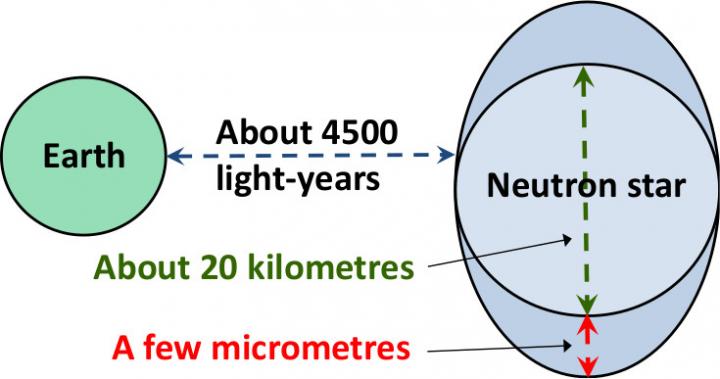
Imagine that the size of a bacterium is measured from a distance of about 4500 light-years. This would be an incredible measurement, considering that a bacterium is so small that a microscope is required to see it, and what an enormous distance light can travel in 4500 years, given that it can round the Earth more than seven times in just one second. But a small deformation of the size of a bacterium, that is an extra height of a few micrometres in one direction, has now been inferred for a neutron star at a distance of about 4500 light-years, from a research by Prof. Sudip Bhattacharyya of the Tata Institute of Fundamental Research (TIFR), India. This research is published in a new paper in Monthly Notices of the Royal Astronomical Society.

Neutron stars are incredibly dense cosmic objects. They are about the size of a city, but contain more material than in the Sun, and a handful of stellar stuff would outweigh a mountain on the Earth. Some of them are observed to spin several hundred times in a second, and we call them millisecond pulsars. A slight asymmetry or deformation around the spin axis of such a star would cause the emission of gravitational waves continuously.

Gravitational waves, which are ripples in spacetime, have recently provided a new window to the universe. But so far they have been found as transient phenomena of mergers of black holes and neutron stars. Continuous gravitational waves, for example from a slightly deformed and spinning neutron star, have so far not been detected. The current instruments may not have the capability to detect these waves, if the deformation is too small.

However, a way to indirectly infer such waves and to measure this deformation is to estimate the contribution of the waves to the spin-down rate of the pulsar, which was not possible till now. PSR J1023+0038 is a unique cosmic source for this purpose, because it is the only millisecond pulsar for which two spin-down rates, in the phase of mass transfer from the companion star and in the phase when there is no mass transfer, were measured. Using these values, and primarily a fundamental principle of physics, that is the conservation of angular momentum, Bhattacharyya has inferred continuous gravitational waves and has estimated the neutron star’s microscopic deformation.

###

Media Contact
Sudip Bhattacharyya
[email protected]

Related Journal Article

http://dx.doi.org/10.1093/mnras/staa2304

Tags: AstronomyAstrophysicsSpace/Planetary Science
Share12Tweet8Share2ShareShareShare2

Related Posts

Graz University of Technology Deciphers the Structural Secrets of MOF Thin Films — Chemistry

Graz University of Technology Deciphers the Structural Secrets of MOF Thin Films

July 2, 2026
Breaking Thermodynamic Limits: Wavelength-Driven Catalysis Advances Ammonia Synthesis — Chemistry

Breaking Thermodynamic Limits: Wavelength-Driven Catalysis Advances Ammonia Synthesis

July 2, 2026

From Quantum Mechanics to AI-Powered Materials Discovery: MARVEL Marks 12 Years of Transforming Computational Science

July 2, 2026

Djire Recognized with National Award for Outstanding Contributions in Research and Teaching

July 2, 2026
Please login to join discussion

POPULAR NEWS

  • Detection of EDCs in Breast Milk and Infant Urine Up to Six Months Highlights Early Exposure Risks

    77 shares
    Share 31 Tweet 19
  • Saying Goodbye to PGY-6: Pediatric Fellowship Realities

    103 shares
    Share 41 Tweet 26
  • New Drug Candidate Developed at McMaster Shows Potential for Treating Brain Cancer

    58 shares
    Share 23 Tweet 15
  • KTU Researchers Explore Ultrasound’s Role in Enhancing Blood Flow Beyond Diagnostics

    53 shares
    Share 21 Tweet 13

About

BIOENGINEER.ORG

We bring you the latest biotechnology news from best research centers and universities around the world. Check our website.

Follow us

Recent News

Steatosis Drives Liver Metastasis Diversity in CRC

Unlocking the Mysteries of Alzheimer’s Disease

Pensoft Introduces New Peer-Reviewed Journal of Regeneration to Advance Restorative Biology Across Species

Subscribe to Blog via Email

Enter your email address to subscribe to this blog and receive notifications of new posts by email.

Join 83 other subscribers
  • Contact Us

Bioengineer.org © Copyright 2023 All Rights Reserved.

Welcome Back!

Login to your account below

Forgotten Password?

Retrieve your password

Please enter your username or email address to reset your password.

Log In
No Result
View All Result
  • Homepages
    • Home Page 1
    • Home Page 2
  • News
  • National
  • Business
  • Health
  • Lifestyle
  • Science

Bioengineer.org © Copyright 2023 All Rights Reserved.