• HOME
  • NEWS
  • EXPLORE
    • CAREER
      • Companies
      • Jobs
    • EVENTS
    • iGEM
      • News
      • Team
    • PHOTOS
    • VIDEO
    • WIKI
  • BLOG
  • COMMUNITY
    • FACEBOOK
    • INSTAGRAM
    • TWITTER
Monday, August 17, 2026
BIOENGINEER.ORG
No Result
View All Result
  • Login
  • HOME
  • NEWS
  • EXPLORE
    • CAREER
      • Companies
      • Jobs
        • Lecturer
        • PhD Studentship
        • Postdoc
        • Research Assistant
    • EVENTS
    • iGEM
      • News
      • Team
    • PHOTOS
    • VIDEO
    • WIKI
  • BLOG
  • COMMUNITY
    • FACEBOOK
    • INSTAGRAM
    • TWITTER
  • HOME
  • NEWS
  • EXPLORE
    • CAREER
      • Companies
      • Jobs
        • Lecturer
        • PhD Studentship
        • Postdoc
        • Research Assistant
    • EVENTS
    • iGEM
      • News
      • Team
    • PHOTOS
    • VIDEO
    • WIKI
  • BLOG
  • COMMUNITY
    • FACEBOOK
    • INSTAGRAM
    • TWITTER
No Result
View All Result
Bioengineer.org
No Result
View All Result
Home NEWS Science News Biology

Microrobots clean up radioactive waste (video)

Bioengineer by Bioengineer
October 30, 2019
in Biology
Reading Time: 2 mins read
0
IMAGE
Share on FacebookShare on TwitterShare on LinkedinShare on RedditShare on Telegram

IMAGE

Credit: American Chemical Society

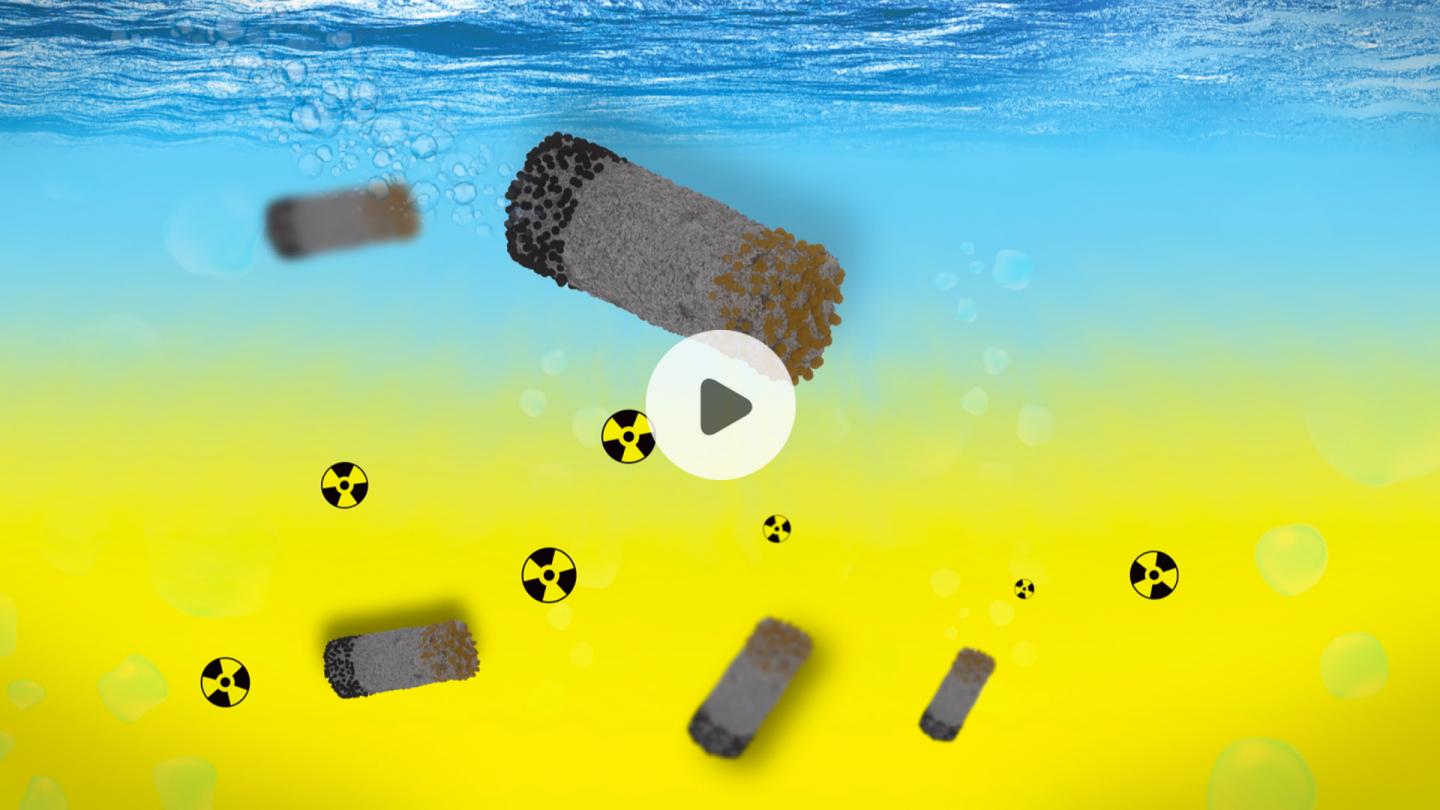
According to some experts, nuclear power holds great promise for meeting the world’s growing energy demands without generating greenhouse gases. But scientists need to find a way to remove radioactive isotopes, both from wastewater generated by nuclear power plants and from the environment in case of a spill. Now, researchers reporting in ACS Nano have developed tiny, self-propelled robots that remove radioactive uranium from simulated wastewater. Watch a video of the microrobots in action here.

The accidental release of radioactive waste, such as what occurred in the Chernobyl and Fukushima nuclear plant disasters, poses large threats to the environment, humans and wildlife. Scientists have developed materials to capture, separate, remove and recover radioactive uranium from water, but the materials have limitations. One of the most promising recent approaches is the use of metal-organic frameworks (MOFs) — compounds that can trap specific substances, including radioactive uranium, within their porous structures. Martin Pumera and colleagues wanted to add a micromotor to a rod-shaped MOF called ZIF-8 to see if it could quickly clean up radioactive waste.

To make their self-propelled microrobots, the researchers designed ZIF-8 rods with diameters about 1/15 that of a human hair. The researchers added iron atoms and iron oxide nanoparticles to stabilize the structures and make them magnetic, respectively. Catalytic platinum nanoparticles placed at one end of each rod converted hydrogen peroxide “fuel” in the water into oxygen bubbles, which propelled the microrobots at a speed of about 60 times their own length per second. In simulated radioactive wastewater, the microrobots removed 96% of the uranium in an hour. The team collected the uranium-loaded rods with a magnet and stripped off the uranium, allowing the tiny robots to be recycled. The self-propelled microrobots could someday help in the management and remediation of radioactive waste, the researchers say.

###

The authors acknowledge funding from the Advanced Functional Nanorobots program, the Czech Science Foundation, the Ministry of Education, Youth and Sports of the Czech Republic and the Neuron Benevolent Fund for Support of Science.

The abstract that accompanies this study is available here.

The American Chemical Society, the world’s largest scientific society, is a nonprofit organization chartered by the U.S. Congress. ACS is a global leader in providing access to chemistry-related information and research through its multiple databases, peer-reviewed journals and scientific conferences. ACS does not conduct research, but publishes and publicizes peer-reviewed scientific studies. Its main offices are in Washington, D.C., and Columbus, Ohio.

To automatically receive news releases from the American Chemical Society, contact [email protected].

Follow us on Twitter | Facebook

Media Contact
Katie Cottingham
[email protected]
301-775-8455

Related Journal Article

http://dx.doi.org/10.1021/acsnano.9b04960

Tags: Chemistry/Physics/Materials SciencesEcology/EnvironmentEnergy SourcesHydrology/Water ResourcesMarine/Freshwater BiologyNanotechnology/MicromachinesPollution/RemediationRobotry/Artificial Intelligence
Share13Tweet8Share2ShareShareShare2

Related Posts

Strubbelig–NHL3 Receptor Complex Helps Arabidopsis Respond to Cellulose Deficiency

Strubbelig–NHL3 Receptor Complex Helps Arabidopsis Respond to Cellulose Deficiency

August 15, 2026
Bombyx mori Satellitome Analysis Reveals Evolutionary Stability, Dispersed Chromosomal Organization, Transposon Origins

Bombyx mori Satellitome Analysis Reveals Evolutionary Stability, Dispersed Chromosomal Organization, Transposon Origins

August 15, 2026

Synthetic pyrenoid reconstruction reveals EPYC1-driven carbon concentration mechanisms and evolution

August 15, 2026

Endophytic Flavobacterium boosts root hairs and drought tolerance through ERF–CEP5 signaling

August 15, 2026
Please login to join discussion

POPULAR NEWS

  • Pilot Study Examines Personal Care Use, Social Media Engagement Among NJ Students

    29 shares
    Share 12 Tweet 7
  • KAIST develops semiconductor neuron that harnesses noise to selectively process signals

    29 shares
    Share 12 Tweet 7
  • Imagining natural and extra robotic thumbs together strengthens kinesthetic sensorimotor networks

    29 shares
    Share 12 Tweet 7
  • PARP1 Drives Neuropathic Pain Through GPX4-Dependent Ferroptosis in Injured Mice’s Sensory Neurons

    29 shares
    Share 12 Tweet 7

About

We bring you the latest biotechnology news from best research centers and universities around the world. Check our website.

Follow us

Recent News

Pilot Study Examines Personal Care Use, Social Media Engagement Among NJ Students

KAIST develops semiconductor neuron that harnesses noise to selectively process signals

Imagining natural and extra robotic thumbs together strengthens kinesthetic sensorimotor networks

Subscribe to Blog via Email

Enter your email address to subscribe to this blog and receive notifications of new posts by email.

Join 85 other subscribers
  • Contact Us

Bioengineer.org © Copyright 2023 All Rights Reserved.

Welcome Back!

Login to your account below

Forgotten Password?

Retrieve your password

Please enter your username or email address to reset your password.

Log In
No Result
View All Result
  • Homepages
    • Home Page 1
    • Home Page 2
  • News
  • National
  • Business
  • Health
  • Lifestyle
  • Science

Bioengineer.org © Copyright 2023 All Rights Reserved.