• HOME
  • NEWS
  • EXPLORE
    • CAREER
      • Companies
      • Jobs
    • EVENTS
    • iGEM
      • News
      • Team
    • PHOTOS
    • VIDEO
    • WIKI
  • BLOG
  • COMMUNITY
    • FACEBOOK
    • INSTAGRAM
    • TWITTER
Monday, May 11, 2026
BIOENGINEER.ORG
No Result
View All Result
  • Login
  • HOME
  • NEWS
  • EXPLORE
    • CAREER
      • Companies
      • Jobs
        • Lecturer
        • PhD Studentship
        • Postdoc
        • Research Assistant
    • EVENTS
    • iGEM
      • News
      • Team
    • PHOTOS
    • VIDEO
    • WIKI
  • BLOG
  • COMMUNITY
    • FACEBOOK
    • INSTAGRAM
    • TWITTER
  • HOME
  • NEWS
  • EXPLORE
    • CAREER
      • Companies
      • Jobs
        • Lecturer
        • PhD Studentship
        • Postdoc
        • Research Assistant
    • EVENTS
    • iGEM
      • News
      • Team
    • PHOTOS
    • VIDEO
    • WIKI
  • BLOG
  • COMMUNITY
    • FACEBOOK
    • INSTAGRAM
    • TWITTER
No Result
View All Result
Bioengineer.org
No Result
View All Result
Home NEWS Science News Chemistry

Microcomb-injected pulsed lasers as variable microwave gears

Bioengineer by Bioengineer
September 29, 2020
in Chemistry
Reading Time: 2 mins read
0
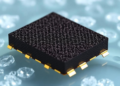
IMAGE
Share on FacebookShare on TwitterShare on LinkedinShare on RedditShare on Telegram

IMAGE

Credit: W. Wenle (EPFL)

Low-noise microwave signals are of critical importance in numerous applications such as high-speed telecommunication and ultrafast data processing. Conventionally, such signals are generated with bulky and delicate microwave oscillators that are not suitable for out-of-door applications. But recently, physicists have been exploring a possible alternative: high-quality microwave generation using optical microresonator frequency combs.

Relying on the high optical frequency and spectral purity of laser fields, optical microresonators can generate low-noise microwaves in a compact and efficient manner. But a microresonator can usually only generate microwaves with very limited frequency tunability. The reason is that the microwave frequency depends on the resonator’s size, which is not itself highly tunable.

Publishing in Science Advances, researchers at Tobias Kippenberg’s lab at EPFL, Trinity College Dublin (TCD), and Dublin City University (DCU) have now developed a novel technique for generating variable low-noise microwaves with a single optical microresonator.

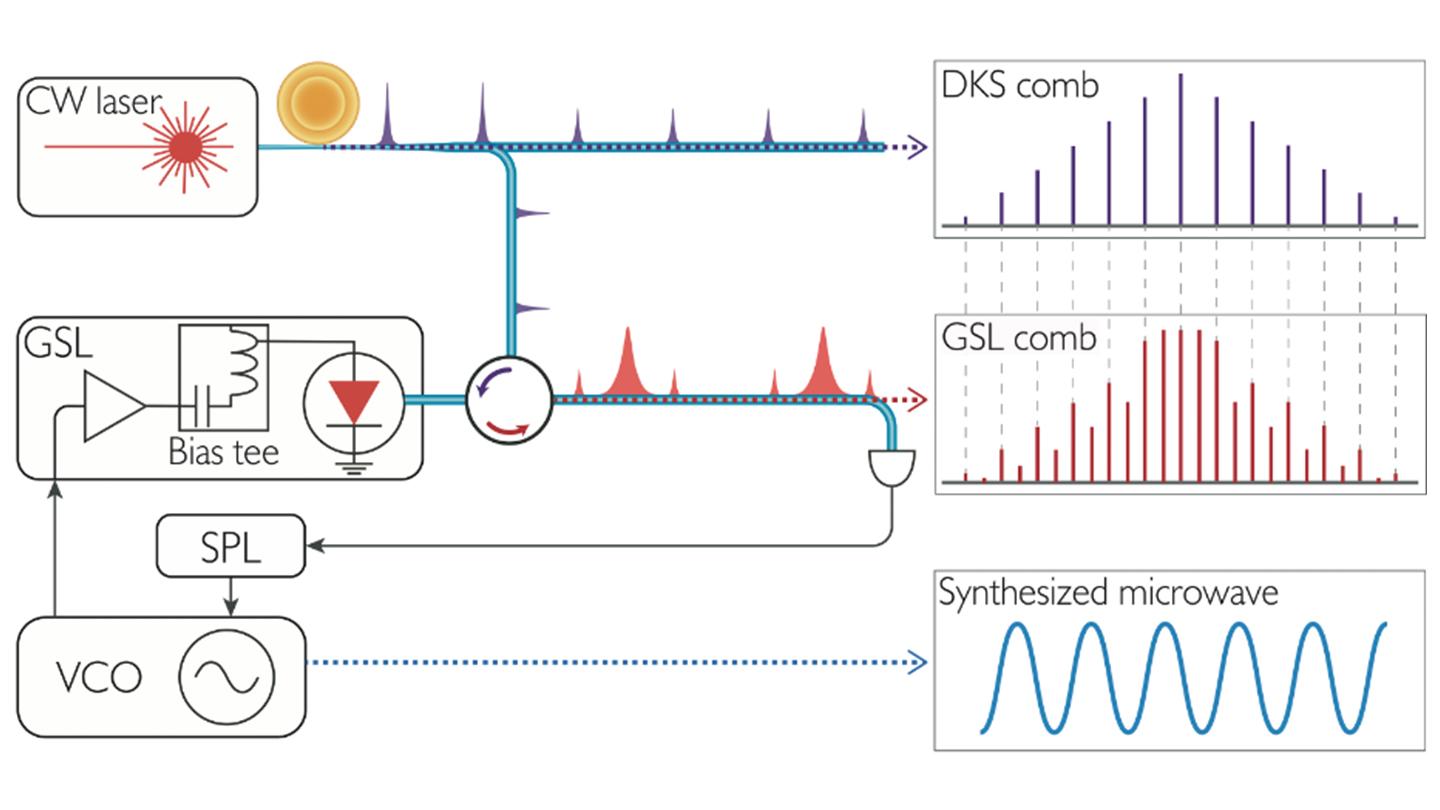
The approach injects a microresonator frequency comb into a compact laser whose intensity is modulated by an off-the-shelf microwave oscillator. By forcing the modulation frequency to tightly follow a subharmonic frequency of the microwave produced by the microresonator frequency comb, the team successfully generated new microwaves whose frequencies can be varied significantly.

In addition, the newly generated microwaves show much lower phase-noise levels than those of a microresonator frequency comb oscillator and off-the-shelf microwave oscillators. This mechanism, called frequency division, is used to transfer the frequency purity of an optical signal into the microwave domain.

The developed technique enables the spectral purity transfer between different microwave signals. “Traditionally, executing perfect microwave frequency division in a variable fashion has not been easy,” explains Dr Wenle Weng, who led the study. “Thanks to the fast-modulated semiconductor laser developed by our colleagues at TCD and DCU, now we can achieve this using a low-cost photodetector and a moderate control system.” The semiconductor laser also generates a secondary frequency comb with more densified spectral emissions that can be useful in many spectroscopic applications.

The key components in the setup of the proof-of-concept experiment, including the microresonator and the semiconductor laser, are discrete and connected with lengthy fibers. The team is now working on integrating and advanced-packing the device. With the ability to be miniaturized and mass-produced, a variable microwave oscillator and frequency comb generator like that can revolutionize the current surging market for portable low-noise microwave and frequency comb sources.

###

Professor Tobias Kippernberg’s lab are part of EPFL’s Institute of Physics (IPHYS), situated in the School of Basics Sciences.

Reference

Wenle Weng, Aleksandra Kaszubowska-Anandarajah, Junqiu Liu, Prince M. Anandarajah, Tobias J. Kippenberg, Frequency division using a soliton-injected semiconductor gain-switched frequency comb. Science Advances 25 September 2020: Vol. 6, no. 39, eaba2807. DOI: 10.1126/sciadv.aba2807

Media Contact
Nik Papageorgiou
[email protected]

Related Journal Article

http://dx.doi.org/10.1126/sciadv.aba2807

Tags: Chemistry/Physics/Materials SciencesTelecommunications
Share13Tweet8Share2ShareShareShare2

Related Posts

Miniature Sensor Uses Light to Detect Touch — Chemistry

Miniature Sensor Uses Light to Detect Touch

May 8, 2026
Iron Minerals Determine Whether Dissolved Organic Matter Fuels Microbes or Becomes Long-Term Carbon Storage — Chemistry

Iron Minerals Determine Whether Dissolved Organic Matter Fuels Microbes or Becomes Long-Term Carbon Storage

May 8, 2026

Kate Evans Appointed Associate Lab Director for Biological and Environmental Systems Science at ORNL

May 8, 2026

Advancing Multiscale Modeling and Overcoming Operational Challenges in Autothermal COâ‚‚-to-Methanol Reactors

May 8, 2026
Please login to join discussion

POPULAR NEWS

  • Research Indicates Potential Connection Between Prenatal Medication Exposure and Elevated Autism Risk

    840 shares
    Share 336 Tweet 210
  • New Study Reveals Plants Can Detect the Sound of Rain

    728 shares
    Share 290 Tweet 182
  • Salmonella Haem Blocks Macrophages, Boosts Infection

    62 shares
    Share 25 Tweet 16
  • Breastmilk Balances E. coli and Beneficial Bacteria in Infant Gut Microbiomes

    57 shares
    Share 23 Tweet 14

About

We bring you the latest biotechnology news from best research centers and universities around the world. Check our website.

Follow us

Recent News

Charting a Path to Safer and More Transparent AI in Protein Design

Breast Cancer Cells That Slowly Tick Could Unlock Secrets to Late Relapse

NELA, P-POSSUM, Muscle Index Predict Elderly Surgery Risk

Subscribe to Blog via Email

Enter your email address to subscribe to this blog and receive notifications of new posts by email.

Join 82 other subscribers
  • Contact Us

Bioengineer.org © Copyright 2023 All Rights Reserved.

Welcome Back!

Login to your account below

Forgotten Password?

Retrieve your password

Please enter your username or email address to reset your password.

Log In
No Result
View All Result
  • Homepages
    • Home Page 1
    • Home Page 2
  • News
  • National
  • Business
  • Health
  • Lifestyle
  • Science

Bioengineer.org © Copyright 2023 All Rights Reserved.