Warming tropical soils could cause a 9% increase in atmospheric CO2 this century
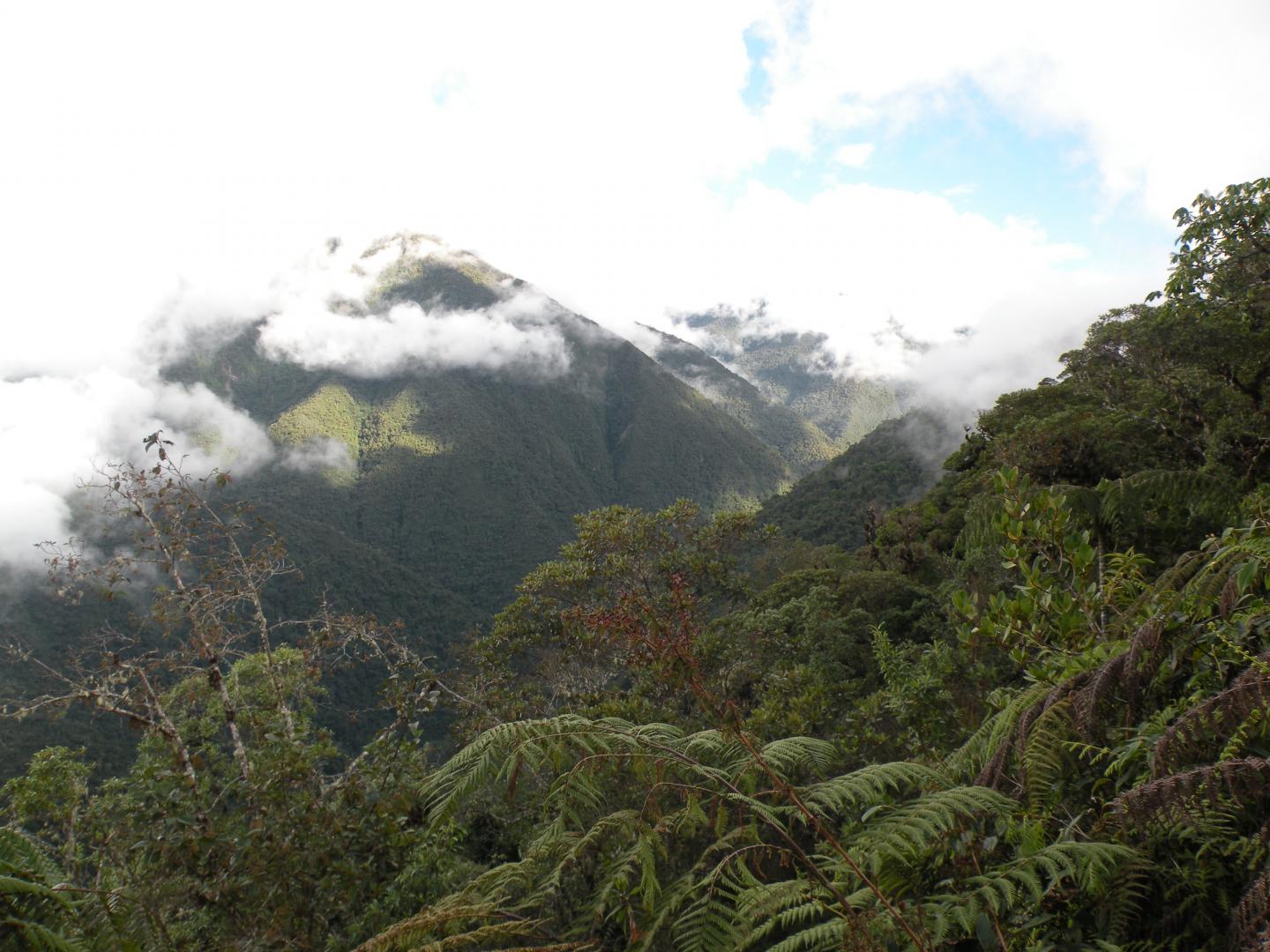
Credit: Andrew Nottingham
As one descends a mountain, the temperature steadily increases. A new study by a team including Andrew Nottingham, a research associate at the Smithsonian Tropical Research Institute (STRI) and post-doctoral fellow at the University of Edinburgh, took advantage of this principle to predict what would happen as tropical soils warm. The team discovered that warmer tropical soils released more car-bon, the species of soil microbes changed and microbial activity increased.
A major cause for concern associated with global warming is the possibility that as soils warm, additional carbon stored in soil organic material may be released into the atmosphere. This would con-tribute to climate warming and warm the soil even more, a ‘positive feedback loop,’ because global warming is caused by the accumulation of carbon dioxide gas in the atmosphere that traps heat from the sun on the Earth’s surface.
“If one accepts the current projections of a 4 to 8 degree Celsius increase in global temperatures during the next century, tropical soils could cause roughly a 9% increase in atmospheric carbon dioxide this century,” Nottingham said.
“The fate of soil carbon in response to global heating remains one of the greatest sources of un-certainty in our predictions of future climate,” said Patrick Meir of Australian National University in Australia and the University of Edinburgh in Scotland and the project’s principal investigator. “Tropical soils have a particularly large influence on the global carbon cycle and are home to unique biodiversity, but their response to warming remains poorly understood.”
Accurate predictions of the amount of carbon dioxide in the atmosphere depend upon understand-ing the contributions from different sources. And while tropical forests may have the potential to release vast amounts of carbon into the atmosphere as they warm, the effects of warming on tropical soils and the microbes that break down organic matter are poorly characterized.
At four sites in the Peruvian Andes, Nottingham and colleagues removed soil cores from the ground. A set of cores stayed at the same site, while other cores were moved to sites either higher up the mountain (thus, cooler) or lower on the mountain (warmer), a 3,000-meter range equivalent to plus or minus 4 to 15 degrees Celsius.
“Our study clearly shows that global warming is likely to create a powerful positive feedback loop, as the microbes and enzymes they synthesize that thrive under warmer conditions release even more carbon from the soil into the atmosphere,” Nottingham said. “We need to use field experiments to investigate this further, especially in lowland tropical forests.”
“Quantifying the likely carbon emissions from warming soils represents a big step forward, made possible through long-term international collaboration,” said Ben Turner, co-author and staff scientist at STRI. “This study indicates that tropical soils are likely to be a considerable source of carbon to the at-mosphere, promoting further increases in temperature.”
###
In addition to Turner, the other co-authors were affiliated with the University of Edinburgh, Scot-land; Australian National University; Pontifical Nacional de San Antonio de Abad in Peru; The Centre for Ecology & Hydrology; Lancaster University in the UK; the University of Manchester in the UK; Universidad Nacional de San Antonio Abad del Cusco; and the University of Colorado in the U.S.
The Smithsonian Tropical Research Institute, headquartered in Panama City, Panama, is a unit of the Smithsonian Institution. The institute furthers the understanding of tropical biodiversity and its importance to human welfare, trains students to conduct research in the tropics and promotes conservation by increasing public awareness of the beauty and importance of tropical ecosystems. Promo video.
Media Contact
Elisabeth B King
[email protected]
Related Journal Article
http://dx.