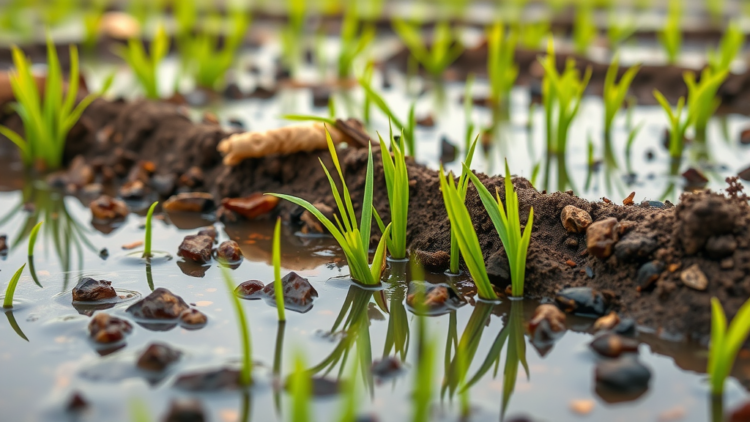
Rice paddies are among the most productive agricultural ecosystems on Earth, feeding billions of people across Asia and beyond. Yet beneath the flooded fields lies a complex microbial world whose balance determines whether the soil stays fertile or degrades over time. A comprehensive review published in the journal Crop Health by researchers from Jiangxi Academy of Agricultural Sciences and Shandong Agricultural University brings together hundreds of studies to map exactly how fertilization shapes the microbial communities, carbon storage, and overall health of paddy soils.
The team, led by Hongyang Xu, Aiping Shu, and colleagues under the supervision of Zengbing Liu, Jinbiao Ma, and Wenchong Shi, systematically reviewed literature from 2020 to 2025, focusing on rice, paddy soils, microorganisms, fertilization practices, and nutrient cycling. Their analysis reveals that paddy soils are fundamentally different from upland soils because of their waterlogged, oxygen-poor environment. This anaerobic state slows the breakdown of organic matter, allowing carbon to accumulate more steadily. In fact, the researchers report that organic carbon turnover in flooded paddies can extend over periods two to three times longer than in well-drained upland soils.
One of the most striking findings concerns the way microbes actually lock carbon into the soil. Rather than simply decomposing material, certain microbial communities convert decomposed carbon into persistent metabolic products such as polysaccharides and lipids. They also secrete extracellular polymeric substances that glue metabolized organic compounds onto mineral surfaces, forming what scientists call mineral-associated organic matter. This stable carbon pool is one of the main reasons paddy soils can hold onto organic carbon for decades. The review emphasizes that microbial carbon use efficiency, meaning the fraction of absorbed carbon that microbes convert into their own biomass rather than respiring away as carbon dioxide, is a critical lever. When efficiency is high, less carbon escapes to the atmosphere and more ends up stored in the soil.
Iron chemistry adds another layer of complexity unique to flooded rice fields. As rice roots release small amounts of oxygen into an otherwise oxygen-starved soil, ferrous iron is oxidized to ferric iron, forming iron plaques on root surfaces. These plaques bind organic carbon into stable iron-organic complexes that shield it from microbial attack, a process the authors describe as the iron oxide carbon sink. In the bulk soil away from the roots, iron reduction proceeds in the opposite direction, helping to form mineral-organic complexes that similarly protect carbon from rapid decomposition. This iron-mediated stabilization gives paddy soils a sequestration advantage that coarse-textured upland soils simply cannot match.
The review also highlights a sobering reality: paddy soil carbon storage is not unlimited. There exists a saturation threshold governed by the finite surface area of the mineral matrix. Once a soil approaches this limit, additional organic inputs preferentially end up in the labile particulate organic matter pool rather than in stable mineral-associated fractions, diminishing the benefit of further fertilization. Soils with higher clay content and richer iron and aluminum oxide compositions can store more carbon before hitting this ceiling, while sandy soils saturate faster. This means that blindly increasing fertilizer rates in already carbon-rich paddies yields diminishing returns and can even backfire environmentally.
When it comes to fertilizer choices, the evidence strongly favors organic amendments over purely synthetic inputs. Organic fertilizers, whether composts, manures, or green manures, directly boost soil organic matter, improve aggregate stability, and provide diverse substrates that feed a broader range of beneficial microbes. The authors found that combined organic and inorganic fertilization generally outperforms either approach alone. In mature, slightly acidic paddies of southern China, a 30 percent organic to 70 percent inorganic ratio is commonly adopted, while in acidic paddy soils a higher organic proportion of 70 percent proves more effective at enhancing carbon sequestration, nitrogen efficiency, and yields.
However, the review does not paint organic fertilizers as universally beneficial. Excessive manure application can raise heavy metal concentrations in soil, suppress enzyme activity, and alter bacterial community structure in undesirable ways. In saline-alkaline paddies, organic inputs carry a risk of accumulating metals that are difficult to remove during fermentation. The authors note that low-level combined applications, such as 70 percent inorganic with 30 percent swine manure, promote the formation of organo-mineral complexes in soil colloids and represent a more prudent strategy for these degraded systems. They also flag that treated domestic wastewater used in place of sludge compost increased rice yield by 27 percent and protein content by 25 percent while reducing heavy metal accumulation, suggesting alternative organic sources deserve serious attention.
The greenhouse gas dimension adds urgency to the findings. Fertilization in paddies typically raises both soil organic carbon and emissions of methane and nitrous oxide. Straw and manure applications feed methanogenic archaea living in the deeper anaerobic layers, driving up methane output. Yet the review documents that composting manure before application cut methane emissions by roughly 20 percent while still increasing soil carbon year over year. Biochar, produced by heating biomass in the absence of oxygen, emerges as another powerful tool. When substituted for straw in double-cropping systems, biochar suppressed methane, boosted soil carbon, and improved net economic returns. Combining silicate amendments with compost also reduced both methane and nitrous oxide by neutralizing soil pH and regulating denitrification.
Looking ahead, the authors argue that unlocking the full potential of paddy soil health will require integrating synthetic biology, materials engineering, and data-driven decision systems. They envision engineered microbial consortia designed to optimize nitrogenase activity, encapsulated within hydrogels or responsive carriers that release nutrients in sync with root growth signals. They also propose machine learning platforms that fuse real-time soil sensing with microbiome data and crop growth stage information to dynamically optimize fertilization. Such a convergence of biotechnology, materials science, and artificial intelligence, the researchers contend, offers the clearest pathway toward rice cultivation that is simultaneously intelligent, green, and high-yielding.
The overarching message is that fertilizer is not simply a matter of adding nutrients. It is an ecological intervention that reshapes entire microbial communities, rewires carbon and nitrogen cycles, and ultimately determines whether paddy soils remain productive for generations or slide toward degradation. By understanding the microbial mechanisms that govern carbon storage and nutrient transformation under flooded conditions, farmers and researchers alike can move beyond blanket recommendations toward precision strategies tailored to soil type, carbon saturation status, and local climate, ensuring that rice paddies continue to sustain both food security and climate goals.
Subject of Research: The effects of fertilization on microbial communities, carbon sequestration, and soil health in paddy rice systems.
Article Title: The impact of fertilization on the health of paddy soil: pathways and prospects for fertility regulation based on microbial communities
Article References: Xu, H., Shu, A., Gan, S., Han, X., Zhang, X., Zhang, W., Liu, Z., Ma, J., Shi, W., & Gao, Z. (2026). The impact of fertilization on the health of paddy soil: pathways and prospects for fertility regulation based on microbial communities. Crop Health, 4(1), Article 16. https://doi.org/10.1007/s44297-026-00078-3
Image Credits: AI Generated
DOI: 10.1007/s44297-026-00078-3
Keywords: paddy soil, rice cultivation, fertilization, microbial communities, soil organic carbon, carbon sequestration, organic fertilizer, greenhouse gas emissions, arbuscular mycorrhizal fungi, iron oxide, soil fertility, synthetic biology
Cite Scienmag News
APA
MLA
Chicago
Alan Morgan. (September 13, 2026). Microbes hold the key to healthier paddy soils, review finds. Scienmag. https://scienmag.com/microbes-hold-the-key-to-healthier-paddy-soils-review-finds/
Alan Morgan. “Microbes hold the key to healthier paddy soils, review finds.” Scienmag, 13 September 2026, https://scienmag.com/microbes-hold-the-key-to-healthier-paddy-soils-review-finds/. Accessed 13 September 2026.
Alan Morgan. “Microbes hold the key to healthier paddy soils, review finds.” Scienmag. September 13, 2026. https://scienmag.com/microbes-hold-the-key-to-healthier-paddy-soils-review-finds/
Copy citation
Download RIS
Tags: anaerobic conditions in paddy soilsarbuscular mycorrhizal fungicarbon sequestrationcarbon sequestration in flooded rice fieldseffects of fertilization on microbial ecosystemsfertilizationgreenhouse gas emissionsimpact of fertilization on soil microbesiron oxidemicrobial communitiesMicrobial influence on paddy soil fertilitymicrobial roles in soil degradation preventionnutrient cycling in rice agricultureorganic carbon turnover in waterlogged soilsOrganic fertilizerpaddy soilrice cultivationrice paddies microbial communitiessoil fertilitysoil health and microbial diversitysoil organic carbonsustainable rice farming practicessynthetic biology