A preclinical study reports that MG53, also known as TRIM72, suppressed bladder cancer progression by promoting the ubiquitination and proteasomal degradation of AMPKα. Researchers found that MG53 expression was lower in bladder cancer tissues than in adjacent normal tissues, while AMPKα levels showed an inverse relationship with MG53. The findings came from tissue and cell studies, including xenograft models, and do not establish a clinical benefit from increasing MG53 in people.
The investigation examined the expression and function of MG53 in bladder cancer. MG53 is a member of the tripartite motif family of E3 ubiquitin ligases, which regulate metabolic homeostasis and tumor-associated signaling. In bladder cancer cells, the team assessed proliferation, invasion, glycolytic metabolism, intracellular reactive oxygen species, or ROS, and apoptosis.
Co-immunoprecipitation and ubiquitination assays were used to investigate the interaction between MG53 and AMPKα. Overexpression of MG53 reduced cell proliferation, invasion, and glycolytic metabolism in bladder cancer cells. It was also accompanied by increased intracellular ROS accumulation and a higher apoptotic rate.
The cells showed increased levels of cleaved caspase-3 and a higher Bax-to-Bcl-2 ratio, while the decrease in glycolytic metabolism was consistent with attenuation of the Warburg effect. These measurements link MG53 overexpression with reduced proliferative and invasive behavior, altered metabolism, and increased cell death in the experimental systems. The reported results do not establish the order in which all of these changes occurred or whether each one directly caused another.
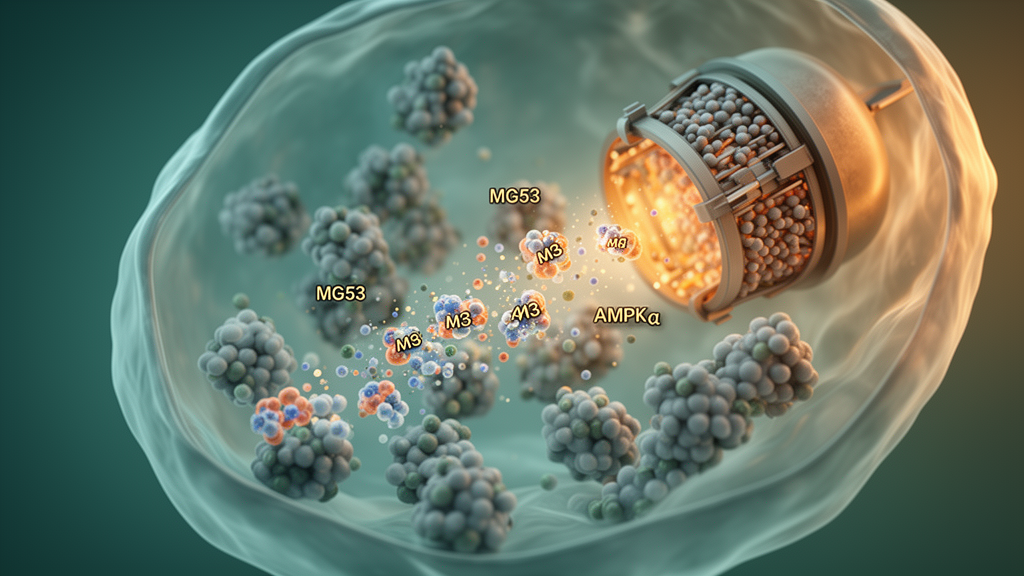
Biochemical experiments identified AMPKα as a molecular target of MG53. Co-immunoprecipitation indicated that MG53 and AMPKα interacted, while ubiquitination assays showed that MG53 promoted AMPKα ubiquitination. The authors further demonstrated that MG53 drove AMPKα toward proteasomal degradation.
Together, the experiments support a mechanism in which elevated MG53 reduces AMPKα abundance, attenuates glycolytic metabolism, and suppresses bladder cancer-cell proliferation and invasion. The evidence comes from molecular assays and bladder cancer-cell experiments; the supplied study summary does not provide the full range of experimental controls or the complete sequence of downstream events. Findings from xenograft models extended the cell results to an in vivo setting.
In those animal models, MG53 overexpression inhibited tumor growth, supporting a suppressive role for the protein in the experimental bladder cancer system. The work identifies MG53 as a candidate therapeutic target, but the researchers explicitly stated that its translational value remains to be established in future preclinical and clinical studies. Accordingly, the results provide a mechanistic and preclinical basis for further investigation of MG53-mediated AMPKα degradation, rather than evidence that MG53-directed treatment is ready for clinical use.
Subject of Research: Preclinical study of MG53-mediated AMPKα degradation in bladder cancer.
Article Title: MG53 suppresses the progression of bladder cancer through E3 ubiquitin ligase-mediated degradation of AMPKα
Article References: He, X., Zhang, H., Zhang, Y., Wu, J., Wang, T., Liu, Y., Jin, K., Tang, W., Ye, Q., & Wang, Q. (2026). MG53 suppresses the progression of bladder cancer through E3 ubiquitin ligase-mediated degradation of AMPKα. Medical Oncology, 43(11), Article 337. https://doi.org/10.1007/s12032-026-03448-7
Image Credits: AI Generated
DOI: 10.1007/s12032-026-03448-7
Keywords: MG53, TRIM72, bladder cancer, AMPKα, E3 ubiquitin ligase, protein degradation, glycolytic metabolism, reactive oxygen species, apoptosis, xenograft models, suppresses, progression
News Source: Nathaniel Bowman. (October 20, 2026). MG53 degrades AMPKα and suppresses bladder cancer in preclinical models. Scienmag.