• HOME
  • NEWS
  • EXPLORE
    • CAREER
      • Companies
      • Jobs
    • EVENTS
    • iGEM
      • News
      • Team
    • PHOTOS
    • VIDEO
    • WIKI
  • BLOG
  • COMMUNITY
    • FACEBOOK
    • INSTAGRAM
    • TWITTER
Thursday, December 4, 2025
BIOENGINEER.ORG
No Result
View All Result
  • Login
  • HOME
  • NEWS
  • EXPLORE
    • CAREER
      • Companies
      • Jobs
        • Lecturer
        • PhD Studentship
        • Postdoc
        • Research Assistant
    • EVENTS
    • iGEM
      • News
      • Team
    • PHOTOS
    • VIDEO
    • WIKI
  • BLOG
  • COMMUNITY
    • FACEBOOK
    • INSTAGRAM
    • TWITTER
  • HOME
  • NEWS
  • EXPLORE
    • CAREER
      • Companies
      • Jobs
        • Lecturer
        • PhD Studentship
        • Postdoc
        • Research Assistant
    • EVENTS
    • iGEM
      • News
      • Team
    • PHOTOS
    • VIDEO
    • WIKI
  • BLOG
  • COMMUNITY
    • FACEBOOK
    • INSTAGRAM
    • TWITTER
No Result
View All Result
Bioengineer.org
No Result
View All Result
Home NEWS Science News

Metal-organic frameworks can separate gases despite the presence of water

Bioengineer by Bioengineer
February 26, 2020
in Science News
Reading Time: 2 mins read
0
IMAGE
Share on FacebookShare on TwitterShare on LinkedinShare on RedditShare on Telegram

IMAGE

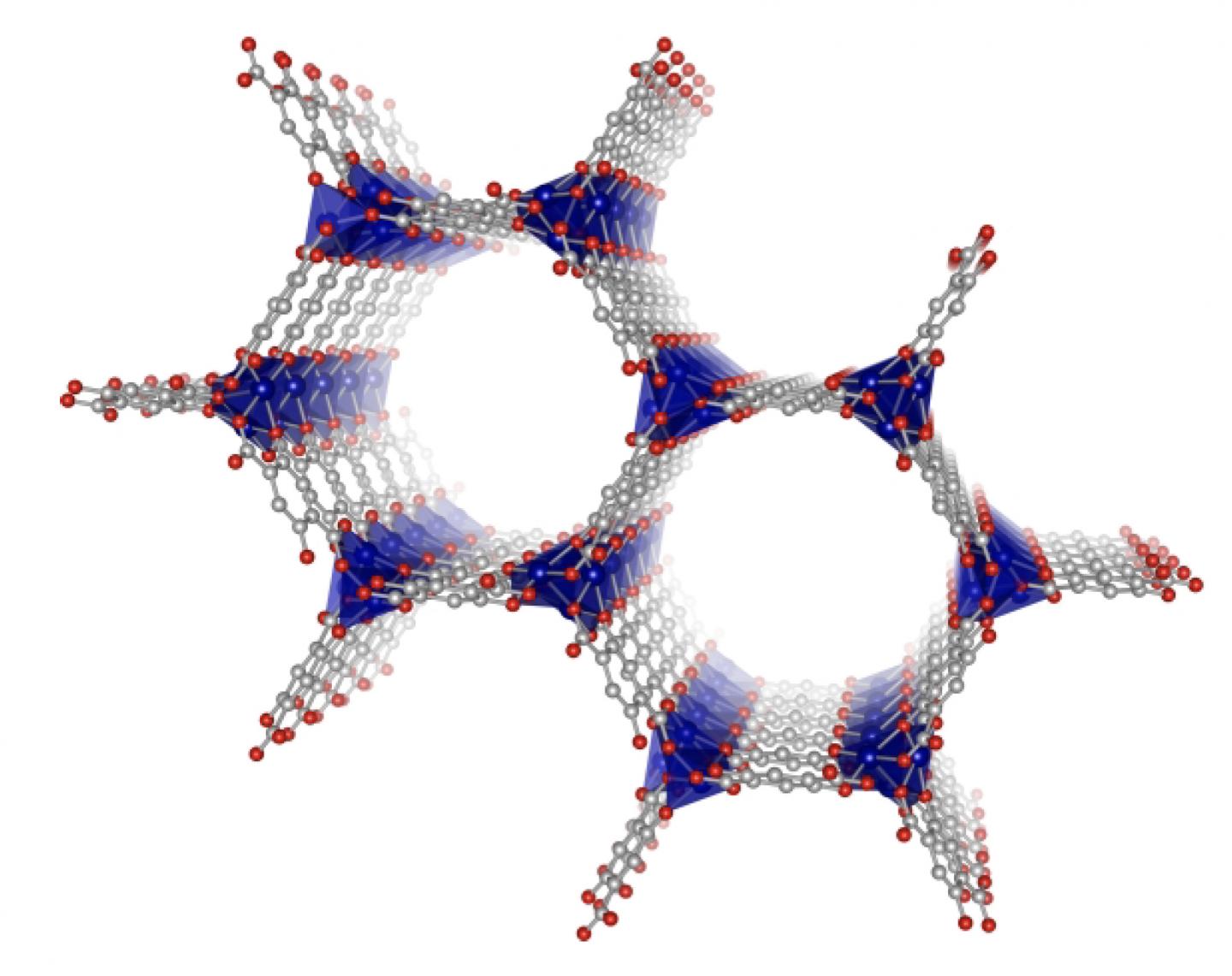
Credit: Vervoorts P. et al., ACS Applied Materials & Interfaces, Jan. 27, 2020


Metal-organic frameworks (MOFs) are promising materials for inexpensive and less energy-intensive gas separation even in the presence of impurities such as water.

Experimental analyses of the performance of metal-organic frameworks (MOFs) for the separation of propane and propene under real-world conditions revealed that the most commonly used theory to predict the selectivity does not yield accurate estimates, and also that water as an impurity does not have a detrimental effect on the material’s performance.

Short chain hydrocarbons are produced in mixtures after treatment of crude oil in refineries and need to be separated in order to be industrially useful. For example, propane is used as a fuel and propene as a raw material for chemical synthesis such as the production of polymers. However, the separation process usually requires high temperatures and pressures, and additionally the removal of other impurities such as water makes the process costly and energy-consuming.

The structure of the studied MOF offers a long-lived, adaptable, and most importantly efficient separation alternative at ambient conditions. They build on the fact that unsaturated molecules such as propene can be complexed with the material’s exposed metal atoms, while saturated ones such as propane fail to do so. While research has focused on developing different metal-organic frameworks for different separation processes, the feasibility of using these materials on industrial-scale applications is commonly only gauged by relying on a theory that makes many idealizing assumptions on both the material and the purity of the gasses. Thus, it has not been clear whether these predictions hold under more complicated but also more realistic conditions.

A team of Hokkaido University researchers around Professor Shin-ichiro Noro in collaboration with Professor Roland A. Fischer’s group at the Technical University of Munich conducted a series of measurements on the performance of a prototypical MOF to ascertain the material’s real-world selectivity, for both completely dry frameworks and ones pre-exposed to water.

Their results recently published in ACS Applied Materials & Interfaces show that the predicted selectivities of the material are too high compared to the real-world results. It also demonstrated that water does not drastically decrease the selectivity, although it does reduce the material’s capacity to adsorb gas. The team then performed quantum-chemical computations to understand why and realized that the water molecules themselves offer new binding sites to unsaturated hydrocarbons, such as propene (but not propane), thus retaining the material’s functionality.

The researchers state: “We showed the power of multi-component adsorption experiments to analyze the feasibility of using an MOF system.” They thus want to raise awareness of the shortcomings of commonly used theories and motivate other groups to also use a combination of different real-world measurements.

###

Media Contact
Naoki Namba
[email protected]
81-117-062-185

Original Source

https://www.global.hokudai.ac.jp/blog/metal-organic-frameworks-can-separate-gases-despite-the-presence-of-water/

Related Journal Article

http://dx.doi.org/10.1021/acsami.9b21261

Tags: Biomedical/Environmental/Chemical EngineeringChemistry/Physics/Materials SciencesEnergy/Fuel (non-petroleum)Industrial Engineering/ChemistryMaterialsTechnology/Engineering/Computer Science
Share12Tweet8Share2ShareShareShare2

Related Posts

Boosting Cancer Immunotherapy by Targeting DNA Repair

December 3, 2025
blank

Evaluating eGFR Equations in Chinese Children

December 3, 2025

Metformin-Alogliptin Combo vs. Monotherapy in Diabetes

December 3, 2025

Botanical Extracts’ Antibacterial Activity Boosted by Enhancers

December 3, 2025
Please login to join discussion

POPULAR NEWS

  • New Research Unveils the Pathway for CEOs to Achieve Social Media Stardom

    New Research Unveils the Pathway for CEOs to Achieve Social Media Stardom

    204 shares
    Share 82 Tweet 51
  • Scientists Uncover Chameleon’s Telephone-Cord-Like Optic Nerves, A Feature Missed by Aristotle and Newton

    120 shares
    Share 48 Tweet 30
  • Neurological Impacts of COVID and MIS-C in Children

    107 shares
    Share 43 Tweet 27
  • MoCK2 Kinase Shapes Mitochondrial Dynamics in Rice Fungal Pathogen

    69 shares
    Share 28 Tweet 17

About

We bring you the latest biotechnology news from best research centers and universities around the world. Check our website.

Follow us

Recent News

Boosting Cancer Immunotherapy by Targeting DNA Repair

Evaluating eGFR Equations in Chinese Children

Metformin-Alogliptin Combo vs. Monotherapy in Diabetes

Subscribe to Blog via Email

Enter your email address to subscribe to this blog and receive notifications of new posts by email.

Join 69 other subscribers
  • Contact Us

Bioengineer.org © Copyright 2023 All Rights Reserved.

Welcome Back!

Login to your account below

Forgotten Password?

Retrieve your password

Please enter your username or email address to reset your password.

Log In
No Result
View All Result
  • Homepages
    • Home Page 1
    • Home Page 2
  • News
  • National
  • Business
  • Health
  • Lifestyle
  • Science

Bioengineer.org © Copyright 2023 All Rights Reserved.