Sliding and twisting of van der Waals layers can produce fascinating physical phenomena. In a recent publication in Nature Communications, Daniel Bennett, Eric Bousquet and Philippe Ghosez, from the group of Theoretical Materials Physics (Q-MAT, CESAM Research Unit) at the University of Liège (BE) , with collaborators from the University of Cambridge (UK) show that moiré polar domains in bilayer hBN give rise to a topologically non-trivial winding of the polarization field, forming networks of merons and antimerons. This research is published in Nature Communications.
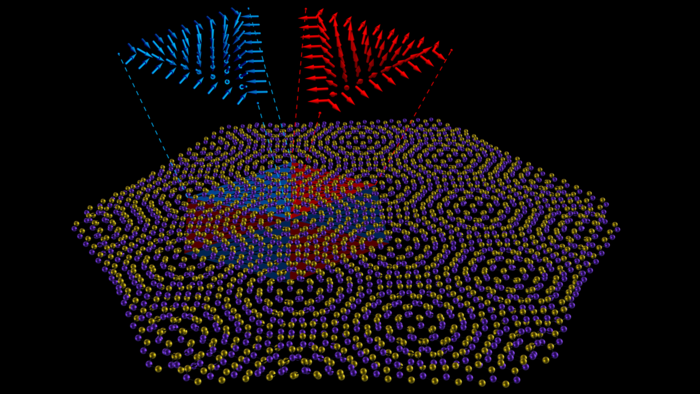
Credit: ©Université de Liège
Sliding and twisting of van der Waals layers can produce fascinating physical phenomena. In a recent publication in Nature Communications, Daniel Bennett, Eric Bousquet and Philippe Ghosez, from the group of Theoretical Materials Physics (Q-MAT, CESAM Research Unit) at the University of Liège (BE) , with collaborators from the University of Cambridge (UK) show that moiré polar domains in bilayer hBN give rise to a topologically non-trivial winding of the polarization field, forming networks of merons and antimerons. This research is published in Nature Communications.
Out-of-plane polarization was recently been discovered in layered systems with broken inversion symmetry such as hexagonal boron nitride and transition metal dichalcogenides such as MoS2. The polarization depends on the relative stacking between the layers, and when the layers are aligned, the out-of-plane polarization can be switched via a sliding between the layers, resulting in ferroelectricity. When there is a relative twist angle or lattice mismatch between the layers, forming a supercell known as a moiré superlattice, there is a local polarization for each different stacking, resulting in a network of moiré polar domains (MPDs). These MPDs have been experimentally shown to result in ferroelectricity, making them a promising option for nanoscale electronic applications such as information processing and memory storage.
Here it is shown that this symmetry breaking also gives rise to a previously overlooked in-plane component of polarization, and the form of the total polarization is determined purely from symmetry considerations. The in-plane component of the polarization makes the MPDs in strained and twisted bilayers topologically non-trivial. In each individual domain, the polarization completes exactly half a winding realizing a topological object known as a meron (half-skyrmion). The MPDs in strained or twisted bilayers therefore form a regular network of topological polar merons and antimerons. For strained bilayers, the polarization flows into and out of the centers of the domains (Néel type), whereas for twisted bilayers, the polarization curls around the centers of the domains (Bloch type). This means that the topological properties in these materials can be controlled by aligning the layers in different ways.
The MPDs in strained or twisted bilayers may serve as a new platform for engineering and exploring topological physics in two-dimensional layered materials.
Journal
Nature Communications
DOI
10.1038/s41467-023-37337-8
Article Title
Polar meron-antimeron networks in strained and twisted bilayers
Article Publication Date
24-Mar-2023