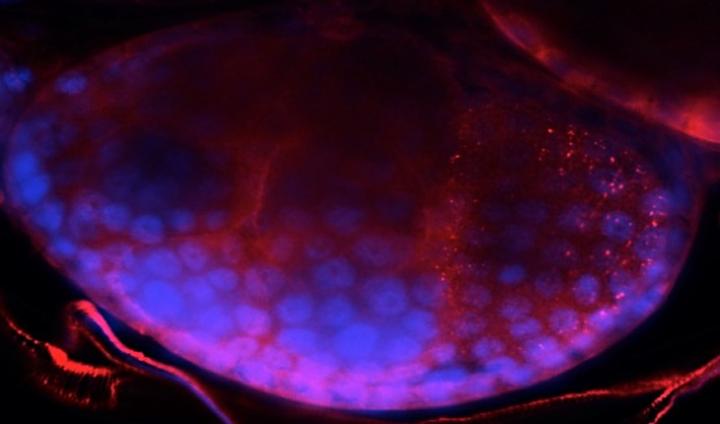
Credit: Rasgon Lab, Penn State
Researchers who developed an improved method of gene editing for the study of arthropods will expand the technology for use in vertebrate species such as mice, fish and birds after receiving new funding from the National Science Foundation.
A team led by Jason Rasgon, professor of entomology and disease epidemiology in Penn State’s College of Agricultural Sciences, received a two-year, more than $1.2 million extension of a previous grant from NSF’s Enabling Discovery through GEnomic Tools (EDGE) program. EDGE grants fund projects aimed at developing new genomic tools and providing the research community with information about how to use them.
The amount of the original award, announced in 2017, was $2.5 million. The new funding recognizes the team for research creativity — a type of merit-based grant extension that is very uncommon for NSF, according the Gary Felton, head of the Department of Entomology.
The gene-editing technology developed by Rasgon’s lab is called Receptor-Mediated Ovary Transduction of Cargo — or ReMOT Control. The tool builds on CRISPR/Cas9, a method for delivering a gene-splicing enzyme to a specific region of DNA to delete or add genes controlling certain traits. Genetic modification via CRISPR/Cas9 can help advance knowledge of an organism’s basic biology and holds promise for solving many challenges in medicine, agriculture and other fields.
Rasgon noted that traditional CRISPR approaches in arthropods rely on delivering gene-editing material to arthropod eggs by embryonic microinjection, which is difficult and inefficient and requires expensive equipment. However, ReMOT Control can deliver gene-editing cargo to a targeted portion of the arthropod genome by easy injection into female arthropods during egg development.
He explained that the team is exploiting a natural process called “vitellogenesis” that is present in almost all multicellular animals.
“In vitellogenesis, yolk proteins are made in the liver of vertebrates or in the fatbody of arthropods and secreted into the circulatory system, where they bind to receptors on the ovaries and are taken up into the developing eggs,” Rasgon said. “We found that we can target our gene-editing cargo into the developing eggs by identifying small molecules, called peptides, that bind to these same receptors and then attaching the cargo to them.”
The process results in offspring that exhibit the desired genetic modification. The researchers have developed a peptide sequence that delivers cargo to the ovaries of about 90% of all arthropods tested, according to Rasgon.
“We and our collaborators have used the system to genetically modify almost a dozen arthropod species,” he said. “We also have developed rapid methods to identify new targeting peptides for species in which our general peptide doesn’t work. To move this process into egg-laying vertebrates such as fish or birds, we simply need to develop targeting peptides for these new species.”
Rasgon said the team also has made progress in the dissemination of the ReMOT Control technology, which he contends could have broad application for scientists involved in research on animal behavior, animal physiology, insect-plant interactions, sustainable agriculture and public health.
“We have shared our methodology and sent reagents to almost 50 laboratories in more than a dozen countries around the world,” he said. “We are very grateful to NSF for recognizing our progress in this project, the ultimate goal of which is to break down barriers to genetic modification and democratize gene-editing capability.”
###
Other researchers on the project are Joyce Sakamoto, research assistant professor of entomology, and Christina Grozinger, distinguished professor of entomology, Penn State; and Angela Douglas, professor of insect physiology and toxicology, Cornell University.
Media Contact
A’ndrea Elyse Messer
[email protected]