• HOME
  • NEWS
  • EXPLORE
    • CAREER
      • Companies
      • Jobs
    • EVENTS
    • iGEM
      • News
      • Team
    • PHOTOS
    • VIDEO
    • WIKI
  • BLOG
  • COMMUNITY
    • FACEBOOK
    • INSTAGRAM
    • TWITTER
Saturday, June 27, 2026
BIOENGINEER.ORG
No Result
View All Result
  • Login
  • HOME
  • NEWS
  • EXPLORE
    • CAREER
      • Companies
      • Jobs
        • Lecturer
        • PhD Studentship
        • Postdoc
        • Research Assistant
    • EVENTS
    • iGEM
      • News
      • Team
    • PHOTOS
    • VIDEO
    • WIKI
  • BLOG
  • COMMUNITY
    • FACEBOOK
    • INSTAGRAM
    • TWITTER
  • HOME
  • NEWS
  • EXPLORE
    • CAREER
      • Companies
      • Jobs
        • Lecturer
        • PhD Studentship
        • Postdoc
        • Research Assistant
    • EVENTS
    • iGEM
      • News
      • Team
    • PHOTOS
    • VIDEO
    • WIKI
  • BLOG
  • COMMUNITY
    • FACEBOOK
    • INSTAGRAM
    • TWITTER
No Result
View All Result
Bioengineer.org
No Result
View All Result
Home NEWS Science News Chemistry

Mercury transit observed at Cerro Tololo Inter-American Observatory — IOTW1948

Bioengineer by Bioengineer
December 2, 2019
in Chemistry
Reading Time: 2 mins read
0
IMAGE
Share on FacebookShare on TwitterShare on LinkedinShare on RedditShare on Telegram

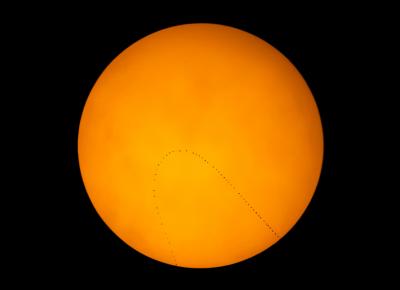
Transit image with a twist (and a turn!)
IMAGE

Credit: NSF’s National Optical-Infrared Astronomy Research Laboratory

About 13 times per century, fleeting Mercury can be seen passing directly in front of the Sun in what is called a transit. The most recent Mercury transit occurred on 11 November 11, 2019.

Teams on Cerro Tololo Inter-American Observatory (CTIO) and Kitt Peak National Observatory (KPNO) developed observing plans in an effort to recreate an experiment to calculate the Earth-Sun distance. CTIO’s Daniel Munizaga obtained this image of the transit with a 6-inch Celestron Nexstar telescope and a Nikon D750 camera by taking images every five minutes. While the path of Mercury across the Sun in fact traced a straight line, in this image the path appears to loop backwards owingdue to an effect called field rotation as the telescope and camera track across the sky.

Juan Seguel also imaged the transit of Mercury from CTIO, accompanied by students from the Universidad de La Serena. They imaged the transit with an 11-inch Nexstar telescope and ZWO 1600MM Pro camera equipped with a Fastar system. Simultaneously, Rob Sparks led a team of students from Ha:san Preparatory and Leadership School imaging the transit on Kitt Peak with an 8-inch Nexstar telescope and Canon 6d camera. Kitt Peak suffereddealt with clouds and could only image part of the transit.

The goal of having two widely separated teams imaging the transit is to recreate the historic measurement of the distance from the Earth to the Sun. Mercury will appear in slightly different positions on the Sun owingdue to parallax. By carefully measuring the difference in Mercury’s position, and knowing how far apart the observers were, the distance to the Sun can be calculated.

Teams will not have another opportunity to attempt this observation until the next transit of Mercury on 14 November 14, 2032.

###

Media Contact
Peter Michaud
[email protected]
808-974-2510

Original Source

https://nationalastro.org/news/mercury-transit-observed-at-cerro-tololo-inter-american-observatory-iotw1948/

Tags: AstronomyAstrophysicsPlanets/MoonsSpace/Planetary ScienceStars/The Sun
Share12Tweet8Share2ShareShareShare2

Related Posts

AI and Physics Collaborate to Design Advanced Hydrogen Storage Materials

June 25, 2026

International Team Including Dresden Scientists Develops Novel Designer Proteins for Advanced Study of Living Tissue

June 25, 2026

New Study Uncovers Key Factors Driving Water Chemistry in Nanoscale Environments

June 25, 2026

Plasma Technology Extends Catalyst Lifespan in Hydrogen Production

June 24, 2026
Please login to join discussion

POPULAR NEWS

  • Saying Goodbye to PGY-6: Pediatric Fellowship Realities

    103 shares
    Share 41 Tweet 26
  • Multi-Hospital Study Reveals Long Covid Burden Is Twice as High as Current Estimates

    92 shares
    Share 36 Tweet 23
  • Detection of EDCs in Breast Milk and Infant Urine Up to Six Months Highlights Early Exposure Risks

    77 shares
    Share 31 Tweet 19
  • New Drug Candidate Developed at McMaster Shows Potential for Treating Brain Cancer

    58 shares
    Share 23 Tweet 15

About

We bring you the latest biotechnology news from best research centers and universities around the world. Check our website.

Follow us

Recent News

Tracking Lanthanide-Labeled Microplastics in Plants

POSTECH Researchers Slash Cost of Reconstituted Cell-Free Systems by 95%

AI and Physics Collaborate to Design Advanced Hydrogen Storage Materials

Subscribe to Blog via Email

Success! An email was just sent to confirm your subscription. Please find the email now and click 'Confirm' to start subscribing.

Join 82 other subscribers
  • Contact Us

Bioengineer.org © Copyright 2023 All Rights Reserved.

Welcome Back!

Login to your account below

Forgotten Password?

Retrieve your password

Please enter your username or email address to reset your password.

Log In
No Result
View All Result
  • Homepages
    • Home Page 1
    • Home Page 2
  • News
  • National
  • Business
  • Health
  • Lifestyle
  • Science

Bioengineer.org © Copyright 2023 All Rights Reserved.