• HOME
  • NEWS
  • EXPLORE
    • CAREER
      • Companies
      • Jobs
    • EVENTS
    • iGEM
      • News
      • Team
    • PHOTOS
    • VIDEO
    • WIKI
  • BLOG
  • COMMUNITY
    • FACEBOOK
    • INSTAGRAM
    • TWITTER
Wednesday, May 13, 2026
BIOENGINEER.ORG
No Result
View All Result
  • Login
  • HOME
  • NEWS
  • EXPLORE
    • CAREER
      • Companies
      • Jobs
        • Lecturer
        • PhD Studentship
        • Postdoc
        • Research Assistant
    • EVENTS
    • iGEM
      • News
      • Team
    • PHOTOS
    • VIDEO
    • WIKI
  • BLOG
  • COMMUNITY
    • FACEBOOK
    • INSTAGRAM
    • TWITTER
  • HOME
  • NEWS
  • EXPLORE
    • CAREER
      • Companies
      • Jobs
        • Lecturer
        • PhD Studentship
        • Postdoc
        • Research Assistant
    • EVENTS
    • iGEM
      • News
      • Team
    • PHOTOS
    • VIDEO
    • WIKI
  • BLOG
  • COMMUNITY
    • FACEBOOK
    • INSTAGRAM
    • TWITTER
No Result
View All Result
Bioengineer.org
No Result
View All Result
Home NEWS Science News Biology

Melanin-producing Streptomyces are more likely to colonize plants

Bioengineer by Bioengineer
November 20, 2019
in Biology
Reading Time: 2 mins read
0
IMAGE
Share on FacebookShare on TwitterShare on LinkedinShare on RedditShare on Telegram

IMAGE

Credit: Phytobiomes Journal


Plant growth-promoting Streptomyces assemble into the internal, root endophytic compartments of a wide variety of plants around the world. These bacteria are well-known for their ability to produce a huge array of secondary metabolites and also protect against pests.

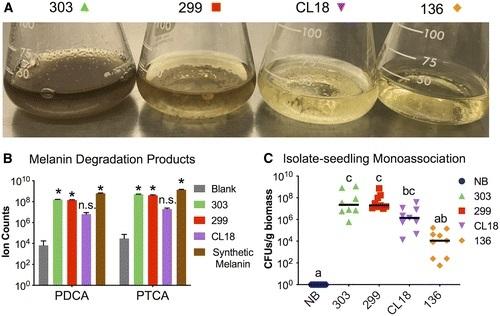
Recent research published in Phytobiomes Journal demonstrates that melanin-producing Streptomyces are more likely to colonize plants, which has been shown to be protective for many different organisms.

According to corresponding author Sarah Lebeis, “We show that the ability to produce melanin protects microbes from harmful chemicals they encounter when they live inside of a plant and that it is active when bacteria are inside plants. We believe that our findings provide a protective pathway potentially utilized by a variety of other microbes when they try to grow inside of plants.”

Lebeis and her fellow researchers at the University of Tennessee had access to an extensive collection of Streptomyces isolates from Arabidopsis thaliana roots grown in two soils in North Carolina. Upon analysis, they came up with the hypotheses that Streptomyces that produces melanin colonizes plants better. They tested this hypothesis using strains from another collection isolated from Poplar trees mostly on the West Coast but also from Appalachia and found similar results.

“This makes us think that this mechanism is more generalizable between plant-microbe interactions,” Lebeis explained. “The soils are very different between the collections, and the potential time required for the association could be very different (6 weeks for Arabidopsis, and potentially years for the Poplar). This make us think that the protection being able to make melanin provides is in response to a strong selective pressure from the plant.”

###

For more information about this research, which links biochemistry and genomics with the plant-microbe interaction field, read “Root-Associated Streptomyces Isolates Harboring melC Genes Demonstrate Enhanced Plant Colonization” published in the September issue of Phytobiomes Journal.

Media Contact
Ashley Bergman Carlin
[email protected]
651-994-3832

Related Journal Article

http://dx.doi.org/10.1094/PBIOMES-01-19-0005-R

Tags: BacteriologyBiologyForestryGenesGeology/SoilMicrobiologyMolecular BiologyPlant Sciences
Share12Tweet8Share2ShareShareShare2

Related Posts

Hidden Giant Viruses Infect and Inherit in Algae — Biology

Hidden Giant Viruses Infect and Inherit in Algae

May 13, 2026
NAD(P)H Dehydrogenase Diversity Drives Clofazimine Resistance — Biology

NAD(P)H Dehydrogenase Diversity Drives Clofazimine Resistance

May 13, 2026

Rhein Alleviates Intestinal Damage in Severe Acute Pancreatitis by Modulating Macrophage Activation via PPARγ

May 13, 2026

Using Real-Time Brain Signals to Forecast and Prevent Attention Lapses in Children

May 13, 2026
Please login to join discussion

POPULAR NEWS

  • Research Indicates Potential Connection Between Prenatal Medication Exposure and Elevated Autism Risk

    842 shares
    Share 337 Tweet 211
  • New Study Reveals Plants Can Detect the Sound of Rain

    728 shares
    Share 290 Tweet 182
  • Salmonella Haem Blocks Macrophages, Boosts Infection

    62 shares
    Share 25 Tweet 16
  • Breastmilk Balances E. coli and Beneficial Bacteria in Infant Gut Microbiomes

    57 shares
    Share 23 Tweet 14

About

We bring you the latest biotechnology news from best research centers and universities around the world. Check our website.

Follow us

Recent News

Auditory Environment of Preterm Infants: Room and Parents Impact

National Coalition Launches Initiative to Enhance HIV Prevention Services in Community Pharmacies

Evaluating the Real-World Efficacy and Safety of Coblopasvir Plus Sofosbuvir for Chronic Hepatitis C Treatment in Wenzhou, Eastern China

Subscribe to Blog via Email

Enter your email address to subscribe to this blog and receive notifications of new posts by email.

Join 82 other subscribers
  • Contact Us

Bioengineer.org © Copyright 2023 All Rights Reserved.

Welcome Back!

Login to your account below

Forgotten Password?

Retrieve your password

Please enter your username or email address to reset your password.

Log In
No Result
View All Result
  • Homepages
    • Home Page 1
    • Home Page 2
  • News
  • National
  • Business
  • Health
  • Lifestyle
  • Science

Bioengineer.org © Copyright 2023 All Rights Reserved.