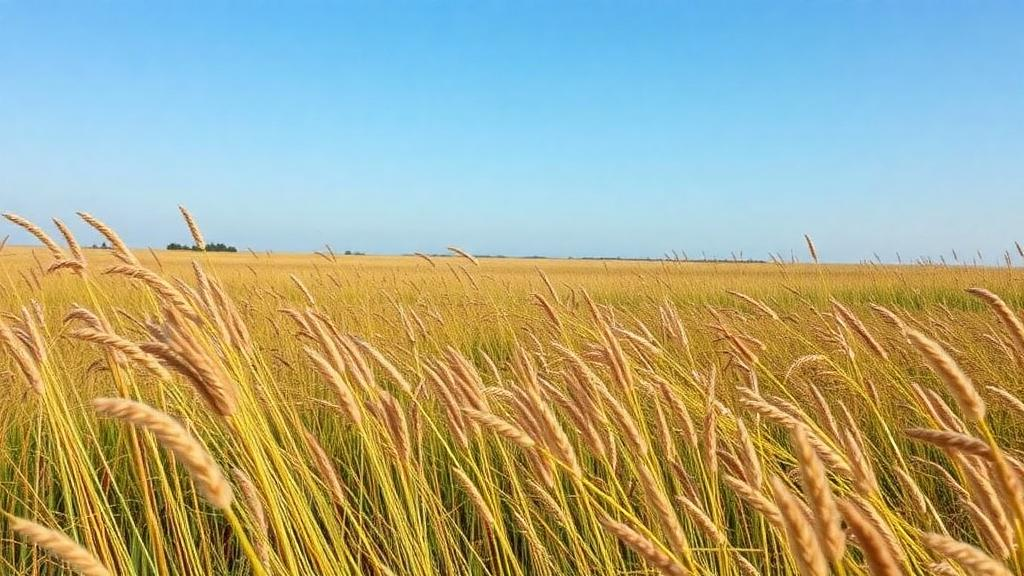
Across the central United States, an ambitious ecological project is quietly unfolding: the return of native prairie to landscapes that agriculture and development have transformed over the past century and a half. Restored prairies can rebuild soil health, filter water, and provide critical habitat for pollinators, grassland birds, and other wildlife that have suffered steep declines. Yet every successful restoration begins with something deceptively small — a seed. And behind every seed lies a network of people who collect it from remnant prairies, grow it in fields and greenhouses, clean and store it, and ultimately deliver it to the sites where restoration happens. A new study from South Dakota State University has, for the first time, mapped the human architecture of this system in the Northern Great Plains, and its findings challenge long-held assumptions about how native seed supply actually works.
The research, led by scientists at the Native Plant Initiative at South Dakota State University and published in the journal People and Nature, took an unusual approach for a field dominated by agronomy and ecology. Rather than focusing primarily on seed biology or production technology, the team applied social science methods, along with resilience and systems thinking, to understand the relationships, values, and institutions that hold the native seed system together. Jennifer Zavaleta Cheek, assistant professor in the SDSU Department of Natural Resource Management, explained that native seed systems face ecological, production, and technological challenges, but that understanding them requires looking beyond infrastructure. Culture, knowledge, economics, and interpersonal trust all shape whether the system can withstand shocks and continue supplying seed over decades, not just seasons.
The study was guided from its inception by the Native Seed Strategy developed by the Northern Great Plains Native Seed Partnership, a collaborative plan that explicitly identified the need to understand the social dimensions of seed supply in order to strengthen collaboration and long-term resilience. Elena Friedman, first author of the paper and a master’s graduate from the program in August 2026, worked alongside Lora Perkins, director of the Native Plant Initiative, and Lauren Redmore, a conservation social scientist with the U.S. Forest Service, to gather the evidence. Their central method was qualitative and intensive: 60 detailed interviews with people involved in every facet of the seed network, from collectors and growers to buyers and land managers. What emerged from those conversations was a picture far more intricate than the researchers had anticipated.
The most striking discovery was that the region does not contain a single native seed system at all. The team had entered the project assuming that one interconnected supply chain served the Northern Great Plains, but the interviews revealed multiple distinct seed systems operating simultaneously in the same geography, each with its own participants, relationships, goals, and rules. This finding has immediate practical consequences. Policies or interventions designed for a hypothetical unified system — subsidies aimed at boosting production, for example, or centralized seed banks — might reach only one network while leaving others untouched, or worse, might disrupt relationships that the designers never knew existed.
Among the distinct networks identified, two stood out in sharp relief: the commercial system and the Tribal system. Participants in the commercial network were oriented around collecting, producing, selling, and using seed for ecological restoration projects, functioning much like a specialized agricultural supply chain with market dynamics, quality standards, and customer relationships. The Tribal system, by contrast, shared the goal of ecological restoration but embedded seed within a much broader community context. Tribal participants use native seeds for food and medicine, and they emphasized the significance of seeds in promoting reciprocity and sovereignty — concepts that have no direct equivalent in a commercial supply chain. In this view, seeds are not commodities to be produced in bulk but relatives and inheritances, carrying obligations of care and exchange across generations.
This distinction matters because previous research, lacking a deep understanding of each group’s goals, practices, and connections to native seeds, might have concluded that integrating the commercial and Tribal systems would benefit both by increasing overall production. Such a recommendation, the SDSU team suggests, would rest on a fundamental misunderstanding. Merging systems with different values and objectives could erode the very relationships and cultural practices that sustain the Tribal network, without delivering meaningful gains to anyone. The finding underscores why social-ecological research — work that treats human communities and natural resources as inseparable parts of one system — is essential before well-intentioned interventions are deployed.
Zavaleta Cheek framed the work explicitly in the language of resilience theory. Building resilience in a native seed system, she argued, is not only a matter of having enough seed or the right storage and production infrastructure. It is equally about strengthening the relationships, knowledge systems, values, and institutions that allow both people and native landscapes to thrive together over time. In resilience terms, a system can appear robust while actually being brittle: abundant seed supply means little if the trust between growers and buyers collapses, if Traditional Ecological Knowledge is lost, or if the institutions governing seed use fail to reflect the communities they affect. The interviews captured precisely these intangible assets, which rarely appear in production statistics but determine whether a system adapts or fractures under stress.
The methodological contribution of the study is also significant. Survey-based and interview-based research of this depth is uncommon in native seed science, where most attention has gone to seed sourcing guidelines, genetic matching of seed to ecoregion, and agronomic techniques for propagating native species. By documenting 60 perspectives across the network, the researchers created something akin to a social map of the seed landscape — a baseline against which future changes can be measured. The work also demonstrates the value of qualitative social science for conservation practice: the surprise of discovering multiple parallel systems would not have emerged from production data alone, which tends to aggregate all seed activity into a single supply curve.
The next phase of the research follows two avenues, mirroring the dual nature of the findings. First, the team will continue investigating the relationships between people, native plants, and resilient landscapes, with a new focus on wild foods and the role they play in shaping resilient food systems — a natural extension of the finding that seeds carry meanings well beyond restoration. Second, with support from the Native Plant Initiative, the researchers hope to partner with specialty crop farmers to produce native seed, aiming to expand production capacity and supply for restoration projects across the region. This second avenue represents a practical test of the study’s insights: any effort to bring new growers into the system will need to respect the distinct networks the research identified rather than assuming a single market to be served.
For the researchers, the ultimate message extends well beyond the prairie states. Plants and landscapes are cultural, Zavaleta Cheek emphasized — what we expect a landscape to look like, which plants we value, and what we consider productive or worth restoring are all shaped by culture and by our relationships with those landscapes. Those values, in turn, influence what societies choose to conserve and restore. As prairie restoration scales up across North America and elsewhere, the SDSU study offers a caution and an invitation: the seed may be the foundation of restoration, but the people who gather, grow, and give meaning to that seed are the foundation of the system itself. Sustaining native landscapes for future generations, the work suggests, means sustaining the human networks that make restoration possible.
Subject of Research: Social-ecological resilience of native prairie seed systems in the Northern Great Plains
Article Title: Plants, people and progress for native prairie seeds
Article References: Plants, people and progress for native prairie seeds. (n.d.). Original publication
Image Credits: AI Generated
DOI: Not provided
Keywords: native seeds, prairie restoration, Northern Great Plains, social-ecological systems, resilience, Tribal seed networks, seed production, South Dakota State University, People and Nature, ecological restoration, seed sovereignty, conservation social science
News Source: Alan Morgan. (October 7, 2026). Behind every restored prairie lies a web of people, values and seed networks. Scienmag.