• HOME
  • NEWS
  • EXPLORE
    • CAREER
      • Companies
      • Jobs
    • EVENTS
    • iGEM
      • News
      • Team
    • PHOTOS
    • VIDEO
    • WIKI
  • BLOG
  • COMMUNITY
    • FACEBOOK
    • INSTAGRAM
    • TWITTER
Sunday, July 5, 2026
BIOENGINEER.ORG
No Result
View All Result
  • Login
  • HOME
  • NEWS
  • EXPLORE
    • CAREER
      • Companies
      • Jobs
        • Lecturer
        • PhD Studentship
        • Postdoc
        • Research Assistant
    • EVENTS
    • iGEM
      • News
      • Team
    • PHOTOS
    • VIDEO
    • WIKI
  • BLOG
  • COMMUNITY
    • FACEBOOK
    • INSTAGRAM
    • TWITTER
  • HOME
  • NEWS
  • EXPLORE
    • CAREER
      • Companies
      • Jobs
        • Lecturer
        • PhD Studentship
        • Postdoc
        • Research Assistant
    • EVENTS
    • iGEM
      • News
      • Team
    • PHOTOS
    • VIDEO
    • WIKI
  • BLOG
  • COMMUNITY
    • FACEBOOK
    • INSTAGRAM
    • TWITTER
No Result
View All Result
Bioengineer.org
No Result
View All Result
Home NEWS Science News Biology

Megadroughts fueled Peruvian cloud forest activity

Bioengineer by Bioengineer
December 9, 2019
in Biology
Reading Time: 3 mins read
0
IMAGE
Share on FacebookShare on TwitterShare on LinkedinShare on RedditShare on Telegram

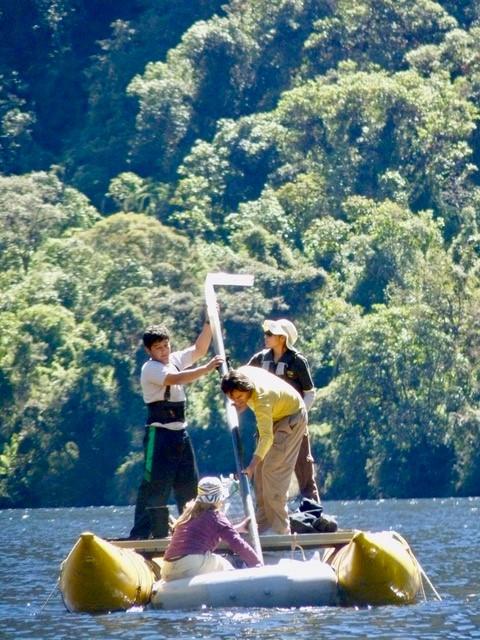
Sediment samples show recovery from some ecosystem damage possible
IMAGE

Credit: Florida Tech


MELBOURNE, FLA. — New research led by scientists from Florida Institute of Technology found that the strong and long-lasting droughts known as megadroughts parched the usually moist Peruvian cloud forests, spurring farmers to colonize new cropland.

The study, “2,100 years of human adaptation to climate change in the High Andes,” reveals that Andean climate changes – especially droughts – over the last 2,100 years were an important determinant of how land was used by native Andean societies. It was published online Dec. 9 in Nature Ecology and Evolution from scientists at Florida Tech, University of Miami and Columbus State University.

The setting of the study is the Laguna de los Cóndores, or Lake of the Condors, in Peru. This is an especially important area to archaeologists as the cliffs above the lake were a tomb-site for over 200 Incan and pre-Incan mummies.

One of the key findings of the study was that the peak of deforestation was about 800 A.D. and that the last deforestation to produce maize agriculture was about 1100 A.D. The farming ended by about 1200 A.D. and the forests reclaimed the valley around the lake. This timing coincided with two things: a wetter regional climate and the beginning of the cliff burials.

“As the landscape changed from a patchwork of maize fields and disturbed forests back to cloud forest, we saw an end to burning and an almost immediate improvement in the lake’s water quality,” said Mark Bush, professor of biology at Florida Tech and the team leader. “This recovery offers us the hope that some of the bad ecosystem impacts from deforestation and grazing in the Andes are reversible.”

But the study also shows that the projected increased droughts resulting from modern climate change in the Andes are likely to cause farmers to deforest and exploit cloud forest regions.

A grant to Bush from the National Geographic Society funded the fieldwork, and follow-up laboratory funding was provided by grants from the National Science Foundation and NASA.

The analysis of sediments recovered from the bottom of the lake provided multiple lines of evidence that included fossil pollen, charcoal and algae, and sediment chemistry. Data from these sources allowed the team to reconstruct an almost year-by-year history of the land use around the lake spanning the last 2,100 years. Multiple cycles of farming activity followed by abandonment aligned to changing climates were recorded, as were five megadroughts.

Each drought lasted for as much as a decade, and each time farmers exploited the valley. Between these dry periods, under the more normal, wetter conditions, the valley was largely abandoned, and forests regrew.

“We were surprised to see how responsive these populations were to climate change,” said Christine Åkesson, who conducted the study as a Ph.D. student at Florida Tech and is the lead author of the paper. “We expected to see a steady rise in land use peaking with the internment of mummies in the cliffs and the collapse of Incan society when the Spanish conquered this part of Peru in the 1570s, but that isn’t what happened.”

###

Media Contact
Adam Lowenstein
[email protected]
321-674-8964

Original Source

https://newsroom.fit.edu/2019/12/09/florida-tech-researchers-find-megadroughts-fueled-cloud-forest-activity/

Related Journal Article

http://dx.doi.org/10.1038/s41559-019-1056-2

Tags: BiodiversityBiologyClimate Change
Share12Tweet8Share2ShareShareShare2

Related Posts

Evolution-Inspired Biosensors Revolutionize Lipid Tracking in Real Time — Biology

Evolution-Inspired Biosensors Revolutionize Lipid Tracking in Real Time

July 2, 2026
New Study Reveals How to Reduce Risk of Dangerous Wildlife Encounters This Summer — Biology

New Study Reveals How to Reduce Risk of Dangerous Wildlife Encounters This Summer

July 2, 2026

Hepatic IFRD1 Alleviates Metabolic Dysfunction-Linked Steatohepatitis Through the GLUD1/α-KG Pathway

July 2, 2026

Intricate Food Webs Support Ecosystem Health and Stability

July 2, 2026
Please login to join discussion

POPULAR NEWS

  • Detection of EDCs in Breast Milk and Infant Urine Up to Six Months Highlights Early Exposure Risks

    77 shares
    Share 31 Tweet 19
  • Saying Goodbye to PGY-6: Pediatric Fellowship Realities

    103 shares
    Share 41 Tweet 26
  • New Drug Candidate Developed at McMaster Shows Potential for Treating Brain Cancer

    58 shares
    Share 23 Tweet 15
  • KTU Researchers Explore Ultrasound’s Role in Enhancing Blood Flow Beyond Diagnostics

    53 shares
    Share 21 Tweet 13

About

We bring you the latest biotechnology news from best research centers and universities around the world. Check our website.

Follow us

Recent News

Quasi-Bound States Boost Quantum Well Photoresponse

Lysine Pyruvylation Links Glycolysis to Epigenetics

Multiphysics Coupling: Single vs. Multiple DeepONet Branches

Subscribe to Blog via Email

Success! An email was just sent to confirm your subscription. Please find the email now and click 'Confirm' to start subscribing.

Join 83 other subscribers
  • Contact Us

Bioengineer.org © Copyright 2023 All Rights Reserved.

Welcome Back!

Login to your account below

Forgotten Password?

Retrieve your password

Please enter your username or email address to reset your password.

Log In
No Result
View All Result
  • Homepages
    • Home Page 1
    • Home Page 2
  • News
  • National
  • Business
  • Health
  • Lifestyle
  • Science

Bioengineer.org © Copyright 2023 All Rights Reserved.