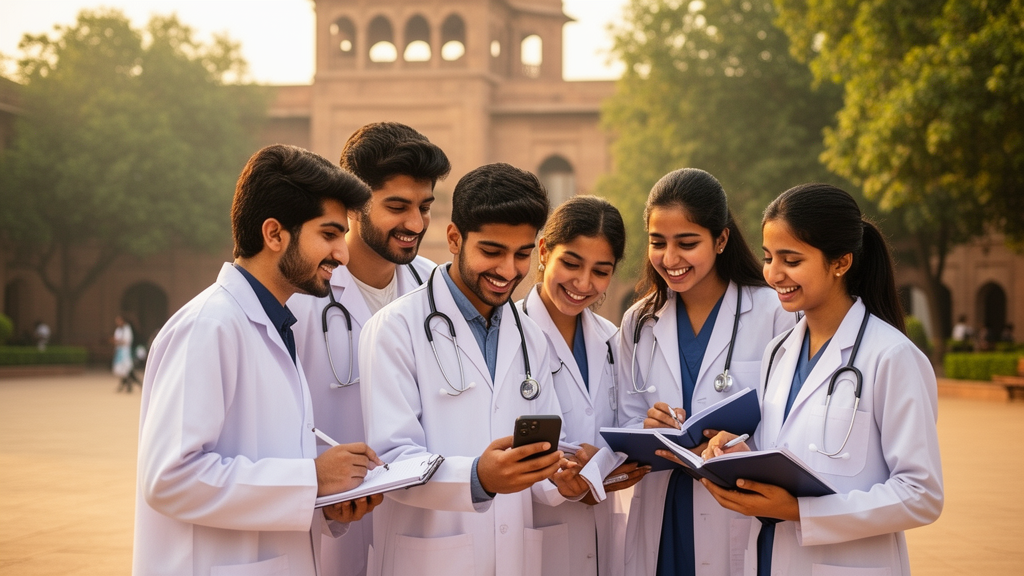
Medical students at a private Pakistani medical college rely on a shifting mix of peer resource sharing, time management, selective curation, device separation, and well-being practices to keep social media from undermining their studies, according to a qualitative case study published in BMC Digital Health. The study, conducted between September 2024 and February 2025, interviewed 25 undergraduate students at ABWA Medical College in Faisalabad, with five participants drawn from each of the five years of the Bachelor of Medicine and Bachelor of Surgery program. Because different students were sampled in each academic year at a single point in time, the researchers stress that the differences they observed between year groups are cross-sectional comparisons and must not be read as a developmental progression within individual learners.
The research team, led by Noor-i-Kiran Naeem with Muhammad Hamza Rana and Christine Phiri Mushibwe, used individual semi-structured interviews lasting 30 to 60 minutes, all conducted in English and audio-recorded with consent. Transcripts were checked against the recordings and returned to participants for member checking. Two researchers independently generated initial codes, and differences were resolved through discussion involving a third researcher rather than through calculation of intercoder agreement. Resilience theory informed the later interpretive stage of the analysis rather than serving as a predefined coding framework, allowing patterns to emerge from participants’ own accounts. Thematic saturation, defined as the point at which further interviews no longer generated substantially new codes or themes, was considered reached within the final sample of 25 participants.
The setting was deliberately bounded. ABWA Medical College follows an integrated modular curriculum supported by a digital learning ecosystem in which Google Classroom serves as the learning management system, teachers share files and video links, and active WhatsApp groups for different classes and modules carry resource sharing, including links to YouTube, Facebook, and LinkedIn. Some senior classes also use optional Facebook groups. The college was selected purposively as an information-rich case, and the authors emphasize that the institution was not treated as representative of all medical colleges. Eligible students needed at least one year of experience using social media for learning, and participation was voluntary, with recruitment through class WhatsApp groups.
The clearest pattern in the findings is that the strategies students described differed by academic-year group. First-year students emphasized supplementary use of YouTube and peer resource sharing as they adjusted to an information-dense curriculum focused on foundational subjects such as anatomy and physiology. One participant said YouTube videos had been lifesavers, especially for anatomy diagrams and physiology explanations. To cope with the volume of available content, these students described creating structured viewing schedules, forming study groups to exchange reliable resources, and prioritizing high-yield materials, while still regarding traditional classroom learning as integral to their foundational knowledge.
Second-year students, by contrast, more often described deliberate self-regulation and the management of distraction. They reported integrating specialized applications such as Teach Me Anatomy and Medscape alongside conventional resources, and they described challenges including procrastination and peer pressure to check links sent by friends. Their coping strategies included using a digital time-tracking tool to monitor study hours, applying the Pomodoro technique of 25-minute focused study sessions followed by short breaks, and practicing periodic digital detox, with one student describing complete avoidance of social media and the phone on some days as a mental reset that helped focus on studies.
Third-year students described confidence in navigating digital tools and selective use of resources for specific learning needs, along with frequent distraction from notifications and unrelated video recommendations. In response, they adopted device management strategies, including preferring laptops over mobile phones for academic use because phones produced constant notification interruptions, and they scheduled specific study times for online resources. They also emphasized collaborative learning through social media platforms, which they said served both to share useful content and to reduce feelings of isolation, with group study providing accountability. Fourth-year students described more selective use of digital resources, including Anki for flashcard-based learning, and reported digital fatigue and eye strain from extended screen exposure, which they mitigated through structured breaks, the Pomodoro technique, and downloading videos for offline study to avoid interruptions.
Final-year students, preparing for clinical practice, described consolidating learning through selective use of YouTube, Google, and WhatsApp groups for rapid revision and peer discussion. They reported fatigue, neck discomfort, and other effects of prolonged device use, and responded by keeping separate devices for educational and entertainment purposes, using a laptop specifically for study while keeping the phone away, taking notes offline, and watching previously downloaded videos. They also described balancing productivity with physical well-being through regular breaks, stretching exercises, and attention to posture during study. Across all five year groups, participants described different combinations of peer support, self-regulation, selective resource use, device management, boundary setting, and health-protective practices.
From these case-derived patterns the team proposed the DR-Compass, an exploratory conceptual model that organizes the reported strategies into personal capacities, behavioral strategies, and available support. The authors are explicit that the model is not validated and does not represent a developmental pathway: it has not undergone psychometric, structural, predictive, or external validation, and further conceptual refinement and testing in larger multicentre samples are required before it can inform assessment or curriculum decisions. The discussion situates the findings within Pakistani medical education, noting local evidence that self-regulated learning and technological competence contribute to students’ functioning in blended learning environments and that multicentre data have linked social media addiction with academic procrastination among medical students.
The study’s limitations are substantial and stated plainly. The sample was small and drawn from a single private medical college, limiting transferability to settings with comparable educational and digital characteristics, and the design prioritized contextual depth over population-level generalizability. Self-reported interview data may have been influenced by social desirability and recall bias. Because students from different academic years were sampled cross-sectionally, cohort effects, prior digital experience, curricular exposure, and personal circumstances may all have shaped the reported patterns, and a longitudinal design would be needed to determine whether and how individual students change their resilience strategies during training. Interviews were conducted by a researcher not affiliated with the institution to reduce the influence of existing institutional relationships, and the team maintained reflexive journals and peer debriefing throughout.
What the study ultimately offers is a detailed, locally grounded description of how one cohort of medical students manages the tensions of digitally mediated learning, from information overload and distraction to screen fatigue and physical discomfort. Digital resilience in this cohort was not reducible to technological proficiency; it was expressed through purposeful choices about attention, information quality, devices, peer support, disengagement, and physical and psychological well-being. The authors call for multicentre studies across public and private medical colleges, longitudinal follow-up of the same learners, and mixed-methods examination of relationships among digital resilience, digital well-being, self-regulated learning, technology use, and educational outcomes, to clarify whether the DR-Compass components recur across institutions and cultures and which forms of institutional support best sustain healthy, purposeful digital learning.
Subject of Research: Digital resilience strategies among undergraduate medical students using social media for learning in Pakistan
Article Title: From stress to strategies: developing digital resilience among medical students in Pakistan – a qualitative case study
Article References: Naeem, N.-I.-K., Rana, M. H., & Mushibwe, C. P. (2026). From stress to strategies: developing digital resilience among medical students in Pakistan – a qualitative case study. BMC Digital Health, 4(1), Article 75. https://doi.org/10.1186/s44247-026-00306-4
Image Credits: AI Generated
DOI: 10.1186/s44247-026-00306-4
Keywords: digital resilience, medical students, social media, qualitative case study, Pakistan, medical education, self-regulated learning, DR-Compass, thematic analysis, cross-sectional study, digital well-being, MBBS
News Source: Denise Maddox. (October 28, 2026). Medical students in Pakistan describe how they stay resilient while learning on social media. Scienmag.