


Chronic wounds affect more than 40 million patients worldwide, draining healthcare systems and trapping sufferers in cycles of pain, impaired mobility and social isolation. In the United States alone, treatment costs for wounds such as diabetic foot ulcers, pressure sores and severe burns are estimated at between 28 and 97 billion dollars annually, and some wounds can remain unhealed for years or even decades. Against this backdrop, a review published in May 2026 in a Springer Nature biomedical materials journal argues that the field’s next leap will not come from a new material alone, but from a smarter way of making materials: fusing electrospun nanofiber mats with quality by design (QbD) principles and artificial intelligence.
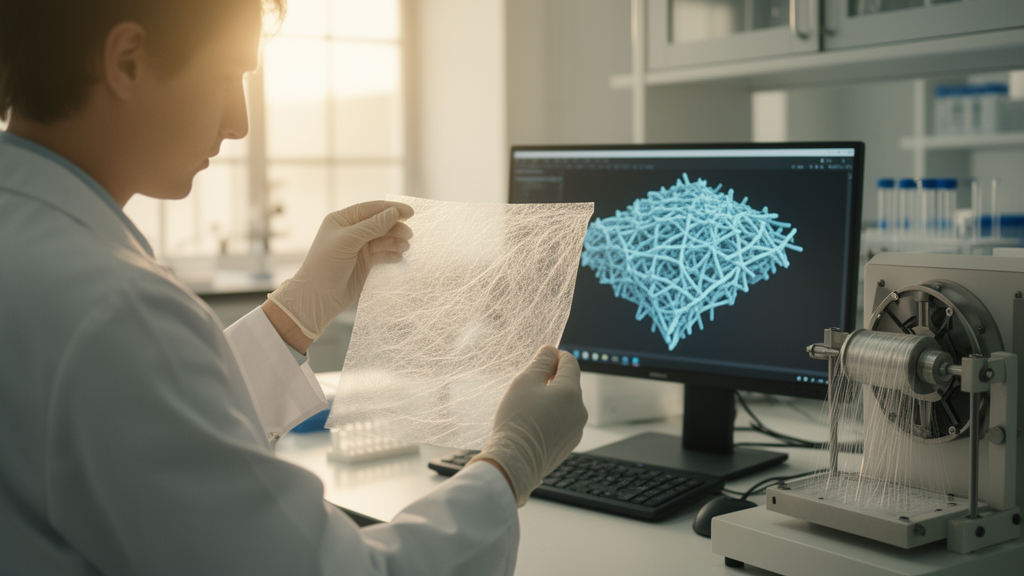
Nanofiber mats, typically 50 to 1000 nanometers in diameter, are produced by electrospinning, a technique that draws polymer solutions into ultrathin threads under high voltage. Their appeal in wound care lies in how closely they imitate the extracellular matrix, the fibrous scaffold that surrounds cells in native tissue. According to the review, experiments have shown that nanofiber dressings promote vascularization, re-epithelialization and collagen production, leading to faster healing. Their porous structure permits gas exchange, absorbs exudate without drying the wound bed, and can be loaded with antimicrobials, growth factors or anti-inflammatory agents to become active therapeutic platforms rather than passive barriers.
The contrast with conventional dressings is stark. Gauze and films act mainly as physical shields against contaminants; gauze can adhere to the wound bed and damage delicate regenerating tissue when removed, and neither format is designed to maintain the moist environment that healing requires. Disturbed moisture balance can promote maceration and bacterial colonization, and conventional dressings cannot deliver drugs to actively support tissue repair. As antibiotic-resistant bacteria spread and healing times stretch, the authors contend that passive coverage is no longer enough, yet many promising nanofiber dressings remain stuck in research laboratories.
The reason, they argue, is developmental: trial-and-error optimization, reliance on anecdotal observation, scaling difficulties and lengthy product cycles have kept laboratory successes from becoming clinical products. QbD offers a systematic alternative. Rooted in Joseph Juran’s work on quality by design and Genichi Taguchi’s robust design methods, and propelled by US Food and Drug Administration initiatives such as the process analytical technology program, QbD builds quality into a product from the start rather than testing it in at the end. For electrospinning, whose fiber characteristics are acutely sensitive to material and process conditions, this means defining a quality target product profile, identifying critical quality attributes (CQAs) such as fiber diameter, mechanical strength, biocompatibility, degradation rate and drug release, and then controlling the critical process parameters that govern them.
Those parameters are numerous and interdependent. Polymer concentration must exceed a critical entanglement threshold to prevent the jet from breaking into droplets; molecular weight, conductivity, surface tension and solvent volatility each shape fiber continuity and morphology. Applied voltage, typically between 10 and 30 kilovolts, flow rate, tip-to-collector distance, needle diameter, collector speed, humidity and temperature all leave their signatures on the final mat. Because changing one parameter usually forces re-optimization of the others, the review highlights design of experiments (DoE) methodologies as the practical toolkit: full factorial designs that map every combination, fractional factorial screens that cut experimental runs, response surface methods such as central composite and Box-Behnken designs, and Taguchi orthogonal arrays analyzed through signal-to-noise ratios.
The cited case studies show what this delivers. A full factorial optimization of tadalafil-loaded polyvinylpyrrolidone and polyethylene oxide nanofibers produced uniform, bead-free fibers averaging 422 nanometers in diameter with 95 percent yield, 94 percent drug loading and roughly 81.5 percent drug release within two minutes. A Box-Behnken optimization of poly(vinyl alcohol)/chitosan nanofibers yielded fibers averaging about 196.5 nanometers, with quadratic models accounting for more than 80 percent of the variation in fiber properties. A central composite design controlling humidity, collector distance, voltage and polymer content achieved a coefficient of determination of 93 percent for predicted fiber diameter, and another CCD-optimized dressing containing carbon quantum dots, iron oxide nanoparticles and rosemary extract showed increased cell viability, reduced wound size and enhanced antibacterial activity in the reported studies.
Artificial intelligence extends this logic from statistical mapping to prediction and control. Machine learning models have surpassed classical statistical techniques in forecasting fiber morphology, often achieving R-squared values above 0.95 for diameter prediction. One optimized artificial neural network predicted the diameter of electrospun Kefiran nanofibers with an R-squared of 0.994, exceeding earlier reported models, while an extreme gradient boosting model trained on roughly 3000 data points across different polymers and solvents reached an R-squared of 0.94 and, paired with a genetic algorithm, enabled inverse design of fibers from 100 to 4000 nanometers with minimal trial and error. Real-time monitoring is advancing in parallel: camera systems watching the Taylor cone and jet path, coupled with AI tools such as U-Net models, can detect droplet accumulation, multi-jet formation or needle clogging and trigger prompt parameter corrections.
The integration runs deeper than prediction. A hybrid unsupervised-supervised learning framework for quality monitoring classified defective versus homogeneous nanofiber regions in scanning electron microscopy images with up to 92.5 percent accuracy at lower computational cost than convolutional neural networks. An AI-enabled digital twin framework quantitatively linked electrospinning parameters to microstructure and performance, with coefficients of determination exceeding 0.95 for air permeability and tensile strength. Beyond manufacturing, AI supports personalized wound care: convolutional neural networks have annotated wound images with performance comparable to clinicians, sensors embedded in dressings can flag shifts in moisture, temperature or pH as early indicators of infection, and agent-based digital twins of wound environments have been combined with deep reinforcement learning to explore healing trajectories in volumetric muscle loss.
Sustainability emerges as a third pillar. The review advocates replacing petroleum-derived polymers with renewable biomaterials such as chitosan, cellulose, alginate, gelatin and plant proteins, some recovered from shellfish or seaweed waste, and swapping hazardous solvents like dimethylformamide and chloroform for acetic acid, ethanol, water, melt electrospinning or supercritical CO2-assisted approaches. Life cycle assessment, traditionally retrospective, can be embedded in QbD as a predictive design tool, with solvent hazard, energy consumption and biodegradation time treated as environmental critical quality attributes. Economically, the authors argue that QbD improves yield while AI cuts failed experiments, and that advanced dressings may lower total healthcare costs by accelerating healing, reducing infection and decreasing dressing-change frequency, particularly for diabetic ulcers, which disproportionately affect older and lower-income patients.
Substantial obstacles remain, and the review is candid about them. Single-needle electrospinning is too slow for industrial scale, prompting interest in needleless, rotary, melt and blow spinning alternatives. Sterilization is unresolved, since gamma irradiation and ethylene oxide can cause chain scission, crosslinking or morphological collapse in electrospun fibers and degrade incorporated drugs and growth factors. Regulatory pathways for adaptive, continuously learning AI medical devices are still evolving, with concepts such as Predetermined Change Control Plans and Good Machine Learning Practice only now being codified. Perhaps most fundamentally, AI models depend on the quality and consistency of heterogeneous datasets, and their performance drops when applied to material systems different from those they were trained on. The authors call for standardized metadata reporting, cross-laboratory validation, uncertainty quantification and physics-informed hybrid modeling to turn these tools from prediction engines into reliable decision-support systems. Whether the promised generation of intelligent, sustainable, patient-specific wound dressings materializes will depend on clearing exactly those hurdles.
Subject of Research: Integration of quality by design and artificial intelligence in the development of electrospun nanofiber wound dressings
Article Title: Innovative wound nanofiber mats: revolutionizing wound care through quality by design and artificial intelligence
Article References: Abodunrin, O. D., Atoyebi, E. O., Bricha, M., & Mabrouk, K. E. (2026). Innovative wound nanofiber mats: revolutionizing wound care through quality by design and artificial intelligence. Biomedical Materials Science, 1(1), Article 4. https://doi.org/10.1186/s44495-026-00004-3
Image Credits: AI Generated
DOI: 10.1186/s44495-026-00004-3
Keywords: nanofibers, electrospinning, wound care, quality by design, artificial intelligence, machine learning, chronic wounds, drug delivery, sustainability, digital twins, regulatory challenges, biomaterials
News Source: Blake Davidson. (October 28, 2026). AI and Quality by Design Reshape the Future of Nanofiber Wound Dressings. Scienmag.



