None
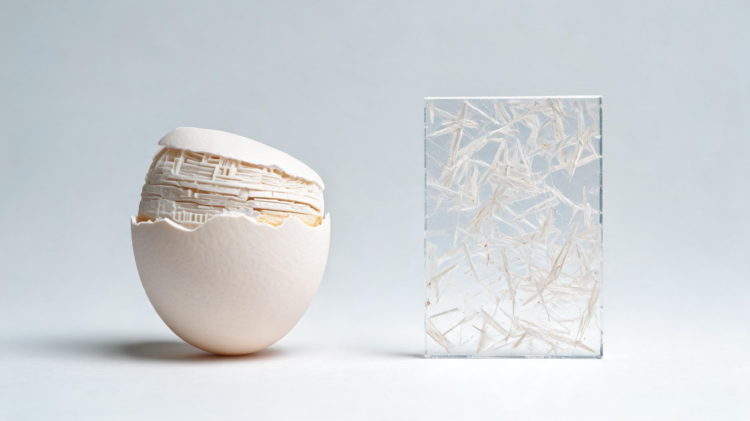
The development of hybrid bio-composites from eggshell and wastepaper particulates represents a meaningful step in the broader movement toward circular economy principles in materials engineering. Waste streams from the food processing and paper industries generate enormous quantities of discarded material each year, and much of this material retains structural and chemical characteristics that make it valuable as a reinforcement phase in polymer systems. Eggshell, in particular, is produced in vast amounts by hatcheries, bakeries, and food manufacturers, and its disposal often contributes to landfill burden and associated environmental costs. By diverting this calcium carbonate–rich bioceramic into composite manufacturing, researchers can simultaneously address a waste management challenge and reduce reliance on synthetic mineral fillers such as ground limestone or engineered calcium carbonate powders that carry higher embodied energy and processing costs.
The compositional profile of eggshell helps explain its effectiveness as a reinforcing filler. Composed of roughly ninety-five percent calcium carbonate in the calcitic polymorph, along with a minor organic fraction containing proteins, amino acids, type X collagen, and sulphated polysaccharides, eggshell occupies a distinctive position among animal-derived fillers. Calcite is a stiff mineral, and its presence in a finely divided particulate form allows it to carry a meaningful share of applied load when well bonded to a surrounding polymer matrix. The residual organic constituents, though small in proportion, can influence surface chemistry and may promote adhesion with polar polymer systems such as epoxy. The mineral’s structural resemblance to the hydroxyapatite of bone has also drawn attention from the biomedical materials community, although the authors of the underlying study are careful to note that any biomedical application remains preliminary until biocompatibility, cytotoxicity, and sterilization assessments are completed.
Wastepaper, by contrast, contributes a fundamentally different reinforcement mechanism. Paper is essentially a mat of cellulose fibers, and cellulose is among the most abundant biopolymers on Earth, offering high specific strength and good stiffness along the fiber axis. When paper is processed into particulates or short fibers and dispersed in a polymer matrix, the cellulose network can bridge cracks, dissipate energy, and improve toughness in ways that rigid mineral fillers alone cannot achieve. This complementary behavior is the central rationale for hybridization: the eggshell phase supplies hardness, rigidity, and wear resistance, while the paper-derived cellulose phase supplies crack bridging and energy absorption. A composite containing both phases can therefore achieve a more balanced property profile than either single-filler system, mitigating the brittleness that often accompanies heavily loaded mineral-filled thermosets.
Epoxy resin serves as a particularly suitable matrix for such hybrid systems. Thermosetting epoxies are valued for their high mechanical strength, strong adhesion to a wide range of organic and inorganic substrates, chemical resistance, low shrinkage during cure, and dimensional stability under fluctuating environmental conditions. These attributes make epoxy a versatile host for particulate and fibrous reinforcements alike. The resin’s ability to wet and bond to both calcitic mineral surfaces and lignocellulosic fibers is critical, because interfacial bonding governs load transfer between matrix and filler, and it is this load transfer that determines whether the composite realizes the full stiffening and strengthening potential of its reinforcement phases. The cured resin’s relative inertness and comparatively low toxicity also underpin the interest in epoxy-based composites for external biomedical-adjacent components, though such claims always require dedicated biological validation.
The findings reported in the study highlight the importance of filler loading as the dominant processing variable. At total filler contents up to ten weight percent, the hybrid composites showed substantial gains in strength, hardness, and wear resistance relative to neat epoxy, with the optimum occurring at six weight percent, where tensile and flexural strength improved by more than forty percent over the unreinforced resin. This kind of loading optimum is a recurring feature in particulate-filled polymer composites. At low to moderate loadings, particles are well separated, the matrix can wet each particle thoroughly, and stress is efficiently transferred from the weaker matrix to the stiffer filler. As loading increases further, the distance between particles shrinks, the amount of resin available to wet each surface declines, and the probability of particle-particle contact rises, setting the stage for agglomeration.
Scanning electron microscopy provided the microstructural evidence that connects processing to performance. At the optimal six weight percent loading, the filler particles were uniformly dispersed, interfacial bonding appeared strong, and microvoids were limited. Uniform dispersion matters because agglomerates act as stress concentrators: a cluster of poorly wetted particles behaves like a pre-existing flaw from which cracks can initiate under tensile or flexural loading. At higher filler contents, the microscopy revealed agglomeration, interfacial debonding, and particle pull-out, all of which are classic signatures of an over-loaded composite. Debonded interfaces no longer transfer load effectively, and pull-out events consume energy in ways that reduce stiffness and strength while often degrading wear behavior. The agreement between the mechanical data and the morphological observations illustrates the value of pairing macroscopic testing with microstructural characterization when developing particulate composites.
The tribological improvements observed in the hybrid system deserve particular attention for applications involving sliding contact or abrasion. Wear resistance in polymer composites is frequently enhanced by hard mineral fillers, which bear contact stresses and shield the softer matrix from direct abrasion. Calcium carbonate–rich eggshell particles can serve this role, while the cellulose component helps maintain cohesive integrity of the wearing surface. For candidate applications such as prosthetic shells, splints, and external medical support components, resistance to surface degradation during handling and everyday use is a practical advantage, even though these components are not load-bearing in the structural sense. The authors appropriately frame such uses as preliminary, emphasizing that suitability for biomedical contexts will require formal biocompatibility and cytotoxicity testing as well as sterilization assessments before any clinical relevance can be claimed.
The hybridization strategy employed here sits within a growing body of work on natural filler composites. Prior studies have explored eggshell alone in epoxy, reporting improvements in tensile strength, hardness, flexural performance, and water resistance as eggshell content increases. Others have examined hybrid systems pairing eggshell with plant fibers such as sisal, jute, coir, and date palm fiber, or incorporating materials as varied as chicken feathers, snail shells, silk fibers, and bagasse. The common thread across these investigations is the strategic substitution of synthetic reinforcements with naturally sourced materials drawn from agricultural, animal, and industrial waste streams. What distinguishes the present work is the deliberate pairing of a bioceramic with a lignocellulosic filler from an entirely different waste stream, creating a composite in which the two phases reinforce through distinct and complementary mechanisms rather than through similar ones.
This distinction matters because many existing hybrid systems combine fillers of the same general class, which tends to provide redundant reinforcement pathways. When both phases stiffen the matrix in the same way, the composite may gain hardness but sacrifice toughness, or vice versa. A bioceramic-plus-cellulose pairing, in contrast, addresses the classic stiffness-toughness trade-off: the mineral phase raises modulus and wear resistance while the fibrous phase contributes crack bridging and energy dissipation. The result, as demonstrated at the optimal loading, is a composite whose strength, hardness, and wear performance improve together rather than at one another’s expense. This complementary reinforcement concept is likely to inform future hybrid designs that combine mineral-rich and fiber-rich wastes from other sources.
From a sustainability standpoint, the environmental calculus of such composites is favorable on several fronts. First, the primary fillers are waste products that would otherwise require disposal, so their incorporation reduces landfill volume and the associated methane and leachate concerns of organic waste. Second, replacing a portion of petrochemical-derived resin with waste-derived filler lowers the composite’s effective polymer content and, by extension, its embodied carbon. Third, paper waste in many developing regions is still landfilled or incinerated, so valorizing it as cellulose reinforcement recovers material value that would otherwise be lost. These benefits align with global environmental stewardship goals and with the growing expectation that engineered materials should be evaluated not only on performance but also on life-cycle impact.
Several practical considerations will shape the path from laboratory demonstration to real-world use. Particle size and processing method strongly influence dispersion and interfacial quality, and prior eggshell studies have shown that particle size affects the balance of strength and hardness achieved. Moisture sensitivity of cellulose is another factor, since lignocellulosic fillers can absorb water and degrade interfacial bonding in humid environments; the reduced water absorption reported in some eggshell-filled systems suggests the mineral phase may partially mitigate this. Consistency of feedstock is also relevant, because eggshell composition and paper fiber quality can vary with source. Scaling production will require reliable cleaning, sterilization, and size-reduction steps for the eggshell, and controlled pulping or milling for the paper, all of which add processing cost that must be weighed against the waste-valorization benefit.
The prospective biomedical applications named in the study, including prosthetic shells, splints, and medical support components, occupy a category of external, non-load-bearing devices where mechanical requirements are moderate but surface quality, dimensional stability, and patient safety are paramount. Before such devices could be realized, the material would need to pass cytotoxicity screening, sensitization and irritation testing, and validation of sterilization methods that do not degrade the cellulose or the matrix. The authors’ explicit acknowledgment that these assessments remain to be conducted reflects a responsible framing of preliminary results, and it provides a clear roadmap for subsequent work. In the nearer term, the demonstrated forty percent improvement in tensile and flexural strength at six weight percent filler loading, achieved with fillers drawn entirely from waste streams, stands on its own as a contribution to sustainable composite design, offering a template for balancing mechanical performance with environmental responsibility in epoxy-based material systems.
Subject of Research: Mechanical properties of eggshell and paper-based epoxy hybrid bio-composites: a study toward biomedical applications
Article Title: Mechanical properties of eggshell and paper-based epoxy hybrid bio-composites: a study toward biomedical applications
Article References: Oladele, I. O., Nisau, O. H., Falana, S. O., Onuh, L. N., Atale, N. P., & Onikanni, O. O. (2026). Mechanical properties of eggshell and paper-based epoxy hybrid bio-composites: a study toward biomedical applications. Journal of Materials Science: Polymers, 1(1), Article 24. https://doi.org/10.1007/s44493-026-00024-3
Image Credits: AI Generated
DOI: 10.1007/s44493-026-00024-3
Keywords: Mechanical, properties, eggshell, paper-based, epoxy, hybrid, bio-composites, toward, biomedical, applications, scientific research
Cite Scienmag News
APA
MLA
Chicago
Denise Maddox. (September 3, 2026). Mechanical properties of eggshell and paper-based epoxy hybrid bio-composites: a study toward biomedical applications. Scienmag. https://scienmag.com/mechanical-properties-of-eggshell-and-paper-based-epoxy-hybrid-bio-composites-a-study-toward-biomedical-applications/
Denise Maddox. “Mechanical properties of eggshell and paper-based epoxy hybrid bio-composites: a study toward biomedical applications.” Scienmag, 3 September 2026, https://scienmag.com/mechanical-properties-of-eggshell-and-paper-based-epoxy-hybrid-bio-composites-a-study-toward-biomedical-applications/. Accessed 3 September 2026.
Denise Maddox. “Mechanical properties of eggshell and paper-based epoxy hybrid bio-composites: a study toward biomedical applications.” Scienmag. September 3, 2026. https://scienmag.com/mechanical-properties-of-eggshell-and-paper-based-epoxy-hybrid-bio-composites-a-study-toward-biomedical-applications/
Copy citation
Download RIS
Tags: applicationsbio-compositesbiomedicalbiomedical application potentialcalcium carbonate bioceramicscircular economy in materials engineeringeco-friendly composite manufacturingeggshellEggshell-based bio-compositesenvironmentally sustainable biomaterialsepoxyHybridhybrid epoxy bio-compositesMechanicalnatural mineral fillers in polymerspaper waste reinforcementpaper-basedpropertiesScientific Researchstructural properties of eggshell particulatessustainable waste management in compositestowardwastepaper particulate reinforcement