• HOME
  • NEWS
  • EXPLORE
    • CAREER
      • Companies
      • Jobs
    • EVENTS
    • iGEM
      • News
      • Team
    • PHOTOS
    • VIDEO
    • WIKI
  • BLOG
  • COMMUNITY
    • FACEBOOK
    • INSTAGRAM
    • TWITTER
Sunday, May 10, 2026
BIOENGINEER.ORG
No Result
View All Result
  • Login
  • HOME
  • NEWS
  • EXPLORE
    • CAREER
      • Companies
      • Jobs
        • Lecturer
        • PhD Studentship
        • Postdoc
        • Research Assistant
    • EVENTS
    • iGEM
      • News
      • Team
    • PHOTOS
    • VIDEO
    • WIKI
  • BLOG
  • COMMUNITY
    • FACEBOOK
    • INSTAGRAM
    • TWITTER
  • HOME
  • NEWS
  • EXPLORE
    • CAREER
      • Companies
      • Jobs
        • Lecturer
        • PhD Studentship
        • Postdoc
        • Research Assistant
    • EVENTS
    • iGEM
      • News
      • Team
    • PHOTOS
    • VIDEO
    • WIKI
  • BLOG
  • COMMUNITY
    • FACEBOOK
    • INSTAGRAM
    • TWITTER
No Result
View All Result
Bioengineer.org
No Result
View All Result
Home NEWS Science News Chemistry

Measuring hemoglobin levels with AI microscope, microfluidic chips

Bioengineer by Bioengineer
February 23, 2021
in Chemistry
Reading Time: 3 mins read
0
IMAGE
Share on FacebookShare on TwitterShare on LinkedinShare on RedditShare on Telegram

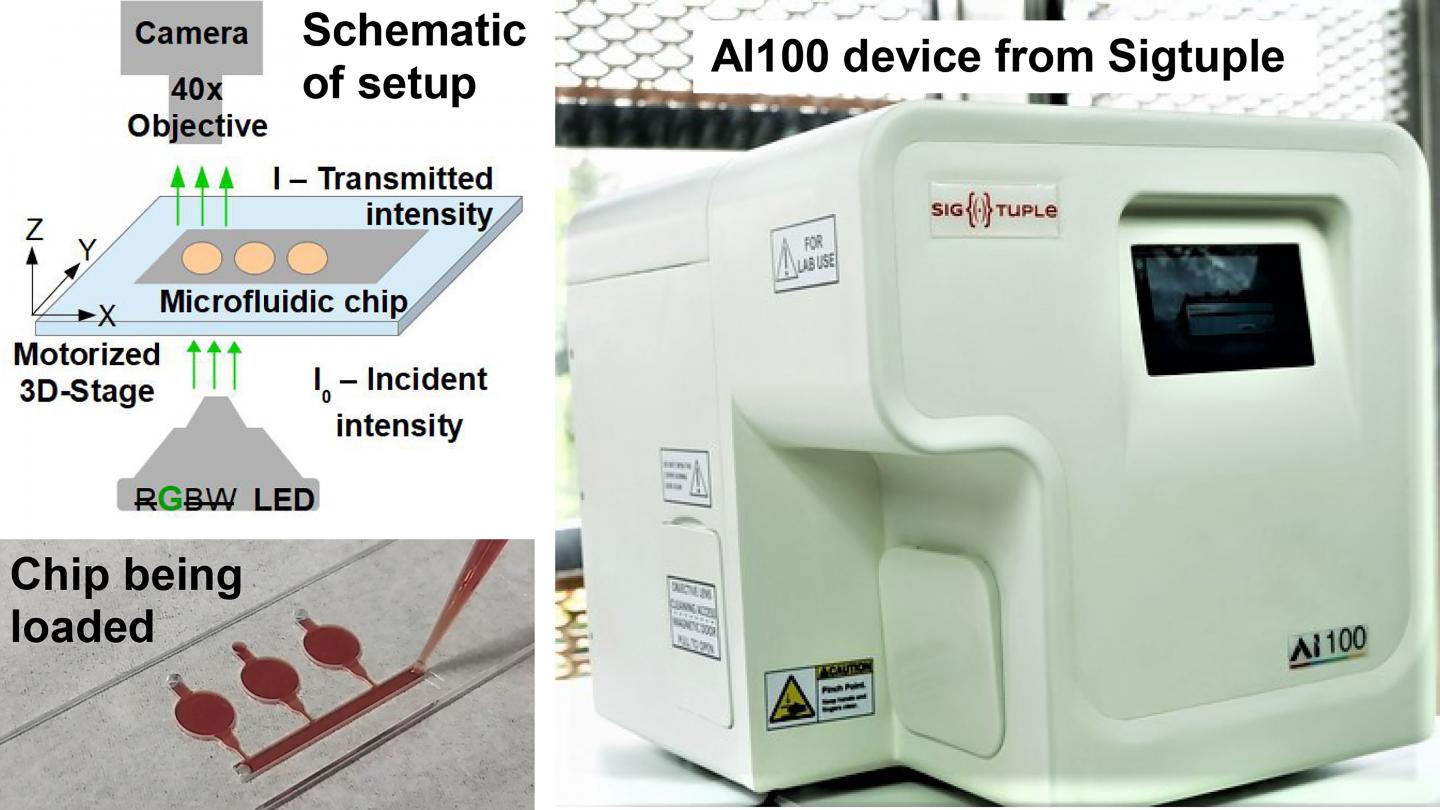
A chip-based, microfluidic, AI-powered diagnostic platform could make medical diagnostics more affordable, accessible.
IMAGE

Credit: SigTuple Technologies Pvt. Ltd.

WASHINGTON, February 23, 2021 — One of the most performed medical diagnostic tests to ascertain the health of patients is a complete blood count, which typically includes an estimate of the hemoglobin concentration. The hemoglobin level in the blood is an important biochemical parameter that can indicate a host of medical conditions including anemia, polycythemia, and pulmonary fibrosis.

In AIP Advances, by AIP Publishing, researchers from SigTuple Technologies and the Indian Institute of Science describe a new AI-powered imaging-based tool to estimate hemoglobin levels. The setup was developed in conjunction with a microfluidic chip and an AI-powered automated microscope that was designed for deriving the total as well as differential counts of blood cells.

Often, medical diagnostics equipment capable of multiparameter assessment, such as hematology analyzers, has dedicated subcompartments with separate optical detection systems. This leads to increased sample volume as well as an increase in cost of the entire equipment.

“In this study, we demonstrate that the applicability of a system originally designed for the purposes of imaging can be extended towards the performance of biochemical tests without any additional modifications to the hardware unit, thereby retraining the cost and laboratory footprint of the original device,” said author Srinivasan Kandaswamy.

The hemoglobin testing solution is possible thanks to the design behind the microfluidic chip, a customized biochemical reagent, optimized imaging, and an image analysis procedure specifically tailored to enable the good clinical performance of the medical diagnostic test.

The data obtained from the microfluidic chip in combination with an automated microscope was comparable with the predictions of hematology analyzers (Pearson correlation of 0.99). The validation study showed the method meets regulatory standards, which means doctors and hospitals are likely to accept it.

The automated microscope, which normally uses a combination of red, green, and blue LEDs, used only the green LED during the hemoglobin estimation mode, because the optimized reagent (SDS-HB) complex absorbs light in the green wavelength.

Chip-based, microfluidic, diagnostic platforms are on the verge of revolutionizing the field of health care and colorimetric biochemical assays are widely performed diagnostic tests.

“This paper lays the foundation and will also serve as a guide to future attempts to translate conventional biochemical assays onto a chip, from point of view of both chip design and reagent development,” said Kandaswamy.

Besides measuring hemoglobin in the blood, a similar setup with minor modifications could be used to measure protein content, cholesterol, and glycated hemoglobin.

###

The article “Developing microscopy based microfluidic SLS assay for on-chip hemoglobin estimation” is authored by Lokanathan Arcot, Srinivasan Kandaswamy, Anil Modali, Sai Siva Gorthi, and Tathagato Rai Dastidar. The article will appear in AIP Advances on Feb. 23, 2021 (DOI: 10.1063/5.0036446). After that date, it can be accessed at https://aip.scitation.org/doi/10.1063/5.0036446.

ABOUT THE JOURNAL

AIP Advances is an open access journal publishing in all areas of physical sciences–applied, theoretical, and experimental. The inclusive scope of AIP Advances makes it an essential outlet for scientists across the physical sciences. See https://aip.scitation.org/journal/adv.

Media Contact
Larry Frum
[email protected]

Related Journal Article

http://dx.doi.org/10.1063/5.0036446

Tags: BiologyBiomechanics/BiophysicsChemistry/Physics/Materials SciencesDiagnosticsHematologyMedicine/HealthTechnology/Engineering/Computer Science
Share12Tweet8Share2ShareShareShare2

Related Posts

Miniature Sensor Uses Light to Detect Touch — Chemistry

Miniature Sensor Uses Light to Detect Touch

May 8, 2026
Iron Minerals Determine Whether Dissolved Organic Matter Fuels Microbes or Becomes Long-Term Carbon Storage — Chemistry

Iron Minerals Determine Whether Dissolved Organic Matter Fuels Microbes or Becomes Long-Term Carbon Storage

May 8, 2026

Kate Evans Appointed Associate Lab Director for Biological and Environmental Systems Science at ORNL

May 8, 2026

Advancing Multiscale Modeling and Overcoming Operational Challenges in Autothermal COâ‚‚-to-Methanol Reactors

May 8, 2026
Please login to join discussion

POPULAR NEWS

  • Research Indicates Potential Connection Between Prenatal Medication Exposure and Elevated Autism Risk

    840 shares
    Share 336 Tweet 210
  • New Study Reveals Plants Can Detect the Sound of Rain

    727 shares
    Share 290 Tweet 181
  • Scientists Investigate Possible Connection Between COVID-19 and Increased Lung Cancer Risk

    68 shares
    Share 27 Tweet 17
  • Salmonella Haem Blocks Macrophages, Boosts Infection

    61 shares
    Share 24 Tweet 15

About

We bring you the latest biotechnology news from best research centers and universities around the world. Check our website.

Follow us

Recent News

Urdu Fall Risk Questionnaire Adapted for Elderly

Key Pharmacological Markers for HIV Prevention in MSM

Taking 8,500 Steps Daily May Aid Long-Term Weight Management, Study Finds

Subscribe to Blog via Email

Success! An email was just sent to confirm your subscription. Please find the email now and click 'Confirm' to start subscribing.

Join 82 other subscribers
  • Contact Us

Bioengineer.org © Copyright 2023 All Rights Reserved.

Welcome Back!

Login to your account below

Forgotten Password?

Retrieve your password

Please enter your username or email address to reset your password.

Log In
No Result
View All Result
  • Homepages
    • Home Page 1
    • Home Page 2
  • News
  • National
  • Business
  • Health
  • Lifestyle
  • Science

Bioengineer.org © Copyright 2023 All Rights Reserved.