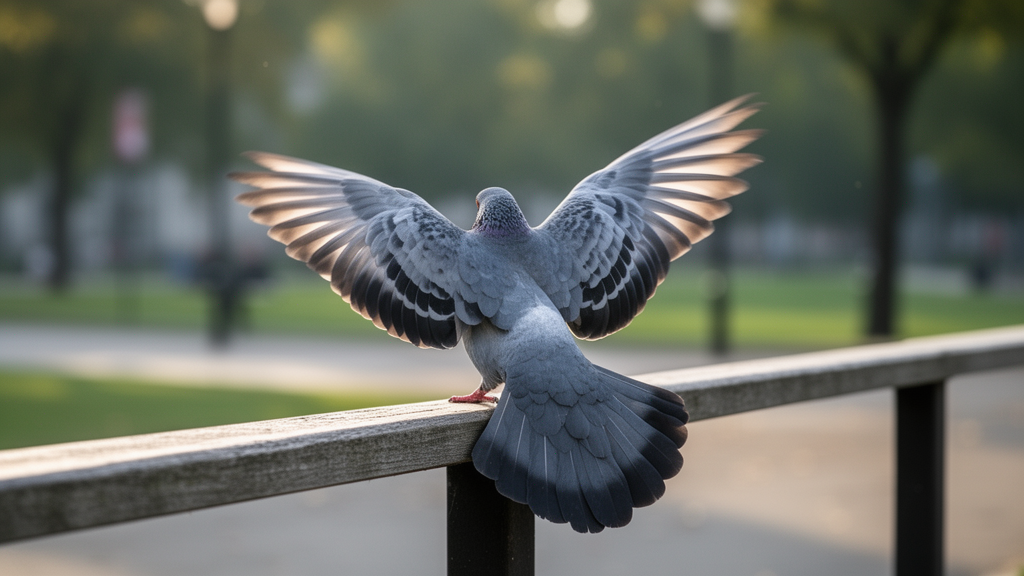
A mathematical modelling study has revealed that while birds could theoretically touch down at zero speed without flapping their wings, achieving such a landing would require far higher initial approach speeds and substantially more physical space than real environments afford. Published in Proceedings of the Royal Society A, the research conducted by aerospace engineering investigators at The University of Manchester demonstrates why powered wing flapping remains essential during landing manoeuvres. The findings suggest that birds do not necessarily select flight paths that minimise energy expenditure or achieve the lowest possible touchdown velocity, but instead adopt flapping trajectories to safely decelerate within confined boundaries.
Lead author Dr Ben Parslew, a Lecturer in Aerospace Engineering at The University of Manchester, noted that although avian landings frequently appear effortless, coming to a controlled halt presents a fundamental physical dilemma. The research team applied mathematical models to simulate optimal flight dynamics and unpowered trajectories, isolating how flapping and gliding interact with landing constraints.
To test whether unpowered deceleration could bring a bird to a safe standstill, the researchers simulated the flight dynamics of a pigeon-sized bird attempting an unpowered touchdown. The mathematical calculations showed that achieving zero speed entirely through unpowered gliding is theoretically possible, but the physical parameters involved are extreme. For an animal of that scale to reach zero velocity at touchdown, it would need to initiate the manoeuvre at more than double its standard cruising velocity. Furthermore, the manoeuvre would require the bird to climb approximately 20 metres vertically while covering around 60 metres of horizontal distance, making the unpowered sequence physically impractical for most natural perching sites.
These numerical findings explain why real birds rely heavily on powered wingbeats during descent. Rather than flapping exclusively to scrub off forward speed, birds appear to use flapping to compress their deceleration trajectory into real-world landing envelopes.
The modelling framework also offers fresh insight into the swooping trajectories commonly adopted by raptors and other perching birds. Previous investigations involving Harris hawks had shown that the raptors frequently drop below the height of an intended perch before executing an upward glide toward the target. Earlier interpretations suggested this swoop served primarily to limit the distance travelled after the wings stalled, a flight regime where aerodynamic control is compromised. The University of Manchester team found that swooping trajectories reflect an intricate compromise between arriving at low speed and minimising total time spent in a stalled state, with touchdown speed exerting a stronger influence than previously documented.
Ground landings introduce a fundamentally different set of mechanical constraints compared to perching approaches. While a bird targeting an elevated perch can swoop beneath its landing surface and bleed kinetic energy by climbing upward against gravity, a bird descending to the ground cannot fly below the terrestrial boundary. The mathematical model demonstrated that an unpowered bird touching down on flat ground cannot fully eliminate its forward and downward velocity prior to foot contact. As a consequence, ground-landing birds must absorb any residual kinetic energy using their wings, their legs, or a combination of both structures.
Coping with these residual impact energies places significant physical demands on the avian skeletal and muscular systems. Dissipating touchdown kinetic energy without the benefit of an upward glide requires sturdier bone architecture and larger limb musculature, particularly throughout the legs. The authors suggest that this fundamental trade-off between retaining a lightweight body for efficient flight and maintaining sufficient skeletal robustness for repeatable landing impacts has exerted strong evolutionary pressure on avian body plans.
Beyond explaining modern avian flight choices, the authors note that the identical mechanical and aerodynamic principles apply broadly across animal flight. The mathematical trade-offs between approach velocity, spatial clearances, control authority, and structural loading could help researchers evaluate how other flying animals manage unpowered landings.
Subject of Research: Aerodynamic modelling of avian landing dynamics and flapping constraints
Article Title: Why birds speed up to slow down: the physics of landing
Article References: Why birds speed up to slow down: the physics of landing. Original publication (Bibliographic details unavailable.)
Image Credits: AI Generated
DOI: Not provided
Keywords: aerodynamics, avian biomechanics, bird flight, flight dynamics, landing physics, mathematical modelling, unpowered landing, aerospace engineering, biomechanics, touchdown speed, swooping flight, perching birds, Harris hawks, wing flapping, avian evolution, aerodynamic control
News Source: Reid Dalton. (November 12, 2026). Mathematical Modelling Explains Why Flapping Helps Birds Land in Limited Spaces. Scienmag.