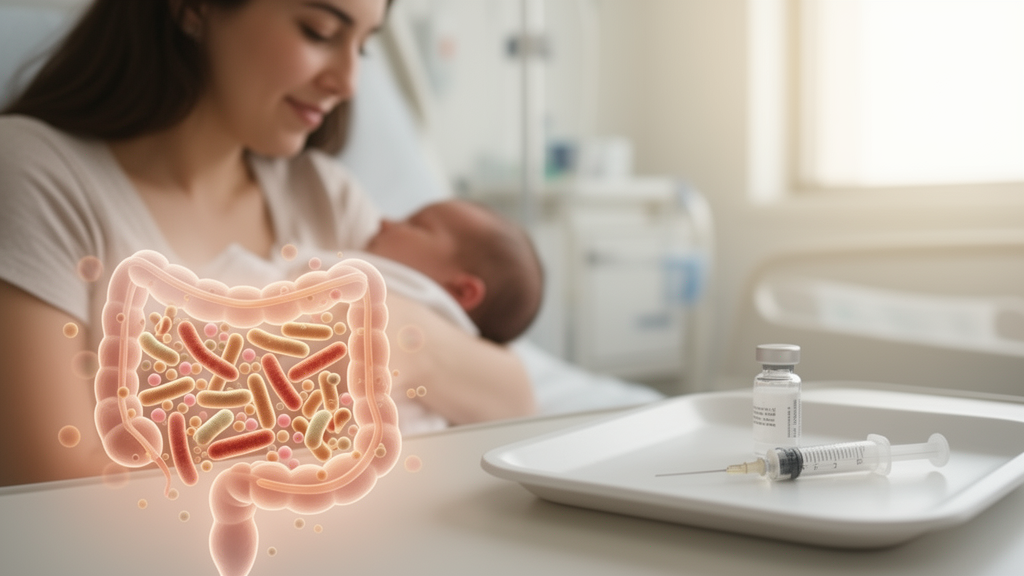
A newborn’s gut is not colonized at random. Within days of birth, microbes from the mother’s gut, vagina, breast milk, skin, and mouth begin an ecological succession that shapes immune maturation, metabolic programming, and development. A review published in Frontiers in Microbiology argues that this maternally driven process, which can be disrupted by cesarean delivery, prematurity, antibiotics, and intensive care, may one day be deliberately restored through maternal fecal microbiota transplantation, or FMT. The authors, a team of Chinese researchers, conclude that the approach is microbiologically feasible and ecologically plausible, but stress that it remains strictly investigational, with no established evidence of durable clinical benefit or long-term safety.
The review’s central premise rests on strain-resolved metagenomics, a technique that can distinguish individual bacterial strains rather than merely identifying genera or species. Using this resolution, several studies have shown that mothers and infants share highly similar or identical bacterial strains. A longitudinal analysis of 714 mother-infant pairs and 4,526 fecal samples identified the maternal gut as the predominant reservoir of infant gut strains, with transmission from the vagina and breast milk occurring only occasionally. Mother-infant gut strain sharing was strongly time dependent, a higher maternal abundance of a species increased the likelihood of its transmission, and maternally shared strains were more likely to persist throughout infancy. Transmitted strains were enriched in genes related to carbohydrate transport and metabolism, coenzyme metabolism, and potential immunomodulatory functions, suggesting that successful colonization depends on functional adaptation to the infant intestine.
Not all maternal microbial sources contribute equally. In a longitudinal multi-site metagenomic study, the maternal gut accounted for an estimated 22.1 percent of microbial abundance in the infant gut, compared with 16.3 percent from the vagina, 7.2 percent from the oral cavity, and 5.0 percent from the skin. Maternal gut-derived strains persisted more effectively, whereas vaginal- and skin-derived strains were generally more transient. Vaginal delivery does expose newborns extensively to maternal vaginal and perineal microorganisms, and early community-level studies found that vaginally delivered neonates resembled their mothers’ vaginal microbiota, but strain-resolved work shows that vaginal strains generally show lower persistence in the infant gut. The review argues that the microbiological significance of vaginal delivery likely lies in preserving a broader maternal transmission process that favors gut-adapted strains, not simply in seeding by typical vaginal taxa.
Several common clinical exposures disrupt this transmission. Cesarean-delivered infants show reduced vertical transmission of maternal gut-associated microbes, particularly Bacteroides, delayed acquisition of key anaerobic commensals, and increased colonization by opportunistic, hospital-associated taxa such as Enterococcus, Enterobacter, and Klebsiella. Preterm birth is associated with delayed microbiota maturation, reduced colonization by Bifidobacterium and Bacteroides, and altered production of microbiota-derived metabolites including short-chain fatty acids. Prenatal, intrapartum, and early postnatal antibiotics can perturb the maternal microbial reservoir and impair establishment of newly acquired strains, with intrapartum exposure linked to depletion of Actinobacteria including Bifidobacteriaceae and expansion of Proteobacteria. These exposures frequently overlap and may act synergistically, redirecting early gut assembly away from maternally derived, gut-adapted strains.
Existing restoration strategies fall short of ecological restoration, according to the review. Probiotics and synbiotics can increase bifidobacterial abundance and partially modify microbiota composition in cesarean-born, antibiotic-exposed, and preterm infants, but they contain only a limited number of predefined strains and cannot reproduce the diversity and maternal specificity of naturally transmitted communities. Engraftment is also strain- and niche-dependent: in the MicrobeMom randomized trial, the supplemented Bifidobacterium breve 702258 strain was detected in only 2 of 65 infants born to mothers receiving the probiotic. Vaginal microbiota seeding, in which cesarean-born infants are exposed to maternal vaginal fluids, has produced inconsistent randomized results, with some trials showing altered neonatal microbiota or accelerated gut maturation and others finding no significant effects on gut microbiota, growth, or allergy risk during the first two years of life.
Vaginal seeding also carries safety concerns. Maternal vaginal secretions may contain potentially pathogenic microorganisms, and the American College of Obstetricians and Gynecologists does not recommend the practice outside research protocols, while the American Academy of Pediatrics advises against routine use because of the potential transmission of pathogens including group B Streptococcus and herpes simplex virus. Against this backdrop, the review positions maternal FMT as a distinct approach: rather than supplementing selected strains or reproducing one exposure at birth, it transfers a complex maternal gut microbial community, potentially carrying multiple maternal gut-derived strains and their ecological interactions.
The direct human evidence comes from a small proof-of-concept study of term infants born by cesarean section. Of 17 mothers screened, only 7 fulfilled stringent donor eligibility criteria, and their infants received a small amount of carefully screened maternal fecal microbiota orally shortly after birth. From approximately the first week of life, the microbiota of treated infants developed toward a pattern more similar to that of vaginally delivered infants than untreated cesarean-born controls, restoring characteristic cesarean-associated deficiencies in taxa such as Bacteroides and reducing potential pathobionts. A subsequent strain-resolved analysis by Dubois and colleagues showed that these changes reflected increased transmission of maternal bacterial strains rather than mere taxonomic convergence, with increased mother-infant strain sharing, increased empirical growth rates of transmitted bacteria, and reduced colonization by potential pathogens.
The authors are emphatic that these microbiological effects should not be read as clinical benefits. Greater similarity to the microbiota of vaginally delivered infants, increased strain sharing, or more persistent engraftment does not in itself demonstrate improved health, and vaginally delivered infants should not be assumed to represent a universal optimal state. Evidence that maternal FMT improves immune maturation, reduces infection or allergic disease, or influences longer-term metabolic or neurodevelopmental outcomes remains insufficient. The SECFLOR study, a double-blind randomized placebo-controlled trial in term infants born by elective cesarean section with assessments to 24 months, has reported 31 randomized infants in a conference account with three adverse events judged unrelated to the intervention, but complete peer-reviewed efficacy results were not provided in that report.
Safety and translational challenges are substantial, particularly because recipients are newborns, many otherwise healthy. Biological relatedness does not guarantee donor safety, as adult FMT experience has documented transmission of antimicrobial-resistant and pathogenic bacteria, including extended-spectrum beta-lactamase-producing and Shiga toxin-producing Escherichia coli. Neonatal applications therefore require stringent screening for enteric pathogens and resistant organisms, with donor eligibility confirmed before each donation. Protocols also need standardization of stool collection, processing, dose, storage, timing, and route of administration, since optimal dose, formulation, and dosing schedule remain uncertain. Existing evidence derives largely from healthy term infants born by elective cesarean section and cannot be extrapolated to preterm infants, infants receiving antibiotics, or those requiring intensive care, who may be more vulnerable to invasive infection or unintended donor-strain colonization.
The review concludes that maternal FMT should remain confined to rigorously controlled clinical research until safety and long-term benefits are established. Future studies should determine which maternal strains engraft, how long they persist, and whether they restore microbial functions and developmental trajectories, integrating strain-resolved metagenomics with metabolomics, immune profiling, and longitudinal clinical phenotyping. Whole-stool maternal FMT may ultimately serve as proof of principle rather than the final therapeutic product, with future approaches possibly shifting toward cultured maternal strain consortia or defined microbial communities that preserve maternal matching while improving safety and standardization. For now, the authors write, maternal FMT is best regarded as an investigational framework for precision early-life microbiota restoration, not a clinical option.
Subject of Research: Maternal fecal microbiota transplantation as an investigational strategy for restoring disrupted mother-to-infant gut microbiota transmission in newborns
Article Title: From maternal microbial transmission to neonatal gut microbiota restoration: the potential and challenges of maternal fecal microbiota transplantation
Article References: Hu, X., Ma, G., Han, J., Zhu, L., He, Y., & Zhu, D. (2026). From maternal microbial transmission to neonatal gut microbiota restoration: the potential and challenges of maternal fecal microbiota transplantation. Frontiers in Microbiology, 17, Article 1972665. https://doi.org/10.3389/fmicb.2026.1972665
Image Credits: AI Generated
DOI: 10.3389/fmicb.2026.1972665
Keywords: maternal FMT, neonatal gut microbiota, maternal microbial transmission, cesarean delivery, strain-resolved metagenomics, probiotics, vaginal seeding, microbial engraftment, donor screening, microbiota restoration, preterm infants, Frontiers in Microbiology
News Source: Harold Sullivan. (October 30, 2026). Maternal FMT Could Restore Newborn Gut Microbes, But Safety Questions Remain. Scienmag.