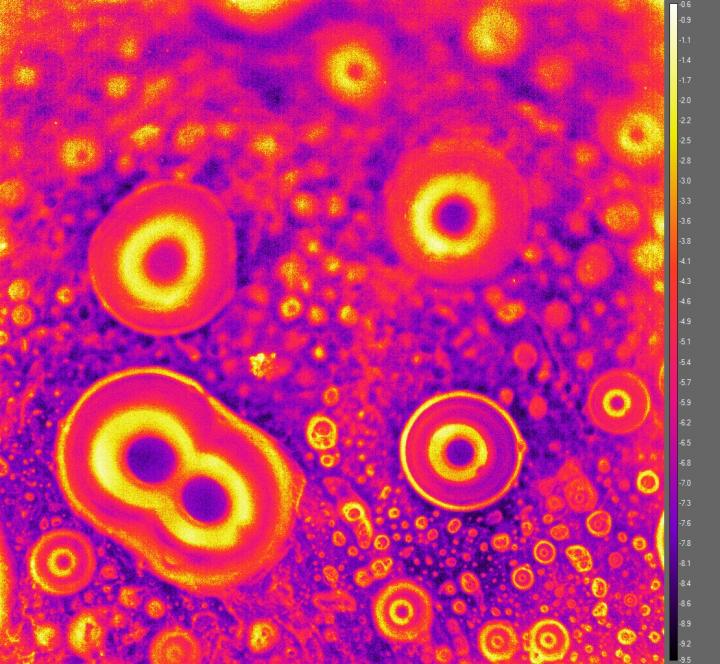
Credit: Rukmava Chatterjee.
Most techniques to prevent frost and ice formation on surfaces rely heavily on heating or liquid chemicals that need to be repeatedly reapplied because they easily wash away. Even advanced anti-icing materials have problems functioning under conditions of high humidity and subzero conditions, when frost and ice formation go into overdrive.
Now, researchers from the University of Illinois at Chicago College of Engineering describe for the first time several unique properties of materials known as phase-switching liquids, or PSLs, that hold promise as next-generation anti-icing materials. PSLs can delay ice and frost formation up to 300 times longer than state-of-the-art coatings being developed in laboratories. Their findings are published in the journal Advanced Materials.
“Ice and frost pose hazards to people and can damage machines and reduce functionality of some technologies, especially those related to energy and transportation, so we have been interested in finding possible ways to overcome their harmful effects, and phase-switching liquids are very promising candidates,” said Sushant Anand, assistant professor of mechanical and industrial engineering and corresponding author of the paper.
PSLs are a subset of phase change materials that have melting points higher than the freezing point of water, which is 0 degrees Celsius, meaning that they would be solids at a range of temperatures close to that at which water freezes. Examples of such materials include cyclohexane, cyclooctane, dimethyl sulfoxide, glycerol, and more.
“At sub-zero temperatures, all PSLs turn solid. So, on a winter day, you could coat a surface where you don’t want icing with a PSL material and it would remain there much longer than most deicing liquids, which demand frequent reapplication,” said Rukmava Chatterjee, a doctoral student in the UIC College of Engineering and the first author of the paper.
While researchers have known about phase change materials for a long time, their unique anti-icing and anti-frosting properties have not been investigated before, Chatterjee explained. Decades ago, Daniel Beysens, research director of the physics and mechanics of heterogeneous media laboratory at Université de recherche Paris Sciences et Lettres and a co-author on the paper, had observed that when materials like cyclohexane were cooled just below their melting points, water droplets condensing on the surface would move around erratically.
“We had looked into this erratic motion before, and we had shown that it originated from the melting of the cyclohexane induced by the heat released into these materials during water droplet condensation,” Anand said.
In their current research, Anand and Chatterjee cooled a range of PSLs to -15 degrees Celsius, rendering them all solid. Under high humidity conditions, they noticed that the solidified PSLs melted directly underneath and in the immediate vicinity of water droplets condensing on the PSLs.
“We were expecting that the erratic droplet motion would stop upon cooling the surface to -15C. But to our surprise, we found that the droplets kept on showing the same hopping motion even at very low temperatures,” Anand said. “It turns out that PSLs are extremely adept at trapping this released heat.
“This quality, combined with the fact that condensed water droplets become extremely mobile on these cooled PSLs means that the formation of frost is significantly delayed. Yes, at a certain point, ice does eventually form and that is inevitable, but some of the PSLs we tested are water soluble, and this contributes to their anti-freezing properties and can help delay ice formation much longer than even the advanced anti-icing coatings.”
Anand and Chatterjee saw the same frost delaying effect with the PSLs even when they were applied as extremely thin layers to objects.
“In our first set of experiments, the PSL coating we used was about 3 millimeters thick. But we also tested them as very thin coatings, like a film, and still saw the same freezing delay effect,” Anand said. “This means that we can potentially use PSLs to coat objects like car windshields or turbine blades without compromising the object’s functionality.”
In further experiments, the researchers found that PSLs have a wide range of optical transparencies, can self-repair after being scratched and can purge liquid-borne contaminants.
“The unique properties of PSLs, which we describe for the first time in this paper, make them excellent candidates for next-generation materials to prevent frost and ice development on surfaces,” Anand said.
Because PSLs are solids at low temperatures, he anticipates that they wouldn’t need to be applied as often as liquid anti-icing agents because they would have better staying power.
“But, of course, we need to conduct additional experiments to determine their limits and figure out if there are ways we can further maximize their ice/frost-repelling abilities,” he said.
###
This work was funded by the Branco Weiss Fellowship, UIC College of Engineering and National Science Foundation grant CBET-1644815.
Media Contact
Sharon Parmet
[email protected]
Original Source
https:/
Related Journal Article
http://dx.