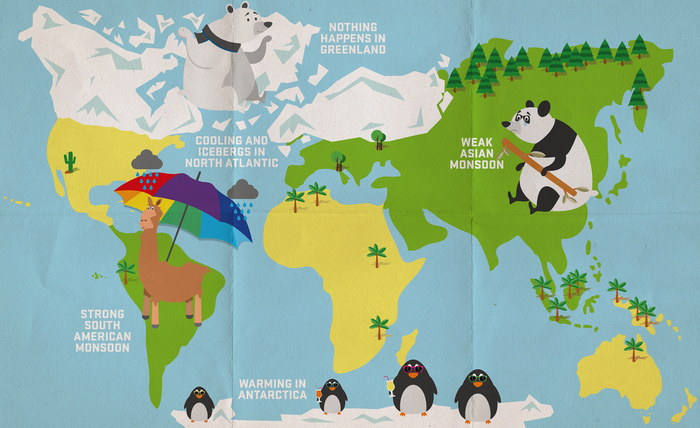
CORVALLIS, Ore. – During the last ice age, massive icebergs periodically broke off from an ice sheet covering a large swath of North America and discharged rapidly melting ice into the North Atlantic Ocean around Greenland, triggering abrupt climate change impacts across the globe.
Credit: Oliver Day, Oregon State University
CORVALLIS, Ore. – During the last ice age, massive icebergs periodically broke off from an ice sheet covering a large swath of North America and discharged rapidly melting ice into the North Atlantic Ocean around Greenland, triggering abrupt climate change impacts across the globe.
These sudden episodes, called Heinrich Events, occurred between 16,000 and 60,000 years ago. They altered the circulation of the world’s oceans, spurring cooling in the North Atlantic and impacting monsoon rainfall around the world.
But little was known about the events’ effect on nearby Greenland, which is thought to be very sensitive to events in the North Atlantic. A new study from Oregon State University researchers, just published in the journal Nature, provides a definitive answer.
“It turns out, nothing happened in Greenland. The temperature just stayed the same,” said the study’s lead author, Kaden Martin, a fourth-year doctoral candidate in OSU’s College of Earth, Ocean, and Atmospheric Sciences. “They had front-row seats to this action but didn’t see the show.”
Instead, the researchers found that these Heinrich events caused rapid warming in Antarctica, at the other end of the globe.
The researchers anticipated Greenland, in close proximity to the ice sheet, would have experienced some kind of cooling. To find that these Heinrich Events had no discernible impact on temperatures in Greenland is surprising and could have repercussions for scientists’ understanding of past climate dynamics, said study co-author Christo Buizert, an assistant professor in the College of Earth, Ocean, and Atmospheric Sciences.
“If anything, our findings raise more questions than answers,” said Buizert, a climate change specialist who uses ice cores from Greenland and Antarctica to reconstruct and understand the Earth’s climate history. “This really changes how we look at these massive events in the North Atlantic. It’s puzzling that far-flung Antarctica responds more strongly than nearby Greenland.”
Scientists drill and preserve ice cores to study past climate history through analysis of the dust and tiny air bubbles that have been trapped in the ice over time. Ice cores from Greenland and Antarctica provide important records of Earth’s atmospheric changes over hundreds of thousands of years.
Records from ice cores from those regions have served as pillars for scientists’ understanding of past climate events, with ice collected from both locations often telling similar stories, Martin said.
The impact of Heinrich Events on Greenland and Antarctica was not well understood, spurring Martin and Buizert to try to find out more about what was happening in those parts of the world.
The core used for the latest study was collected in 1992 from the highest point of Greenland, where the ice sheet is around 2 miles thick. Since then, the core has been in storage in the National Science Foundation Ice Core Facility in Denver.
Advancement in scientific tools and measurements over the last few decades gave Martin, Buizert and their colleagues the opportunity to re-examine the core using new methods.
The analysis shows that no changes in temperatures occurred in Greenland during Heinrich Events. But it also provides a very clear connection between Heinrich Events and the Antarctic response.
“When these big iceberg discharges happen in the Arctic, we now know that Antarctica responds right away,” Buizert said. “What happens in one part of the world has an effect on the rest of the world. This inter-hemispheric connection is likely caused by change in global wind patterns.”
The finding challenges the current understanding of global climate dynamics during these massive events and raises new questions for researchers, Buizert said. The researchers’ next step is to take the new information and run it through climate models to see if the models can replicate what occurred.
“There has to be a story that fits all of the evidence, something that connects all the dots,” he said. “Our discovery adds two new dots; it’s not the full story, and it may not be the main story. It is possible that the Pacific Ocean plays an important role that we haven’t figured out yet.”
The ultimate goal is to better understand how the climate system is connected and how the components all interact, the researchers said.
“While Heinrich Events are not going to happen in the future, abrupt changes in the globally interconnected climate system will happen again,” Martin said. “Understanding the global dynamics of the climate system can help us better project future impacts and inform how we respond and adapt.”
Additional co-authors are Ed Brook, Jon Edwards, Michael Kalk and Ben Riddell-Young of OSU; Ross Beaudette and Jeffrey Severinghaus of the Scripps Institution of Oceanography; and Todd Sowers of Pennsylvania State University.
The research was supported by the National Science Foundation, the Global Climate Change Foundation and the Gary Comer Science and Education Foundation.
Journal
Nature
DOI
10.1038/s41586-023-05875-2
Method of Research
Data/statistical analysis
Subject of Research
Not applicable
Article Title
‘Bipolar impact and phasing of Heinrich-type climate variability
Article Publication Date
24-Apr-2023