


Keck Medicine of USC study identifies psychological measures that may predict who is more likely to complete – or quit – a demanding marine training course
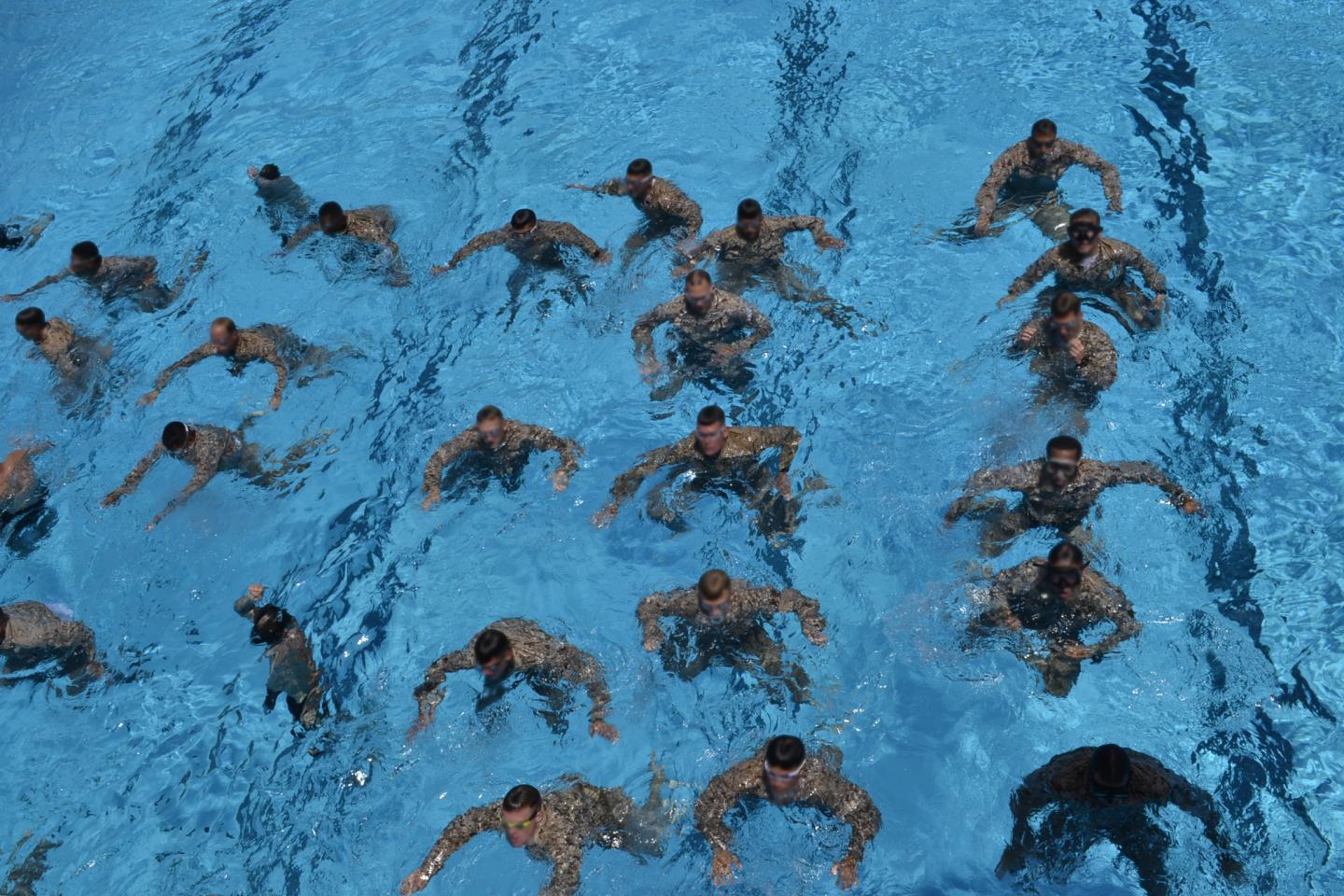
Credit: Courtesy of USC Center for Body Computing
LOS ANGELES — The United States military has a constant need for service members who can serve in elite and specialized military units, such as the Marine Corps. However, because the training courses for these forces is so rigorous, the dropout rate is high.
To help determine predictors of success or failure in elite military training, Leslie Saxon, MD, executive director of the USC Center for Body Computing, and fellow Center for Body Computing researchers monitored the physical and psychological activity of three consecutive classes of Marines and sailors enrolled in a 25-day specialized training course.
The results were published in the Journal of Medical Internet Research mHealth and uHealth.
A total of 121 trainees participated. Only slightly more than half (64) successfully completed the course.
Researchers found there was no correlation between finishing and performance on physical training standards, such as hikes or aquatic training. Physical markers such as heart rate or sleep status also did not play a role.
Rather, the biggest determinant was mental. Trainees who identified themselves as extroverted and having a positive affect — the ability to cultivate a joyful, confident attitude — were most likely to complete the course.
“These findings are novel because they identify traits not typically associated with military performance, showing that psychological factors mattered more than physical performance outcomes,” says Saxon, who is also a cardiologist with Keck Medicine of USC and a professor of medicine (clinical scholar) at the Keck School of Medicine of USC.
Researchers were also able to pinpoint psychological stressors that triggered dropping out of the course. Trainees typically quit before a stressful aquatic training exercise or after reporting an increase in emotional or physical pain and a decrease in confidence. This led researchers to be able to predict who would drop out of the course one to two days in advance.
While Saxon has been studying human performance in elite athletes for 15 years, this was her first study involving the military. She partnered with the USC Institute for Creative Technologies, which has established military research programs, to run the study with a training company in Camp Pendleton, Calif. that trains Marines in amphibious reconnaissance. Typically, only around half of the participants finish the training.
The study authors collected baseline personality assessments of the trainees before the recruits began the course, assessing personality type, emotional processing, outlook on life and mindfulness. Researchers next provided subjects with an iPhone and Apple Watch, and a specially designed mobile application to collect continuous daily measures of trainees’ mental status, physical pain, heart rate, activity, sleep, hydration and nutrition during training.
The mobile application also prompted trainees to answer daily surveys on emotional and physical pain, well-being and confidence in course completion and instructor support.
“This study, the first to collect continuous data from individuals throughout a training, suggests that there may be interventions the military can take to reduce the number of dropouts,” says Saxon. “This data could be helpful in designing future training courses for Marines and other military units to increase the number of elite service members, as well as provide insights on how to help athletes and other high performers handle challenges.”
Saxon is already testing whether or not various psychological interventions or coaching might encourage more trainees to stay the course.
###
Other USC Center for Body Computing study authors include Rebecca Ebert, BS, senior research coordinator, and Mona Sobhani, PhD, director of research and operations. Researchers from the USC Marshall School of Business and the Department of Computer Science at the USC Viterbi School of Engineering also contributed to the study.
About Keck Medicine of USC
Keck Medicine of USC is one of only two university-based medical systems in the Los Angeles area. Its internationally renowned physicians and scientists provide world-class patient care at Keck Hospital of USC, USC Norris Cancer Hospital, USC Verdugo Hills Hospital and more than 80 outpatient clinics in Los Angeles, Orange, Kern, Tulare and Ventura counties.
Keck Medical Center was ranked No. 16 on U.S. News & World Report’s 2019-20 Best Hospital Honor Roll and among the top 3 hospitals in Los Angeles and top 5 in California. The hospital also ranked in the top 4 in urology (tie); top 10 in geriatrics; top 15 in ophthalmology, cardiology & heart surgery, gastroenterology & GI surgery and nephrology; top 20 in neurology & neurosurgery; top 25 in cancer; and top 35 in pulmonology & lung surgery.
For more information, visit KeckMedicine.org.
Media Contact
Mary Dacuma
[email protected]
Related Journal Article
http://dx.



