A scientometric analysis of more than four decades of literature has traced how research on two land-based intensive aquaculture technologies, recirculating aquaculture systems (RAS) and biofloc technology (BFT), has grown from a single indexed paper in 1977 into a field that now produces hundreds of articles a year. The study, published in the journal Discover Data, retrieved 853 journal articles from the Scopus database and analyzed publication trends, citation patterns, prolific contributors, international collaborations and research hot spots using the Biblioshiny application of R software and the network visualization tool VOSviewer.
The headline finding is a sharp acceleration in output. Growth was slow through the twentieth century, with only 61 articles, or 7.15 percent of the corpus, published between 1977 and 2000. The decade from 2001 to 2010 produced 152 articles, or 17.81 percent. Then the last 14 years, from 2011 to 2024, delivered a three-fold increase over the previous decade, totaling 640 articles, or 75.02 percent of all publications on the subject. Despite that surge, the average annual growth rate across the whole period was just 1.45 percent, a figure the authors describe as not very encouraging and attribute partly to the specialized, interdisciplinary nature of the field, which spans aquaculture, technology, microbiology and environmental science.
The 853 articles appeared in 369 journals and were written by 3,349 authors from 86 countries, averaging 5.23 authors per article. Around 96 percent of the papers were produced in joint authorship, which the authors read as evidence that harnessing the potential of RAS and BFT has required collaborative research effort. Together the corpus earned 20,232 citations, an average of 23.72 citations per publication.
Citation patterns followed the expected age effect. Papers published between 2001 and 2010 earned the highest average of 52.39 citations per paper, while articles from 1977 to 2000 averaged 38.11. Records from the recent three years, 2021 to 2025, had earned only 6.17 citations on average, reflecting the time it takes for citations to accumulate. Interestingly, a Pearson correlation between publication year and average citations per paper found no significant relationship, reporting a small negative association of r(44) = 0.0958 with p = 0.526. The authors conclude that quality, applicability and novelty, rather than the age of a publication, are what determine citation impact. Descriptive statistics across 43 observations showed a mean publication count of 19.74, a strong negative correlation between the number of papers and article age (r = -0.845, p < 0.01), and a moderate negative correlation between paper count and average citations (r = -0.335, p < 0.05).
China led the field by volume, contributing to 243 articles, or 28.49 percent of the corpus, with 3,790 citations. Authors from the United States contributed to 86 articles, or 10.09 percent, but earned 4,777 citations, making their papers more impactful per article. Spain and India contributed 48 and 47 articles respectively, earning 1,465 and 536 citations, while Brazil and Germany added 41 and 40 articles. Chinese authors collaborated with counterparts in 20 other countries, and the strongest partnerships emerged between China and Australia, and China and Belgium, with link strengths of 9 and 7 in the collaboration network.
Institutional analysis identified 1,125 organizations among the contributors. China Agricultural University in Beijing topped the list with 24 papers averaging 20.38 citations each, followed by Shanghai Ocean University in China and the University of South Bohemia in the Czech Republic with 18 articles each. Yet the most cited work came from Europe: papers involving Wageningen University in the Netherlands averaged 71.54 citations, with the University of Cadiz in Spain and the Conservation Funds Freshwater Institute in the United States earning 64.67 and 54.50 citations per paper. Of 65 institutions with five or more articles, 24 had no inter-institutional collaboration at all, a gap the authors flag as a coordination shortfall at the global level.
Author productivity showed a similar concentration. Only 19 of the 3,349 authors contributed to five or more articles. Li Daoliang led with 19 papers, while Liu Shuangyin and Xu Longqin contributed 10 each. Keyword clustering of the top 109 terms out of 2,165 revealed eight research hot spots, ranging from environmental sustainability and nutrient recycling to biological interactions, fish health and immunity, nutrition and welfare, biofloc management of water quality parameters through ammonia oxidation and carbon-nitrogen ratio control, growth and stocking density, greenhouse gas emissions including nitrous oxide, and aeration and dissolved oxygen management.
The journal analysis confirmed a classic concentration pattern. The top 35 journals published 46.54 percent of all articles, led by Aquaculture (Elsevier) with 104 records, followed by Aquacultural Engineering with 27, Aquaculture Research with 24 and Science of the Total Environment with 21. Meanwhile, 251 journals published just a single article each on the subject. The distribution closely approximated the three zones of Bradford’s Law of Scattering, with a calculated multiplier of 5.7 and a percentage error of just 0.012 percent, confirming that literature on RAS and BFT clusters in a small core of specialized journals.
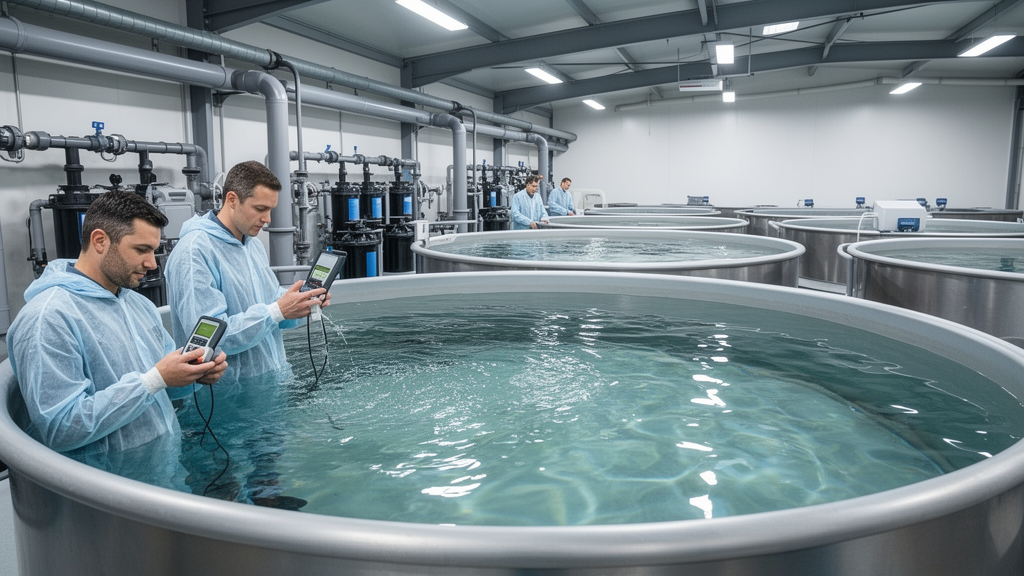
The authors situate the growth surge in the context of rising demand for sustainable food production. Aquaculture already accounts for 49.2 percent of the world’s aquatic animal production, yielding over 87.5 billion kilograms of fish annually. RAS and BFT, both land-based systems, promise high productivity, with RAS output described as 15 to 20 times that of traditional aquaculture, and water savings of around 90 percent compared with conventional systems. BFT maintains water quality through microbial assimilation of nitrogenous wastes with zero water exchange, while RAS enables precise control of water quality, year-round production independent of climate, and reduced disease risk. The global RAS market, currently valued at USD 2,467.8 million, is projected to reach USD 4,200 million by 2035 at a 5.4 percent compound annual growth rate.
The study has limitations the authors acknowledge directly. Data came solely from Scopus, retrieved on 28 August 2024, so locally relevant publications not indexed in that database, and literature published after the retrieval date, fall outside the analysis. Database-specific publication biases and citation record quirks also apply. The correlation and cluster analyses are fundamentally descriptive, depicting the scholarly landscape rather than providing definitive measures of scientific impact or quality. Looking forward, the authors call for stronger collaboration at author, institutional and international levels, and highlight emerging computational tools, including artificial intelligence, the Internet of Things, machine learning and blockchain, as underexplored avenues that could be tested in RAS and BFT systems to enhance operational efficiency and productivity.
Subject of Research: Scientometric analysis of global research trends in recirculating aquaculture systems and biofloc technology
Article Title: Research dynamics in intensive aquaculture technologies with special reference to recirculating aquaculture system and biofloc technology: a scientometric analysis
Article References: Datta, S. N., Singh, N., Kaur, V. I., & Mandal, A. (2026). Research dynamics in intensive aquaculture technologies with special reference to recirculating aquaculture system and biofloc technology: a scientometric analysis. Discover Data, 4(1), Article 7. https://doi.org/10.1007/s44248-026-00104-3
Image Credits: AI Generated
DOI: 10.1007/s44248-026-00104-3
Keywords: aquaculture, recirculating aquaculture systems, biofloc technology, scientometrics, bibliometrics, Scopus, citation analysis, research collaboration, sustainable aquaculture, water reuse, Bradford's Law, China
News Source: Denise Maddox. (October 29, 2026). Mapping the Research Boom in Recirculating Aquaculture and Biofloc Systems. Scienmag.