• HOME
  • NEWS
  • EXPLORE
    • CAREER
      • Companies
      • Jobs
    • EVENTS
    • iGEM
      • News
      • Team
    • PHOTOS
    • VIDEO
    • WIKI
  • BLOG
  • COMMUNITY
    • FACEBOOK
    • INSTAGRAM
    • TWITTER
Sunday, July 5, 2026
BIOENGINEER.ORG
No Result
View All Result
  • Login
  • HOME
  • NEWS
  • EXPLORE
    • CAREER
      • Companies
      • Jobs
        • Lecturer
        • PhD Studentship
        • Postdoc
        • Research Assistant
    • EVENTS
    • iGEM
      • News
      • Team
    • PHOTOS
    • VIDEO
    • WIKI
  • BLOG
  • COMMUNITY
    • FACEBOOK
    • INSTAGRAM
    • TWITTER
  • HOME
  • NEWS
  • EXPLORE
    • CAREER
      • Companies
      • Jobs
        • Lecturer
        • PhD Studentship
        • Postdoc
        • Research Assistant
    • EVENTS
    • iGEM
      • News
      • Team
    • PHOTOS
    • VIDEO
    • WIKI
  • BLOG
  • COMMUNITY
    • FACEBOOK
    • INSTAGRAM
    • TWITTER
No Result
View All Result
Bioengineer.org
No Result
View All Result
Home NEWS Science News Chemistry

Mapping the energy transport mechanism of chalcogenide perovskite for solar energy use

Bioengineer by Bioengineer
December 4, 2019
in Chemistry
Reading Time: 2 mins read
0
IMAGE
Share on FacebookShare on TwitterShare on LinkedinShare on RedditShare on Telegram

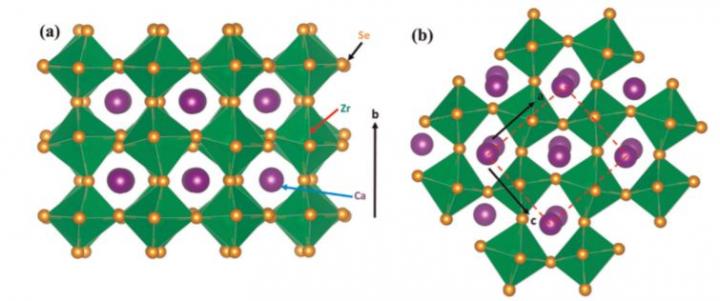
Engineers have characterized the thermal energy conversion mechanism in the lattice of an advanced nanomaterial called chalcogenide perovskite and demonstrated its ‘tunability’– important for its potential use in solar energy generation
IMAGE

Credit: Ganesh Balasubramanian, Eric Osei-Agyemang and Challen Enninful Adu


For solar cells to be widely used in the coming decades researchers must resolve two major challenges: increasing efficiency and lowering toxicity.

Solar energy works through a process that converts light into energy called the photovoltaic effect. Certain light sensitive materials when packaged together in a “cell” have the ability to convert energy from light into electricity.

Most of today’s solar cells require a highly processed form of Silicon. The processing results in toxic effects on humans and the environment. According to an article published in AZO Materials in 2015, many strides have been made since the first solar cell was developed, but average efficiency rates are still well below 30 percent, with many cells barely reaching 10 percent efficiency.

Researchers have recently been working with a material?an emerging chalcogenide perovskite CaZrSe3?that has shown great potential for energy conversion applications because of its notable optical and electrical properties.

“These materials hold extreme promise for solar energy conversion applications,” says Ganesh Balasubramanian, assistant professor of mechanical engineering at Lehigh University’s P.C. Rossin College of Engineering and Applied Science. “One can potentially design them as solar thermoelectric materials that convert thermal energy from the sun to usable electric power.”

Balasubramanian, working with postdoctoral student Eric Osei-Agyemang and undergraduate Challen Enninful Adu, have for the first time, revealed first-hand knowledge about the fundamental energy carrier properties of chalcogenide perovskite CaZrSe3. They have published their findings in NPJ Computational Materials in an article called “Ultralow lattice thermal conductivity of chalcogenide perovskite CaZrSe3 contributes to high thermoelectric figure of merit.” This work compliments a recent article by the same team published in Advanced Theory and Simulations called “Doping and Anisotropy-Dependent Electronic Transport in Chalcogenide Perovskite CaZrSe3 for High Thermoelectric Efficiency.”

“Together they provide a holistic look at the transport properties of these materials,” says Balasubramanian. “They also demonstrate that chalcogenide perovskite CaZrSe3 can potentially be used for waste heat recovery or solar energy conversion to electricity.”

To arrive at their results, the team performed quantum chemical calculations examining the electronic and lattice properties of these materials to derive useful material transport information.

The news that energy transport through advanced materials such as chalcogenides can be tuned by nano structuring should be welcomed by other researchers in the field, says Balasubramanian, bringing scientists closer to applying these techniques to achieve a solar energy production method that is cheaper, more efficient and less toxic.

###

Media Contact
Lori Friedman
[email protected]
610-758-3224

Related Journal Article

http://dx.doi.org/10.1038/s41524-019-0253-5

Tags: Chemistry/Physics/Materials SciencesEnergy SourcesMaterialsMechanical EngineeringNanotechnology/MicromachinesTechnology/Engineering/Computer Science
Share12Tweet8Share2ShareShareShare2

Related Posts

Intelligent Microgrid Management Promises Lower Household Energy Bills and Reduced Diesel Emissions — Chemistry

Intelligent Microgrid Management Promises Lower Household Energy Bills and Reduced Diesel Emissions

July 4, 2026
Graz University of Technology Deciphers the Structural Secrets of MOF Thin Films — Chemistry

Graz University of Technology Deciphers the Structural Secrets of MOF Thin Films

July 2, 2026

Breaking Thermodynamic Limits: Wavelength-Driven Catalysis Advances Ammonia Synthesis

July 2, 2026

From Quantum Mechanics to AI-Powered Materials Discovery: MARVEL Marks 12 Years of Transforming Computational Science

July 2, 2026
Please login to join discussion

POPULAR NEWS

  • Detection of EDCs in Breast Milk and Infant Urine Up to Six Months Highlights Early Exposure Risks

    77 shares
    Share 31 Tweet 19
  • Saying Goodbye to PGY-6: Pediatric Fellowship Realities

    103 shares
    Share 41 Tweet 26
  • New Drug Candidate Developed at McMaster Shows Potential for Treating Brain Cancer

    58 shares
    Share 23 Tweet 15
  • KTU Researchers Explore Ultrasound’s Role in Enhancing Blood Flow Beyond Diagnostics

    53 shares
    Share 21 Tweet 13

About

We bring you the latest biotechnology news from best research centers and universities around the world. Check our website.

Follow us

Recent News

Quasi-Bound States Boost Quantum Well Photoresponse

Lysine Pyruvylation Links Glycolysis to Epigenetics

Multiphysics Coupling: Single vs. Multiple DeepONet Branches

Subscribe to Blog via Email

Success! An email was just sent to confirm your subscription. Please find the email now and click 'Confirm' to start subscribing.

Join 83 other subscribers
  • Contact Us

Bioengineer.org © Copyright 2023 All Rights Reserved.

Welcome Back!

Login to your account below

Forgotten Password?

Retrieve your password

Please enter your username or email address to reset your password.

Log In
No Result
View All Result
  • Homepages
    • Home Page 1
    • Home Page 2
  • News
  • National
  • Business
  • Health
  • Lifestyle
  • Science

Bioengineer.org © Copyright 2023 All Rights Reserved.