
Credit: M. Peck
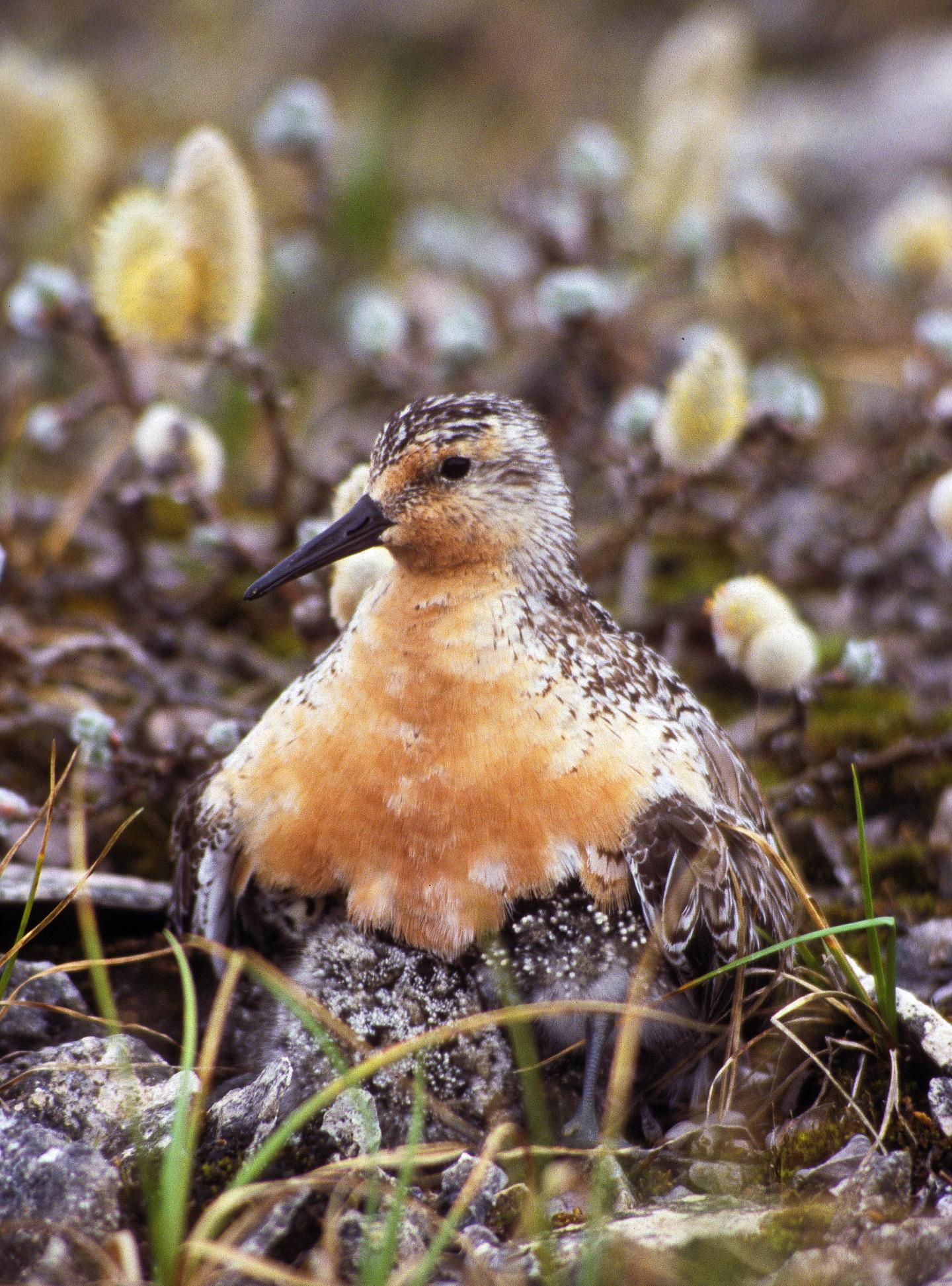
The rufa subspecies of Red Knot travels from its breeding grounds in the Canadian Arctic to its winter habitat in South America and back each year, an incredible 15,000 kilometers each way. Its numbers have fallen precipitously in recent decades, and with such a broad range, determining what's behind the shorebird's decline is a huge challenge. A new study from The Condor: Ornithological Applications examines Red Knot nesting habitat preferences across the Arctic and determines that while there is plenty of breeding habitat to support today's population, climate change could pose a threat in the future.
Rutgers University's Richard Lathrop, Conserve Wildlife Foundation of New Jersey's Larry Niles, and their colleagues attached radio tags to 365 knots captured while migrating through Delaware Bay in 1999-2006. To learn where and in what sort of habitat the tagged birds nested, they then conducted surveys via small airplane across the south and central Canadian Arctic, a vast study area spanning from Victoria Island in the west to Baffin Island in the east. They also carried out detailed ground-based surveys on Nunavut's Southampton Island. Across both scales, knots preferred to nest in sparsely vegetated areas on sedimentary bedrock, near but not directly adjacent to the coast or interior wetlands, to which they commute in order to forage.
The study shows that there are more than 74,000 square kilometers of suitable rufa Red Knot habitat across their Central Arctic breeding range–enough space for at least that many breeding pairs, assuming one square kilometer of territory per nest. Since the entire population currently numbers only around 42,000 individuals, it's unlikely that a lack of available breeding habitat is contributing to the species' decline; knots' problems must lie elsewhere. However, suitable breeding conditions for a number of Arctic shorebirds, including knots, are predicted to shift and decline in coming decades due to climate change. An understanding of species-habitat relationships will be crucial for present and future conservation efforts.
"It took many person-hours over many years of intensive field surveys to find the several dozen occupied Red Knot nests that we located and documented. The area we aerially searched for radio-tagged birds spanned over 1700 km in length, the same distance as from Georgia to Maine," says Niles.
Lathrop adds, "Using the power of satellite remote sensing, data mining analysis, and geospatial modeling, we were able to extrapolate from the field and radio-telemetry surveys to map potential nesting habitat for these birds across wide expanses of the Canadian Arctic. These same tools and techniques could be applied to advance our knowledge about other Arctic-nesting shorebirds."
"Implementing effective conservation actions for long-distance migrant birds often involves the systematic elimination of insignificant factors to identify important biotic and abiotic contributors to population dynamics," according to Brad Andres, National Coordinator for the U.S. Fish and Wildlife Service's Shorebird Conservation Plan, who was not involved in the study. "For the first time, Lathrop and his colleagues have described environmental conditions conducive for nesting by rufa Red Knots and provide evidence that breeding ground habitats are likely not limiting the recovery of the population. Their work also furnishes a baseline to evaluate the ability of a changing Arctic climate to provide breeding habitat for this shorebird of high conservation concern."
###
"Mapping and modeling the breeding habitat of the Red Knot, Calidris canutus, at landscape and regional scales" will be available August 1, 2018, at http://www.bioone.org/doi/full/10.1650/CONDOR-17-247.1 (issue URL http://www.bioone.org/toc/cond/120/3).
About the journal: The Condor: Ornithological Applications is a peer-reviewed, international journal of ornithology, published by the American Ornithological Society. For the past two years, The Condor has had the number one impact factor among 27 ornithology journals.
Media Contact
Rebecca Heisman
[email protected]
http://americanornithologypubs.org/
Related Journal Article
http://dx.doi.org/10.1650/CONDOR-17-247.1