Traditional and complementary medicine has quietly become one of the fastest-growing corners of oncology research, and a new large-scale analysis has now mapped exactly how that growth unfolded. In a bibliometric study published in Supportive Care in Cancer, researchers Amit Gajarmal, Mahesh S., and Sandip Baheti of the Central Council for Research in Ayurvedic Sciences in India analyzed 5,770 unique publications retrieved from the PubMed and Scopus databases, covering the period from January 2000 to November 2025. Their goal was not to test whether any particular herbal remedy or mind-body practice works against cancer symptoms, but to chart the shape of the field itself: who is publishing, where, with whom, and around which scientific themes. The result is a quarter-century aerial photograph of a research landscape that has expanded from modest beginnings into a sustained, globally distributed enterprise centered on patient quality of life.
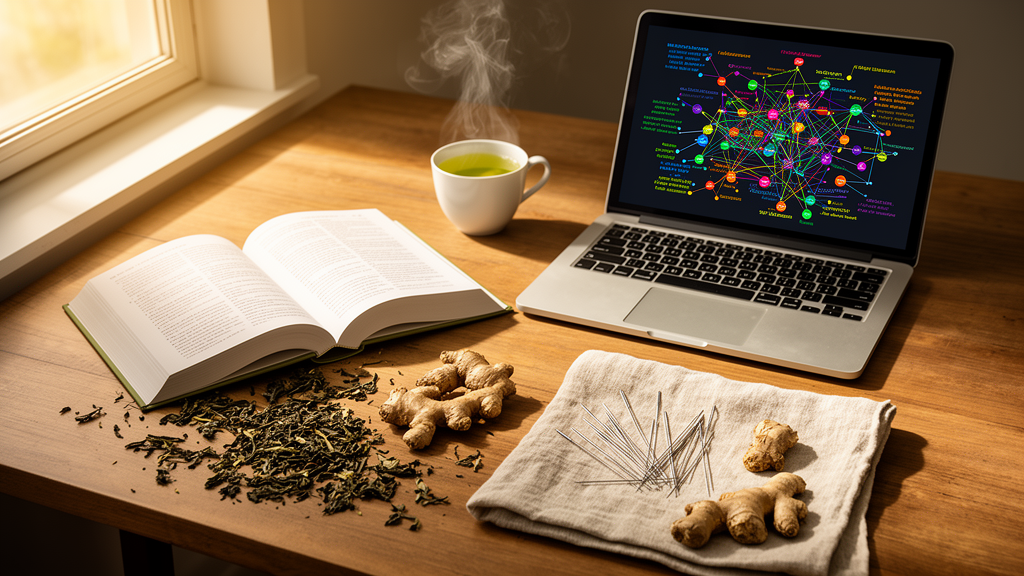
The technical machinery behind the study is worth understanding, because bibliometrics is a discipline with its own rigor. The authors conducted a scientometric analysis using standardized search strategies across two of the largest biomedical literature databases, then applied PRISMA-style screening principles to isolate publications genuinely relevant to traditional and complementary medicine in cancer supportive care. For the mapping and visualization work, they used VOSviewer, a widely adopted software tool that constructs networks from bibliographic data and clusters them algorithmically. Co-authorship networks revealed patterns of collaboration between researchers and institutions; country-level analysis exposed the geography of output and citation; keyword co-occurrence mapping grouped the vocabulary of thousands of abstracts into thematic clusters; and citation structure analysis identified which works the field treats as foundational. Each of these lenses captures a different dimension of scientific activity, and together they turn an undifferentiated pile of nearly six thousand papers into an interpretable map.
The temporal trends tell a clear story of acceleration. Research output showed only modest growth during the early 2000s, a period when complementary medicine was still largely treated with skepticism in mainstream oncology journals. After 2010, the field entered a phase of sustained expansion, and the peak of activity arrived between 2020 and 2024. That late surge coincides with several converging forces: the maturation of integrative oncology as a recognized subspecialty, the publication of clinical practice guidelines endorsing evidence-based integrative therapies during and after breast cancer treatment by the Society for Integrative Oncology and their endorsement by the American Society of Clinical Oncology, and the World Health Organization’s escalating institutional commitment to traditional medicine, including its global traditional medicine centre and the Global Traditional Medicine Strategy 2025–2034. The pandemic years also intensified interest in supportive care broadly, as clinicians confronted the symptom burden of patients who could not easily access conventional services.
Geographically, the analysis confirmed what many observers suspected but had never quantified at this scale. The United States emerged as the dominant contributor across every metric examined: publication volume, citation impact, and international collaboration. China and the United Kingdom followed as the next most influential producers. This concentration matters because the modalities under study, from Traditional Chinese Medicine and Ayurveda to Unani, Kampo, Jamu, traditional Korean medicine, naturopathy, and anthroposophic medicine, are rooted in regions and health systems that do not map neatly onto the Anglo-American research establishment. The authors found that collaboration networks were globally distributed but regionally concentrated, with limited cross-regional integration. In practical terms, Asian research communities studying traditional medicine systems often publish and collaborate within their own regional clusters, while North American and European groups form largely separate networks, and the bridges between them remain thin.
The thematic analysis may be the most revealing part of the study. Keyword clustering showed a strong patient-centered orientation across the literature, with quality of life, symptom management, and supportive care outcomes forming the gravitational center of the field. This is a significant departure from earlier eras of complementary medicine research, which often fixated on whether herbal preparations could shrink tumors or extend survival, questions where the evidence remained weak and controversy ran high. The modern literature instead asks how these modalities help patients live better through treatment: managing cancer-related fatigue, chemotherapy-induced nausea, pain, anxiety, sleep disturbance, and the diffuse distress of survivorship. The keyword clusters also highlighted the growing embedding of traditional and complementary medicine modalities within the framework of integrative oncology, where they are studied as adjuncts to, rather than alternatives for, conventional treatment.
Why does this shift toward patient-centered outcomes matter scientifically? Part of the answer lies in the epidemiology of cancer itself. Global cancer statistics from the GLOBOCAN 2022 estimates document tens of millions of new cases annually across 185 countries, and as survival improves, the population of people living with and beyond cancer grows correspondingly. Surveys reviewed in the study’s supporting literature indicate that a substantial proportion of cancer patients use complementary and alternative medicine, with meta-analytic evidence showing especially high prevalence in Asian countries and documented decade-over-decade increases in places like Jordan. When large numbers of patients are already using these therapies, often without telling their oncologists, the scientific and clinical imperative becomes harm reduction and evidence-informed integration rather than prohibition. Quality of life data themselves carry prognostic weight, with prior literature linking quality of life measures to survival outcomes, which gives symptom-focused research a legitimacy that extends beyond comfort alone.
The study’s authors were candid about the field’s weaknesses, and their conclusions read as both a progress report and a warning. Fragmented collaboration networks mean that findings generated in one region may not be replicated, critiqued, or even noticed in another, slowing the accumulation of reliable evidence. Uneven geographic representation raises the possibility that traditional medicine systems with deep regional roots, such as the AYUSH systems of India or the herbal traditions of Indonesia and Japan, are underrepresented in the high-impact literature relative to their actual clinical use. Methodological variability is perhaps the most consequential problem: when studies of acupuncture, herbal medicine, yoga, or mind-body interventions use inconsistent outcome measures, comparator arms, and quality standards, systematic reviewers and guideline developers struggle to synthesize the evidence into clinical recommendations. The authors explicitly call for stronger international collaboration and well-designed clinical studies to support the evidence-informed integration of traditional and complementary medicine within supportive oncology.
There is also a structural dimension to the findings that extends beyond medicine into science policy. The acknowledgment section of the paper credits the library of the Central Council for Research in Ayurvedic Sciences under India’s Ministry of AYUSH, a detail that illustrates how national governments are now investing institutional resources in traditional medicine research infrastructure. The WHO’s strategy documents signal that this is a coordinated global project, not a fringe movement. For bibliometricians, the study demonstrates the continuing utility of network visualization tools like VOSviewer for auditing an entire field’s health, identifying orphan topics that lack attention, and exposing collaboration gaps that funding agencies could target. For clinicians, it offers reassurance that the literature they might consult on supportive care is growing rapidly, alongside a caution that its geographic and methodological foundations remain uneven.
The broader takeaway is that traditional and complementary medicine in cancer care has crossed a threshold. What was once a scattered collection of small studies, often published in specialized journals and read by a self-selected audience, has become a substantial, measurable, and internationally active research domain with a defined patient-centered agenda. The 5,770 publications analyzed here represent twenty-five years of accumulating effort to ease the symptom burden of cancer treatment using every tool available, from ginger’s well-documented anti-nausea pharmacology to structured mind-body programs. Whether the next decade of that effort produces the rigorous, cross-regional, methodologically consistent evidence base that the field’s own mapping says it needs will depend on whether researchers in Boston, Beijing, London, and Patiala can finally start reading, citing, and building on each other’s work.
Subject of Research: Bibliometric mapping of global research trends in traditional and complementary medicine for cancer supportive care
Article Title: Global research trends in traditional and complementary medicine for cancer supportive care: a bibliometric analysis (2000–2025)
Article References: Gajarmal, A., S., M., & Baheti, S. (2026). Global research trends in traditional and complementary medicine for cancer supportive care: a bibliometric analysis (2000–2025). Supportive Care in Cancer, 34(10), Article 958. https://doi.org/10.1007/s00520-026-11207-7
Image Credits: AI Generated
DOI: 10.1007/s00520-026-11207-7
Keywords: traditional and complementary medicine, cancer supportive care, integrative oncology, bibliometric analysis, quality of life, symptom management, VOSviewer, PubMed, Scopus, international collaboration, Traditional Chinese Medicine, Ayurveda
News Source: Nathaniel Bowman. (October 15, 2026). Mapping 25 Years of Traditional and Complementary Medicine Research in Cancer Supportive Care. Scienmag.