• HOME
  • NEWS
  • EXPLORE
    • CAREER
      • Companies
      • Jobs
    • EVENTS
    • iGEM
      • News
      • Team
    • PHOTOS
    • VIDEO
    • WIKI
  • BLOG
  • COMMUNITY
    • FACEBOOK
    • INSTAGRAM
    • TWITTER
Monday, May 11, 2026
BIOENGINEER.ORG
No Result
View All Result
  • Login
  • HOME
  • NEWS
  • EXPLORE
    • CAREER
      • Companies
      • Jobs
        • Lecturer
        • PhD Studentship
        • Postdoc
        • Research Assistant
    • EVENTS
    • iGEM
      • News
      • Team
    • PHOTOS
    • VIDEO
    • WIKI
  • BLOG
  • COMMUNITY
    • FACEBOOK
    • INSTAGRAM
    • TWITTER
  • HOME
  • NEWS
  • EXPLORE
    • CAREER
      • Companies
      • Jobs
        • Lecturer
        • PhD Studentship
        • Postdoc
        • Research Assistant
    • EVENTS
    • iGEM
      • News
      • Team
    • PHOTOS
    • VIDEO
    • WIKI
  • BLOG
  • COMMUNITY
    • FACEBOOK
    • INSTAGRAM
    • TWITTER
No Result
View All Result
Bioengineer.org
No Result
View All Result
Home NEWS Science News Chemistry

Manipulating electron spin using artificial molecular motors

Bioengineer by Bioengineer
June 7, 2019
in Chemistry
Reading Time: 2 mins read
0
IMAGE
Share on FacebookShare on TwitterShare on LinkedinShare on RedditShare on Telegram

IMAGE

Credit: NINS/IMS

In spintronics, the use of organic materials as a “spin transport material” has recently garnered significant attention as they exhibit long spin-relaxation times and long spin-diffusion lengths owing to the weak spin-orbit interaction (SOI) of light elements. Meanwhile, the weak SOI of organic materials become a drawback when they are used as a “spin filter”. A spin-polarized current is, therefore, typically generated by inorganic materials with ferromagnetism or strong SOIs. However, the recent finding of spin-selective electron transport through chiral molecules, i.e., the so-called chirality-induced spin selectivity (CISS) effect, suggests an alternative method of using organic materials as spin filters for spintronics applications. Through this effect, right-handed and left-handed molecules generate down- and up-spin, respectively. However, chiral molecules used in the experiments reported so far are static molecules. Hence, the manipulation of spin-polarization direction by external stimuli has not been realized yet.

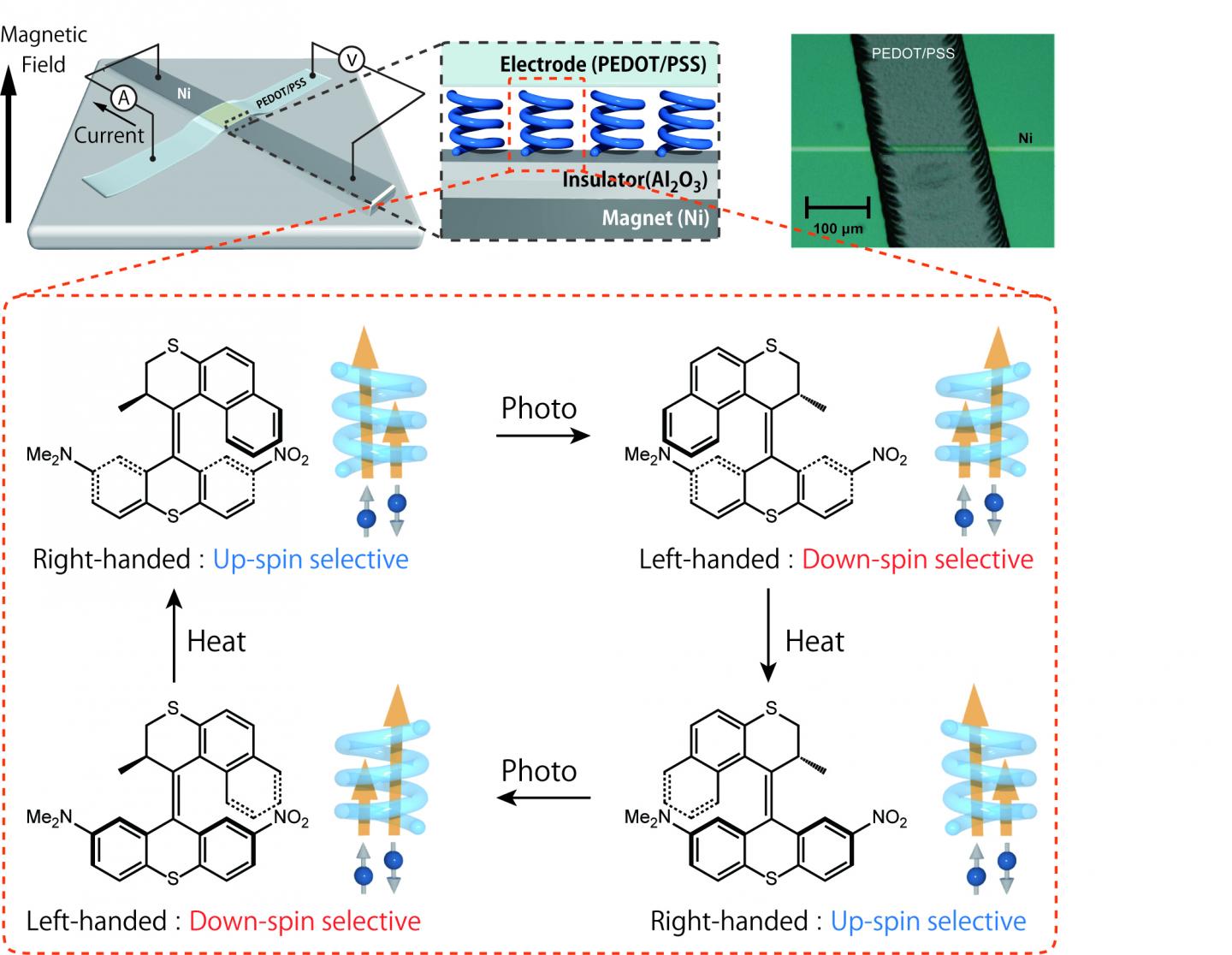
Now, researchers at Institute for Molecular Science, RIKEN, Nara Institute of Science and Technology, Suranaree University and Vidyasirimedhi Institute of Science and Technology fabricated a novel solid-state spin filtering device that sandwiches a thin layer of artificial molecular motors (Figure 1). Because the artificial molecular motors demonstrate 4 times chirality inversion by light irradiation and thermal treatments during the 360-degree molecular rotation, the spin-polarization direction of electrons that pass through the molecular motors should be switched by light irradiation or thermal treatments.

Figure 2 shows (left) the magnetoresistance (MR) curves recorded after various visible light-irradiation time for a device fabricated with a left-handed isomer. In the initial state, a clear antisymmetric MR curve with a negative slope was observed, which means a clear up-spin selectivity. The MR signal decreased as light irradiation proceeded, and finally the slope of the MR signal was inverted to positive, indicating a light-induced spin switching in the spin-polarized current from up-spin selective to down-spin through the left-handed-to-right-handed chirality inversion. A subsequent thermal activation process for the left-handed isomer inverted the slope of the MR curve from positive to negative again, as shown in Figure 2 (right), implying a thermal-activation-induced spin switching from down-spin selective to up-spin selective through the right-handed-to-left-handed chirality inversion. Similar phenomena were observed in subsequent measurements after photo-irradiation and thermal treatments. This series of experiments clearly demonstrated that 4 times spin switching were induced during the 360-degree rotation of the molecular motors.

In this new type of novel organic spintronics device, the right-handed/left-handed chirality, which is the origin of spin-polarization generation through the CISS effect, is reconfigurable by external stimuli and precise control of the spin-polarization direction in the spin-polarized currents by utilizing an artificial molecular motor was realized, for the first time. The present results are beneficial for the development of next-generation organic photo/thermospintronic devices combined with molecular machines.

###

Media Contact
Masayuki Suda
[email protected]

Original Source

https://www.ims.ac.jp/en/

Related Journal Article

http://dx.doi.org/10.1038/s41467-019-10423-6

Tags: Chemistry/Physics/Materials SciencesElectromagneticsMaterialsNanotechnology/Micromachines
Share13Tweet8Share2ShareShareShare2

Related Posts

Humans and Zebra Finches Share Similar Speech Learning Techniques #ASA190 — Chemistry

Humans and Zebra Finches Share Similar Speech Learning Techniques #ASA190

May 11, 2026
Unveiling Dark Matter Through Molecular Insights — Chemistry

Unveiling Dark Matter Through Molecular Insights

May 11, 2026

From Touch to Sight: A Bioinspired Multisensory Framework Endows Robots with Human-Like Perception

May 11, 2026

Announcing the 2026 Carbon Future Young Investigator Award Winners

May 11, 2026
Please login to join discussion

POPULAR NEWS

  • Research Indicates Potential Connection Between Prenatal Medication Exposure and Elevated Autism Risk

    841 shares
    Share 336 Tweet 210
  • New Study Reveals Plants Can Detect the Sound of Rain

    728 shares
    Share 290 Tweet 182
  • Salmonella Haem Blocks Macrophages, Boosts Infection

    62 shares
    Share 25 Tweet 16
  • Breastmilk Balances E. coli and Beneficial Bacteria in Infant Gut Microbiomes

    57 shares
    Share 23 Tweet 14

About

We bring you the latest biotechnology news from best research centers and universities around the world. Check our website.

Follow us

Recent News

Humans and Zebra Finches Share Similar Speech Learning Techniques #ASA190

New Study Uncovers How Fungal Parasites Attack Strawberries and Raspberries

City of Hope Researchers to Present Groundbreaking Immunotherapy and Precision Medicine Advances Across Multiple Cancer Types at ASCO 2026

Subscribe to Blog via Email

Enter your email address to subscribe to this blog and receive notifications of new posts by email.

Join 82 other subscribers
  • Contact Us

Bioengineer.org © Copyright 2023 All Rights Reserved.

Welcome Back!

Login to your account below

Forgotten Password?

Retrieve your password

Please enter your username or email address to reset your password.

Log In
No Result
View All Result
  • Homepages
    • Home Page 1
    • Home Page 2
  • News
  • National
  • Business
  • Health
  • Lifestyle
  • Science

Bioengineer.org © Copyright 2023 All Rights Reserved.