


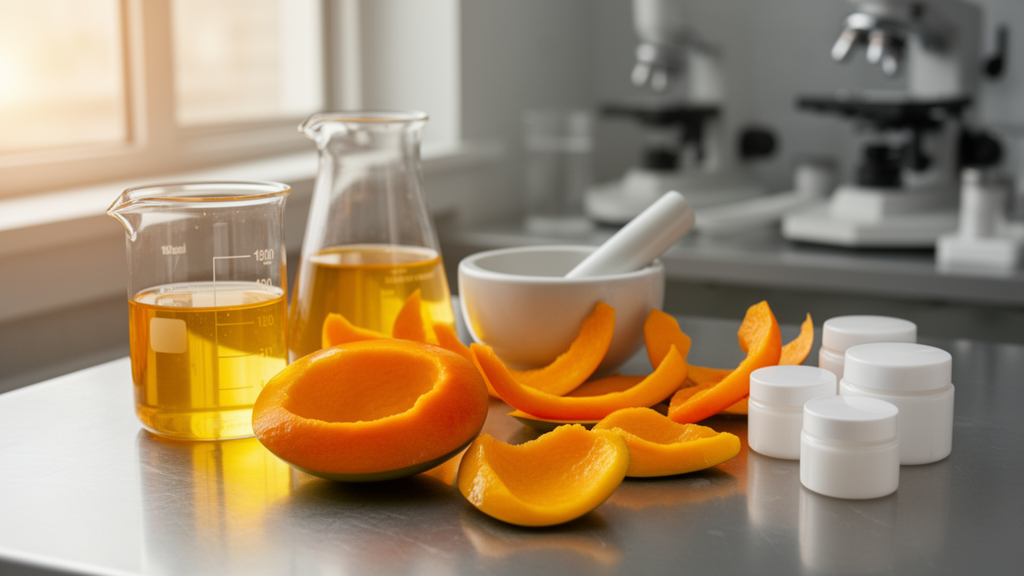
The peel and seed that mango processors throw away by the ton may be far more valuable than their reputation as biowaste suggests. A review published in Biotechnology for Sustainable Materials on 2 March 2026 compiles two decades of research showing that these byproducts, which account for roughly 35 to 60 percent of the mango fruit discarded during industrial processing, are dense with fiber, polyphenols, carotenoids, vitamins, and other bioactive compounds that researchers have already worked into ointments, nanoemulsions, hydrogels, lipsticks, and even solid shampoo bars. The review, led by Himakshi Baruah and Anupam Sarma at institutions in India, draws on 121 peer-reviewed articles and 6 web resources published between 2005 and 2025, selected from roughly 500 retrieved records after an initial search that returned nearly 8,000 results.
The scale of the raw material is enormous. Mango is among the most widely consumed fruits globally and ranks as India’s third-largest agricultural product, with about 2.26 million acres, or 40 percent of the land used to cultivate Indian fruit, devoted to mango farming. More than 100 countries grow a range of cultivars, and over a million tons of mango seeds are produced each year as waste with no current commercial use, according to figures cited in the review. Because processing steps such as pureeing, canning, and pickling concentrate the discarded tissue, the peel and seed that survive in the waste stream contain higher levels of many bioactive compounds than the pulp that reaches consumers.
Chemically, the byproducts are remarkably rich. Mango peel carries a total phenolic content reported at 57,240 mg/kg of dry matter, higher in relative terms than apple peel, along with dietary fiber ranging from about 36 to 78 g per 100 g of dry weight and carotenoid concentrations of 0.1 to 51 mg/g. Dominant phenolics include gallic acid, chlorogenic acid, caffeic acid, ferulic acid, and p-coumaric acid, while catechin and epicatechin lead the flavonoid fraction and quercetin glycosides reach 785 mg/kg of dry matter in some varieties. The xanthone mangiferin, one of the most studied mango compounds, appears at 270 mg/kg of dry matter in Uba peels and at higher concentrations still in peel and seed kernel than in flesh. Seed kernels contribute oleic and stearic acids, phytosterols, tocopherols, and gallotannins. The authors stress that all of these concentrations vary with cultivar, maturity stage, geography, and extraction method, so no single number characterizes any variety.
Much of the therapeutic evidence remains at the laboratory stage. In cell culture, mango peel and seed polyphenol extracts have shown antiproliferative activity against a panel of human cancer lines, including MCF-7 breast carcinoma, HCT116 and HT-29 colon carcinoma, and HL-60 leukemia cells, with one microwave-assisted peel extract reaching an IC50 of 22.98 µg/mL against HT-29 cells after 24 hours. Antidiabetic effects have been explored through enzyme inhibition and in 3T3-L1 adipocyte cells, where mango byproduct extracts raised expression of the insulin-signaling genes IRS1, PI3K, and GLUT4, with carotenoid extracts boosting GLUT4 expression 2.6-fold and polyphenol extracts raising PI3K expression 3.0-fold. These are mechanistic and in vitro findings, not clinical results, and the review’s authors themselves note that comprehensive in vivo validation of the anti-inflammatory and anticancer activities is still needed.
Formulation scientists have moved some of this chemistry closer to application. A microemulsion loaded with Thai mango seed kernel extract, chosen for its high content of pentagalloylglucopyranose, remained physically stable over six months of storage and, in ex vivo skin studies, carried the extract up to 60 times deeper into skin layers than a control, without visible irritation. A self-nanoemulsifying formulation released more than 300 mg/g of polyphenols over six hours, roughly 4.3 times the delivery of a conventional cream. A microemulsion-based hydrogel combining mango seed extract with lemongrass oil released about 80 percent of its polyphenols within 12 hours and showed anti-inflammatory activity four times that of a marketed adapalene-clindamycin gel in the reported comparison, alongside activity against Cutibacterium acnes biofilms. Zinc-pectinate gel beads encapsulating the same seed extract released their payload only in colonic medium containing pectinolytic enzymes, pointing toward colon-specific delivery.
Cosmetic applications are the most commercially advanced. Mango seed butter, whose fatty acid profile resembles cocoa and shea butter, is already an established emollient in European personal care products, appearing in lip balms, cleansing lotions, body creams, and hair treatments according to Centre for the Promotion of Imports market data. In controlled studies, a foot care cream built on 25 percent mango butter showed significant healing of cracked heels in clinical testing and superior wound closure in rat models, while a nanostructured lipid carrier carrying peel and kernel extract improved erythema, elasticity, melanin, and hydration measures in a three-month in vivo evaluation. A cream containing 1 percent Choke-Anan mango seed kernel extract demonstrated good physical stability and no skin irritation in clinical assessment, and solid shampoo bars incorporating peel extract outperformed tocopherol and butylated hydroxytoluene controls in antioxidant assays while eliminating plastic packaging and water use.
Safety data are encouraging but incomplete. Subacute oral toxicity studies in rats found no significant changes in body weight, organ weights, liver enzymes, or kidney function markers at doses of 100, 250, and 500 mg/kg of mango seed extract, and histopathology revealed no macroscopic or microscopic organ damage. Rabbit skin irritation tests of the mango butter cream were negative. Yet aquatic toxicity studies complicate the picture: zebrafish embryos exposed to mango leaf and peel extract for 96 hours showed reduced hatching, pericardial and yolk sac edema, and mortality between 24 and 48 hours, and catfish juveniles exposed to seed extract displayed behavioral abnormalities and altered hematological indices. The review concludes that mango extracts show low systemic toxicity in mammals but can be behaviorally and developmentally toxic to aquatic organisms, and it calls for long-term chronic toxicity studies, standardized extraction, and dose-response assessments.
A persistent obstacle is the absence of any standardized extraction process for bioactive compounds from plant tissue, a gap the review highlights repeatedly. Researchers have compared conventional maceration and Soxhlet methods against newer techniques including ultrasonication, pulsed electric fields, high-voltage electrical discharges, microwave-assisted extraction, pressurized liquid extraction, and supercritical carbon dioxide extraction, each yielding different profiles of phenolics, carotenoids, and lipids from the same raw material. Because extract composition shifts with cultivar, maturity, region, preprocessing, and method, comparing studies is difficult and industrial reproducibility remains unproven. Regulatory guidelines governing the use of mango peel and seed extracts in pharmaceutical, food, and cosmetic formulations are also described as unclear, with allergic reactions, toxicity profiles, and contaminant residues insufficiently evaluated.
The patent and market landscape reflects this uneven maturity. Filed patents cover shelf-stable fruit confections built on fruit byproducts, an improved process for recovering pectin and polyphenolic compositions from mango peels with yields of roughly 32 to 40 percent, and a botanical stick lip balm free of preservatives. Mango seed butter sits in ingredient directories and trade briefings as a stable, oxidation-resistant lipid with a high unsaponifiable fraction, while peel extracts, despite their mangiferin, quercetin, carotenoid, and pectin content, remain at an earlier stage of commercialization. The review positions both streams as components of a circular economy in which mango processing waste becomes high-value input for the pharmaceutical and cosmeceutical industries rather than an environmental liability, provided that extraction standardization, safety testing, and regulatory clarity catch up with the chemistry.
Subject of Research: Review of bioactive compounds in mango peel and seed waste and their applications in pharmaceutical and cosmeceutical formulations
Article Title: Valorization of mango peel and seed for sustainable applications in healthcare and cosmeceuticals: a review
Article References: Baruah, H., Das, B. K., Chakraborty, T., Goswami, A. K., Goswami, D., Pathak, K., & Sarma, A. (2026). Valorization of mango peel and seed for sustainable applications in healthcare and cosmeceuticals: a review. Biotechnology for Sustainable Materials, 3(1), Article 3. https://doi.org/10.1186/s44316-026-00054-5
Image Credits: AI Generated
DOI: 10.1186/s44316-026-00054-5
Keywords: mango peel, mango seed, food waste valorization, bioactive compounds, mangiferin, polyphenols, cosmeceuticals, pharmaceutical excipients, nanoemulsion, toxicology, circular economy, extraction methods
News Source: Gregory Coleman. (October 29, 2026). Mango Waste Gets a Second Life in Drugs and Cosmetics, Review Finds. Scienmag.



