• HOME
  • NEWS
  • EXPLORE
    • CAREER
      • Companies
      • Jobs
    • EVENTS
    • iGEM
      • News
      • Team
    • PHOTOS
    • VIDEO
    • WIKI
  • BLOG
  • COMMUNITY
    • FACEBOOK
    • INSTAGRAM
    • TWITTER
Friday, July 3, 2026
BIOENGINEER.ORG
No Result
View All Result
  • Login
  • HOME
  • NEWS
  • EXPLORE
    • CAREER
      • Companies
      • Jobs
        • Lecturer
        • PhD Studentship
        • Postdoc
        • Research Assistant
    • EVENTS
    • iGEM
      • News
      • Team
    • PHOTOS
    • VIDEO
    • WIKI
  • BLOG
  • COMMUNITY
    • FACEBOOK
    • INSTAGRAM
    • TWITTER
  • HOME
  • NEWS
  • EXPLORE
    • CAREER
      • Companies
      • Jobs
        • Lecturer
        • PhD Studentship
        • Postdoc
        • Research Assistant
    • EVENTS
    • iGEM
      • News
      • Team
    • PHOTOS
    • VIDEO
    • WIKI
  • BLOG
  • COMMUNITY
    • FACEBOOK
    • INSTAGRAM
    • TWITTER
No Result
View All Result
Bioengineer.org
No Result
View All Result
Home NEWS Science News Chemistry

Manganese single-atom catalyst boosts performance of electrochemical CO2 Reduction

Bioengineer by Bioengineer
August 31, 2020
in Chemistry
Reading Time: 2 mins read
0
IMAGE
Share on FacebookShare on TwitterShare on LinkedinShare on RedditShare on Telegram

IMAGE

Credit: FENG jiaqi

Electrochemical CO2 reduction reaction (CO2RR) is a promising approach to convert CO2 into useful chemicals.

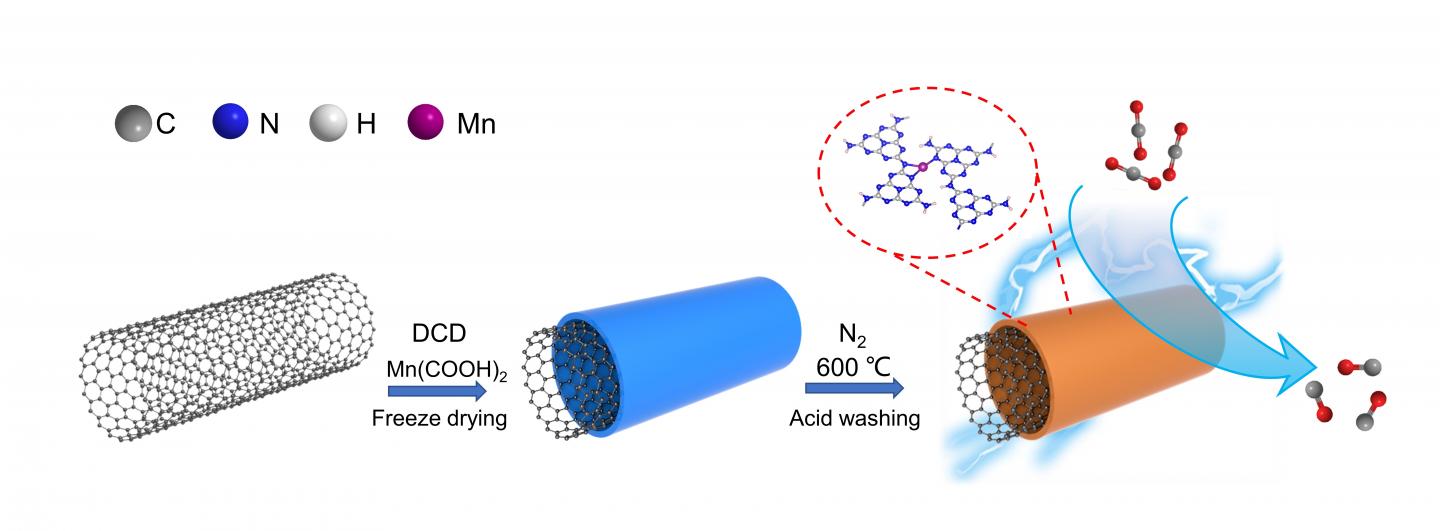
A research team led by Prof. ZHANG Suojiang from the Institute of Process Engineering (IPE) of the Chinese Academy of Sciences prepared a manganese (Mn) single-atom catalyst (SAC) with Mn-N3 site supported by graphitic C3N4, which exhibited efficient performance of CO2 electroreduction.

This work was published in Nature Communications on August 28.

It is a great challenge to obtain high Faradaic efficiency (FE) and high current density simultaneously by cheap catalysts for CO2RR.

The prepared catalyst exhibited a maximum CO FE of 98.8% with 14.0 mA cm-2 CO current density (jCO) at overpotential of 0.44 V in KHCO3 electrolyte, outperforming all reported Mn SACs.

Moreover, a higher jCO value of 29.7 mA cm-2 was obtained at overpotential of 0.62 V, when ionic liquid was used as electrolyte.

X-ray absorption spectroscopy and high-angle annular dark-field scanning transmission electron microscopy confirmed atomically dispersed Mn in the catalyst, and the best-fitting analysis indicated that the isolated Mn atom was three-fold coordinated by N atoms.

“In situ X-ray absorption spectra and density functional theory calculations demonstrated that the remarkable performance of the catalyst was attributed to the Mn-N3 site, which facilitated the formation of the key intermediate COOH* through a lowered free energy barrier,” said Prof. ZHANG Suojiang.

This work shows that the CO2RR activity of Mn-based catalysts can be enhanced through changing coordinated environment.

“It provides an important scientific basis and feasibility for low cost and high efficient electrochemical CO2 reduction to useful chemicals,” said Prof. ZHANG Xiangping, a co-corresponding author of the paper.

###

Media Contact
LI Xiangyu
[email protected]

Related Journal Article

http://dx.doi.org/10.1038/s41467-020-18143-y

Tags: Atomic PhysicsChemistry/Physics/Materials Sciences
Share12Tweet8Share2ShareShareShare2

Related Posts

Graz University of Technology Deciphers the Structural Secrets of MOF Thin Films — Chemistry

Graz University of Technology Deciphers the Structural Secrets of MOF Thin Films

July 2, 2026
Breaking Thermodynamic Limits: Wavelength-Driven Catalysis Advances Ammonia Synthesis — Chemistry

Breaking Thermodynamic Limits: Wavelength-Driven Catalysis Advances Ammonia Synthesis

July 2, 2026

From Quantum Mechanics to AI-Powered Materials Discovery: MARVEL Marks 12 Years of Transforming Computational Science

July 2, 2026

Djire Recognized with National Award for Outstanding Contributions in Research and Teaching

July 2, 2026
Please login to join discussion

POPULAR NEWS

  • Detection of EDCs in Breast Milk and Infant Urine Up to Six Months Highlights Early Exposure Risks

    77 shares
    Share 31 Tweet 19
  • Saying Goodbye to PGY-6: Pediatric Fellowship Realities

    103 shares
    Share 41 Tweet 26
  • New Drug Candidate Developed at McMaster Shows Potential for Treating Brain Cancer

    58 shares
    Share 23 Tweet 15
  • KTU Researchers Explore Ultrasound’s Role in Enhancing Blood Flow Beyond Diagnostics

    53 shares
    Share 21 Tweet 13

About

BIOENGINEER.ORG

We bring you the latest biotechnology news from best research centers and universities around the world. Check our website.

Follow us

Recent News

Steatosis Drives Liver Metastasis Diversity in CRC

Unlocking the Mysteries of Alzheimer’s Disease

Pensoft Introduces New Peer-Reviewed Journal of Regeneration to Advance Restorative Biology Across Species

Subscribe to Blog via Email

Enter your email address to subscribe to this blog and receive notifications of new posts by email.

Join 83 other subscribers
  • Contact Us

Bioengineer.org © Copyright 2023 All Rights Reserved.

Welcome Back!

Login to your account below

Forgotten Password?

Retrieve your password

Please enter your username or email address to reset your password.

Log In
No Result
View All Result
  • Homepages
    • Home Page 1
    • Home Page 2
  • News
  • National
  • Business
  • Health
  • Lifestyle
  • Science

Bioengineer.org © Copyright 2023 All Rights Reserved.