A computational study published in Results in Chemistry has examined whether the main constituents of common thyme, Thymus vulgaris, together with the turmeric pigment curcumin, can disable the hemagglutinin protein of the H1N1 influenza virus. The research, led by Azadeh Kordzadeh with colleagues Zahra Hosseinzade, Amin Hadi and Sajad Ghaderi, combined molecular dynamics simulations with quantum mechanical calculations to compare how four small molecules—thymol, carvacrol, linalool and curcumin—interact with the viral surface protein that influenza uses to attach to and enter human cells. The results point to thyme-derived compounds, and thymol in particular, as markedly more disruptive to hemagglutinin’s structure than curcumin, a finding that could shape the search for plant-based antiviral leads at a time when resistance to existing influenza drugs is an escalating clinical concern.
The motivation behind the work lies in a well-known weakness of current influenza therapy. Drugs such as oseltamivir, zanamivir and peramivir all target neuraminidase, one of the two surface glycoproteins of the influenza virus, and single amino acid substitutions in that protein can render them ineffective. Influenza type A, the subtype responsible for pandemics since 1918, remains the most clinically significant of the influenza types, and the fragility of neuraminidase-targeted treatment has pushed researchers toward alternative targets and alternative chemical scaffolds. Hemagglutinin, the second surface glycoprotein, offers such a target: it carries the receptor-binding site that recognizes sialic acid on host cells and the fusion machinery that delivers the viral genome inside. Natural products, long valued as a reservoir of bioactive molecules including saponins, flavonoids, coumarins and stilbenoids, have repeatedly yielded compounds that interfere with viral proteins, and the authors set out to test whether thyme’s principal essential-oil constituents could do the same to hemagglutinin.
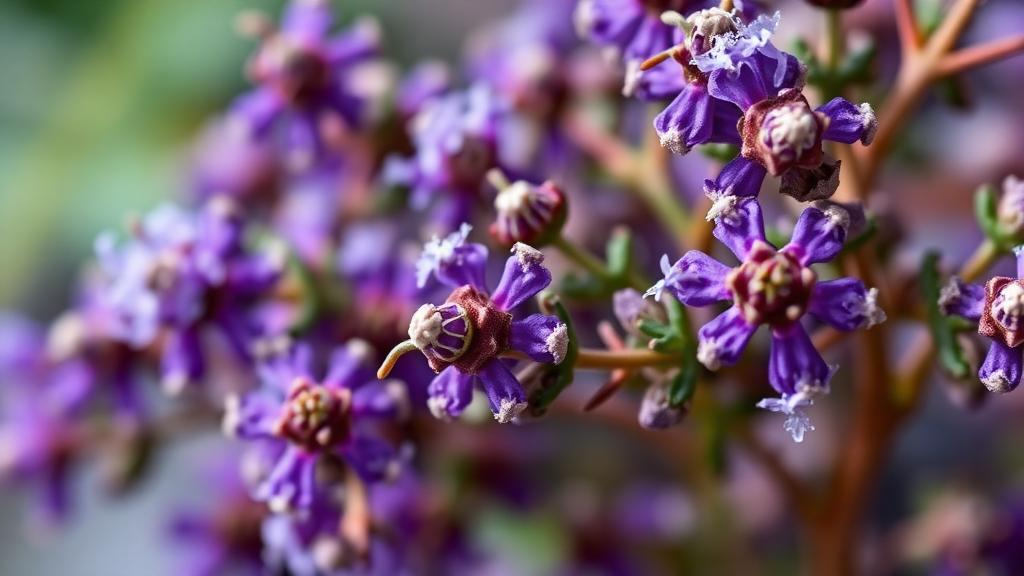
Thymus vulgaris, a woody member of the mint family native to southern Europe and the western Mediterranean, has a long history of medicinal use as an antiseptic, antimicrobial and tonic. Gas chromatography–mass spectrometry analyses of its essential oil identify five dominant constituents whose proportions vary widely between chemotypes: thymol, ranging from 6.7 to 66.10 percent; linalool, from 1.36 to 22.25 percent; carvacrol, from 2.33 to 20.03 percent; α-terpineol, from 0.15 to 11.61 percent; and geraniol, from 0.32 to 11.31 percent. Thymol and carvacrol are monoterpene phenols, linalool is a monoterpene alcohol, and all three have documented anti-inflammatory, antimicrobial and antioxidant activity. Curcumin, the polyphenolic yellow pigment of Curcuma longa, was included as a comparator because of its extensive literature on antiviral and anti-inflammatory effects, even though its clinical translation has been hampered by poor bioavailability and chemical instability.
The computational strategy rested on an atomistic model of the H1N1 hemagglutinin trimer, taken from the Protein Data Bank under entry 3LZG. The trimeric form is the biologically relevant prefusion assembly: each protomer consists of an HA1 chain forming the globular receptor-binding head and an HA2 chain containing the membrane-fusion stalk. The receptor-binding site sits at the distal tip of HA1 and is built from three structural elements—the 130-loop, the 190-helix and the 220-loop. Simulating the intact trimer matters because models that omit the trimeric interface cannot capture conformational stability, allosteric coupling between protomers, or the large-scale rearrangements that hemagglutinin undergoes when triggered by low pH to fuse viral and cellular membranes. The team therefore ran all-atom simulations in GROMACS 5.1.4 using the GROMOS54A7 force field, the SPC water model, a Nosé-Hoover thermostat at physiological temperature and a Berendsen barostat at 1 bar, with particle-mesh Ewald summation for electrostatics and a 1.2-nanometer cutoff for Lennard-Jones interactions.
Each simulation placed the hemagglutinin trimer in a cubic box seven nanometers on a side, solvated it, neutralized it and introduced three copies of one ligand at a concentration of 14 millimolar. Using multiple ligand molecules rather than a single one allowed the researchers to observe whether adsorption occurs competitively and which sites on the protein surface are preferred. After energy minimization, each system was equilibrated for 20 nanoseconds in the canonical ensemble and a further 20 nanoseconds under constant pressure, before a production run of 100 nanoseconds whose final 10 nanoseconds were analyzed in detail. Binding energies were decomposed with the MM-PBSA method, and the trajectories were visualized with VMD. Complementing the dynamics, density functional theory calculations at the B3LYP/6-31G(d,p) level in the GAMESS program yielded optimized geometries, HOMO and LUMO energies, dipole moments and polarizabilities, with partial atomic charges fitted to the electrostatic potential in an aqueous environment to mimic the biological milieu.
The docking-like outcome of the dynamics was striking in its site selectivity. Starting from random positions in the solvent, carvacrol and linalool both migrated to and adsorbed onto the 190-helix of HA1, a structural element that contributes directly to receptor binding, and onto the fusion-related stalk region of HA2. Thymol bound to the fusion-related stalk of HA2. Curcumin, by contrast, ended up at a site involving no functionally important residues. The energetic decomposition explained the difference. Thymol achieved the strongest Lennard-Jones interaction with the protein at −231.42 kJ/mol and the highest overall binding energy at −360.56 kJ/mol, followed by linalool at −351.21 kJ/mol and carvacrol at −229.71 kJ/mol. Curcumin’s binding energy of −167.28 kJ/mol was the weakest of the four, with both its dispersive and electrostatic contributions substantially smaller. Thymol also formed more hydrogen bonds with hemagglutinin than any other ligand tested.
Conformational analysis reinforced the picture. Relative to hemagglutinin in pure water, the root mean square deviation of the protein increased after adsorption of every thyme constituent, with thymol producing the largest structural drift, whereas curcumin’s trajectory closely resembled the ligand-free reference. Root mean square fluctuation profiles showed that the thyme compounds perturbed residues in both the receptor-binding HA1 head and the fusion-related HA2 stalk, while curcumin left the fluctuation pattern essentially unchanged. The radius of gyration, nearly constant between water and the curcumin-bound system at roughly 7.9 to 8.1 nanometers, decreased significantly when the thyme compounds adsorbed, indicating a more compact protein. Secondary-structure analysis added a further signature: thyme constituents reduced beta-sheet content and increased coil structures, whereas curcumin left the secondary structure largely intact. The thyme compounds also raised the protein’s solvent-accessible surface area and its number of hydrogen bonds with water—thymol lifted the hydrogen-bond count from 5623 to 5817—evidence that they remodel both the fold and the solvation shell of hemagglutinin.
Quantum chemical descriptors and pharmacokinetic screening filled in the electronic and drug-likeness context. Curcumin showed the smallest HOMO-LUMO band gap, 0.12263 Hartree, together with the largest dipole moment and polarizability, consistent with easier electron transfer and higher intrinsic reactivity; the three thyme compounds clustered at higher band gaps between 0.21645 and 0.23092 Hartree with lower polarizabilities. Yet the simulations showed that this electronic reactivity did not translate into stronger protein binding. On the pharmacokinetic side, linalool, thymol and carvacrol fully satisfied Lipinski’s Rule of Five, with molecular weights near 150 g/mol, single hydrogen-bond donors and acceptors, and log P values below 3.3, while curcumin violated one criterion with six hydrogen-bond acceptors, echoing its known bioavailability problems. None of the four compounds was predicted to be mutagenic or tumorigenic by the SwissADME toxicity models.
The authors are careful to frame the findings as computational hypotheses rather than therapeutic claims. Molecular dynamics and quantum mechanics offer atomic-resolution insight into binding geometry, energetics and conformational change, but phytochemical effects are notoriously context-dependent across in vitro, in vivo and clinical settings, and the study’s own limitations—a small number of ligand molecules per box and a 100-nanosecond timescale without an explicit viral membrane—leave room for refinement. Even so, the convergence of strong binding energies, occupation of the receptor-binding helix and the fusion stalk, drug-like physicochemical profiles and demonstrable structural destabilization makes the thyme constituents, and thymol above all, credible leads for experimental follow-up. Biochemical binding assays, antiviral testing in cell culture and ultimately in vivo studies will determine whether the simulated disruption of hemagglutinin can be reproduced where it matters: in a infected host, at the first step of the influenza life cycle.
Subject of Research: Computational evaluation of Thymus vulgaris constituents and curcumin as inhibitors of influenza H1N1 hemagglutinin
Article Title: Evaluating the antiviral potential of Thymus vulgaris constituents and curcumin against influenza hemagglutinin: A molecular dynamics study
Article References: Kordzadeh, A., Hosseinzade, Z., Hadi, A., & Ghaderi, S. (2026). Evaluating the antiviral potential of Thymus vulgaris constituents and curcumin against influenza hemagglutinin: A molecular dynamics study. Results in Chemistry, 31, Article 103943. https://doi.org/10.1016/j.rechem.2026.103943
Image Credits: AI Generated
DOI: 10.1016/j.rechem.2026.103943
Keywords: influenza, hemagglutinin, Thymus vulgaris, thymol, carvacrol, linalool, curcumin, molecular dynamics, quantum chemistry, antiviral, drug discovery, natural products
News Source: Bethany Barker. (October 7, 2026). Thyme Compounds Outperform Curcumin in Simulations Against Flu Protein. Scienmag.