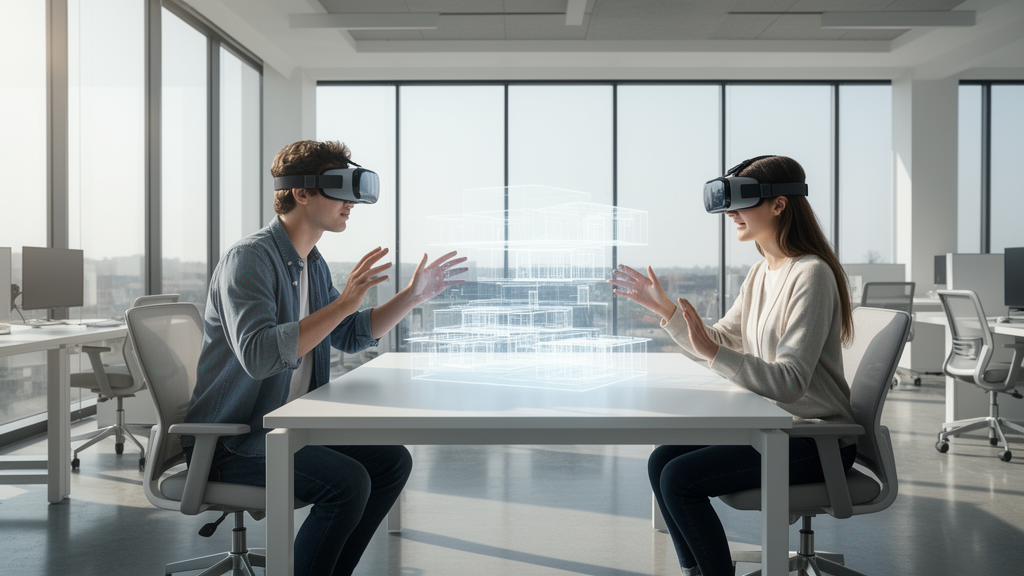
A qualitative multimodal investigation tracking undergraduate chemistry students has demonstrated that dyadic collaboration inside immersive virtual reality environments can be systematically assessed across five core behavioral dimensions, revealing that technological access alone does not ensure equitable or productive peer learning. Conducted at a large public university in Australia and reported in Computers & Education: X Reality, the research examined how pairs of learners coordinated verbal exchanges, embodied physical movements, and digital representations while exploring complex molecular structures. By integrating established computer-supported collaborative learning principles with the Theory of Immersive Collaborative Learning, the investigators established an observational framework capturing peer verbal responsiveness, awareness of partner gestures, multimodal externalization of ideas, joint task engagement, and mutual assistance. Across eighteen first-year chemistry students organized into nine dyads, the team observed marked variations in interactive quality, categorizing student partnerships into distinct high, moderate, and low collaboration profiles based on how effectively partners shared agency and manipulated responsive three-dimensional objects.
Collaborative learning has long served as an essential pillar of contemporary science instruction, grounded in social constructivist perspectives that view knowledge building as an inherently interactive process where learners externalize thoughts, negotiate interpretations, and internalize complex conceptual models through dialogue with peers. Although computer-mediated educational tools have expanded substantially, immersive virtual reality introduces distinct environmental affordances that fundamentally reshape conventional peer dynamics beyond traditional turn-taking or desktop-based screen sharing. Within head-mounted display environments, users possess three-dimensional agency, experiencing spatial presence, hand tracking, and digital representations that simulate bodily movements in shared virtual space. However, as educational institutions increasingly adopt immersive hardware, researchers have noted that empirical investigations often focus on individual cognitive gains rather than the intricate mechanisms governing small-group social interaction. While immersive settings allow students to interact directly with microscopic scientific phenomena, designing collaborative tasks remains challenging, leaving critical empirical gaps regarding whether learners naturally coordinate their actions or devolve into isolated, disengaged work patterns.
To rigorously evaluate the collaborative process in immersive science settings, the investigators constructed a specialized conceptual framework drawing from two complementary theoretical traditions. The team adapted the desktop computer-supported collaborative learning framework established by Meier and colleagues, which evaluated dyadic processes across nine dimensions such as mutual understanding, information pooling, task division, and interpersonal dynamics within medical-psychology education. Because Meier’s model focused on desktop interfaces, it could not account for the rich embodied actions, physical gestures, and shared spatial manipulations unique to head-mounted displays. Consequently, the authors incorporated Makransky and Petersen’s Theory of Immersive Collaborative Learning, known as TICOL. This framework maps how technological capabilities like motion tracking and shared digital artifacts activate specific social affordances, thereby influencing psychological factors such as social presence, body ownership, and personal agency. By harmonizing Meier’s codable behavioral categories with TICOL’s pathways, the researchers generated an observational scheme tailored specifically to capture multimodal coordination in immersive environments.
The empirical investigation involved eighteen first-year undergraduate students, comprising sixteen men and two women enrolled in chemistry-related degree programs at an Australian public university during the first semester of 2024. Participants possessed foundational chemistry coursework from secondary school or introductory university modules, ensuring that cognitive effort focused on conceptual problem-solving rather than basic factual recall. Before commencing the primary data collection, the researchers conducted a pilot trial with three advanced chemistry pairs to refine logistical scheduling and establish standard protocols for researcher interventions during technical roadblocks. For the main study, participants were randomly arranged into nine distinct dyads and assigned to complete SnowflakesVR, a narrative, self-paced software application developed by the research team. Operating within a co-located physical room measuring three meters by three meters, each student donned a head-mounted display paired with handheld controllers that provided haptic vibration feedback upon task milestones, enabling physical spatial navigation and uninhibited natural verbal communication.
Inside SnowflakesVR, learners were represented to each other as floating three-dimensional avatars displaying neutral digital faces and articulated hands that mirrored real-time controller movements. The instructional sequence required partners to investigate hydrogen bonding dynamics, assemble water molecule clusters into lattices, and examine three-dimensional networks to deduce why snowflakes form their characteristic six-fold hexagonal architecture. Each session was constrained to a maximum duration of two hours, during which investigators maintained an observational role, recording synchronized audio, third-person room video, and first-person visual fields from both headsets. Because challenging tasks could induce counterproductive frustration, researchers were permitted to offer minimal technical assistance if pairs stalled completely. Following data collection, the authors synchronized the audiovisual feeds, transcribed all verbal dialogue by speaker turn, and quantified speech velocity over time, plotting longitudinal word counts. Two independent coders evaluated video segments and word counts, achieving ninety percent agreement and a Cohen’s kappa coefficient of 0.88 across the coding framework.
The resulting categorical framework classified immersive collaborative interactions across five operational dimensions labeled Category A through Category E, providing concrete criteria for distinguishing high, moderate, and low performance levels. Category A evaluated student responsiveness to peer verbal cues, contrasting partners who consistently acknowledged and built upon each other’s reasoning with those who offered minimal, disjointed affirmations or remained unresponsive. Category B measured the observation of and responsiveness to a partner’s physical gestures and virtual displacements, tracking whether learners actively monitored and adapted to peer movements. Category C assessed the quality of externalizing ideas, specifically evaluating how learners combined spoken dialogue with spatial gestures and virtual object repositioning to articulate complex scientific concepts. Category D examined the degree of joint task engagement, distinguishing continuous joint decision-making from split efforts where one individual dominated while the other watched. Finally, Category E measured mutual assistance, assessing whether partners recognized a peer’s confusion and offered scaffolded guidance rather than usurping control of the virtual controls.
Applying these criteria across the nine participating student pairs revealed three distinct collaborative profiles, with three pairs demonstrating high-quality collaboration, two exhibiting moderate-quality dynamics, and four displaying low-quality collaboration. The high-quality group, exemplified by chemical engineering undergraduates Amazis and Michael, maintained continuous, reciprocal engagement throughout their session. Quantitative analysis of their transcript demonstrated remarkably balanced verbal participation, with Amazis uttering 1,780 words and Michael contributing 1,754 words. When Amazis identified hexagonal geometry within the molecular network, he directed Michael’s attention by pointing his avatar’s hand to specific coordinate vertices while inviting his peer to inspect the model from his physical viewpoint. When Michael struggled to align an inverted water cluster within the crystal lattice, Amazis provided real-time verbal encouragement and extended his virtual hand to reorient the molecule, allowing Michael to snap the cluster into place, illustrating seamless joint problem-solving and mutual cognitive support.
In contrast, the moderate-quality profile, benchmarked by the partnership of Brandon and Joshua, revealed fluctuating and intermittent collaborative engagement characterized by uneven verbal dominance and isolated physical gestures. Longitudinal dialogue tracking showed Joshua speaking 1,425 words while Brandon contributed only 593 words across the module. Although both chemical engineering students demonstrated initial willingness to collaborate, Joshua frequently assumed a controlling posture, dismissing Brandon’s tentative observations regarding structural similarities between graphite and diamond lattices. When Brandon encountered mechanical difficulty snapping a water cluster into position during a later assembly stage, Joshua did not provide instructional cues; instead, he stepped into Brandon’s workspace, physically seized the virtual molecule from Brandon’s digital hands, and attached it independently before progressing to the submission interface. This pattern demonstrated that while moderate pairs possessed the capacity for cooperative inquiry, their interactions frequently fragmented into unilateral execution, reducing opportunities for reflective peer negotiation.
The low-quality collaboration profile, represented by Jonah and Keenan, illustrated severe interactional imbalances where the intended cooperative benefits of the immersive module were almost entirely unrealized. Keenan, who had no previous immersive technology experience, contributed a total of only 64 words throughout the entire learning session, whereas Jonah, who regularly played virtual games at home, spoke 1,190 words. Jonah consistently manipulated the three-dimensional water structures, altered bonding angles, and answered system prompts without receiving substantive input from his partner. Keenan remained largely passive, restricting his responses to brief acknowledgments like ‘yeah’ and observing Jonah’s actions without contributing independent hypotheses or non-verbal gestures. During a mid-session pattern recognition task, Jonah solved all structural puzzles single-handedly while Keenan adopted an obedient spectator role. The authors observed that this extreme disparity prevented any collective knowledge building and masked Keenan’s conceptual understanding, demonstrating that immersive visual stimuli alone cannot overcome passive interpersonal disengagement.
Interpreting these findings through the lens of TICOL, the researchers underscored that immersive technological affordances operate as situational enablers rather than guaranteed drivers of productive collaborative learning. In high-functioning partnerships like Amazis and Michael, system capabilities successfully activated theoretical pathways 2, 4, and 9, wherein mutual visibility of avatar movements supported socio-emotional responsiveness, fostering a secure communicative space where students openly tested and refined scientific assertions. However, four out of nine dyads failed to develop productive collaboration despite having identical software prompts, indicating that individual factors including prior technological confidence, personality traits, and task expectations heavily influence peer dynamics. When digital modules permit a single user to fulfill objectives unilaterally, passive learners readily retreat into silent observance. The researchers emphasized that designing effective virtual curricula requires embedding structured interdependencies, such as distributed information roles or required simultaneous physical interactions, ensuring that progress through virtual scientific tasks necessitates joint decision-making rather than solitary execution.
The authors identified several methodological boundaries that contextualize their conclusions, emphasizing that the qualitative analysis of nine self-selected undergraduate dyads within a single Australian university chemistry course cannot be generalized universally across diverse educational contexts or larger group sizes. Furthermore, while the study utilized TICOL pathways as an interpretive framework, it did not directly collect physiological or psychometric measures of presence, agency, or cognitive load, relying instead on inferential alignment with observable behaviors. Nevertheless, the resulting five-part framework provides educators and software developers with an empirically grounded blueprint for evaluating immersive social dynamics. By illustrating how unmonitored immersive learning can inadvertently foster isolated behaviors or conversational dominance, the study reinforces the necessity for instructors to actively monitor student dyads and implement targeted pedagogical scaffolding, ensuring that immersive technologies fulfill their educational promise through truly shared, multimodal scientific inquiry.
Subject of Research: Multimodal assessment of dyadic collaborative learning processes in immersive virtual reality science education
Article Title: Assessing the quality of the collaborative learning process in iVR
Article References: Hernandez-Alvarado, R. B., Won, M., Treagust, D., & Mocerino, M. (2026). Assessing the quality of the collaborative learning process in iVR. Computers & Education: X Reality, 8, Article 100161. https://doi.org/10.1016/j.cexr.2026.100161
Image Credits: AI Generated
DOI: 10.1016/j.cexr.2026.100161
Keywords: immersive virtual reality, collaborative learning, science education, chemistry education, multimodal analysis, SnowflakesVR, Theory of Immersive Collaborative Learning, CSCL framework, dyadic interaction, shared virtual objects, embodied gestures, inter-rater reliability, joint task engagement, mutual assistance, verbal responsiveness, undergraduate education, instructional design
News Source: Denise Maddox. (November 23, 2026). Immersive Virtual Reality Study Identifies Five Key Dimensions of Collaborative Learning. Scienmag.